Wildlife worry
p. 55 · Read in the full issue
By Liz Thompson
IN 1991, the World Wildlife Foundation and Papua New Guinea’s Department of Environment and Conservation initiated a comprehensive review of the manage ment of nature protection within PNG.
The country is the world’s largest tropical island nation and the richest in flora and fauna of all the Pacific islands and Pacific rim countries. The remark able diversity it houses has been increas ingly threatened by enormous popu lation growth and massive resource exploitation. While Papua New Guinean society previously had a balanced and sustainable relationship with the natural environment, these changes have meant that the organised conservation of nature in PNG is becoming a serious issue, in fact, it must become a priority.
However, as is the case in many developing countries, the community has always had a utilitarian relationship with the natural environment. The fact that they live within it and utilise it as a source of food and shelter means that an essentially western notion of conser vation, as in the protection of wilderness from human activity, is entirely inappro priate here. Paul Chatterton has been working for the World Wide Fund for Nature (WWF) helping them to establish a Community Resource Conservation programme (CRC) in PNG in conjunc tion with the National Alliance of Non-
Government Organisations (NANGO)
and various NGO groups.
One of the most important issues has been to determine a method and ap proach towards conservation which is in keeping with the communities’ utili tarian needs. Most people still live in a rural environment and are dependent upon nature for their survival.
NANGO representative Vincent Manukayasi points out that many Papua New Guineans “do not feel that the establishment of conservation areas where traditional landholders are marginalised or treated as passive objects of conservation is a viable strategy for the
protection of bio-diversity. Mutually
beneficial relationships between humans and their biological environment which have been part of PNG life for thousands of years should be respected and strengthened in both the conservation needs assessment process and active conservation process. Traditional land holders should be involved in all stages of projects as active agents of conser vation”.
However, the two areas to be ad dressed, that is the problem of increased population and greater pressure on the land and its resources and the fact of massive resource exploitation, often by multi-national companies, are quite dif
ferent problems. The CRC in its outlined agenda may well serve to alleviate the
environmental problems resulting from
increased population but will face much greater difficulties in the area of resource
exploitation.
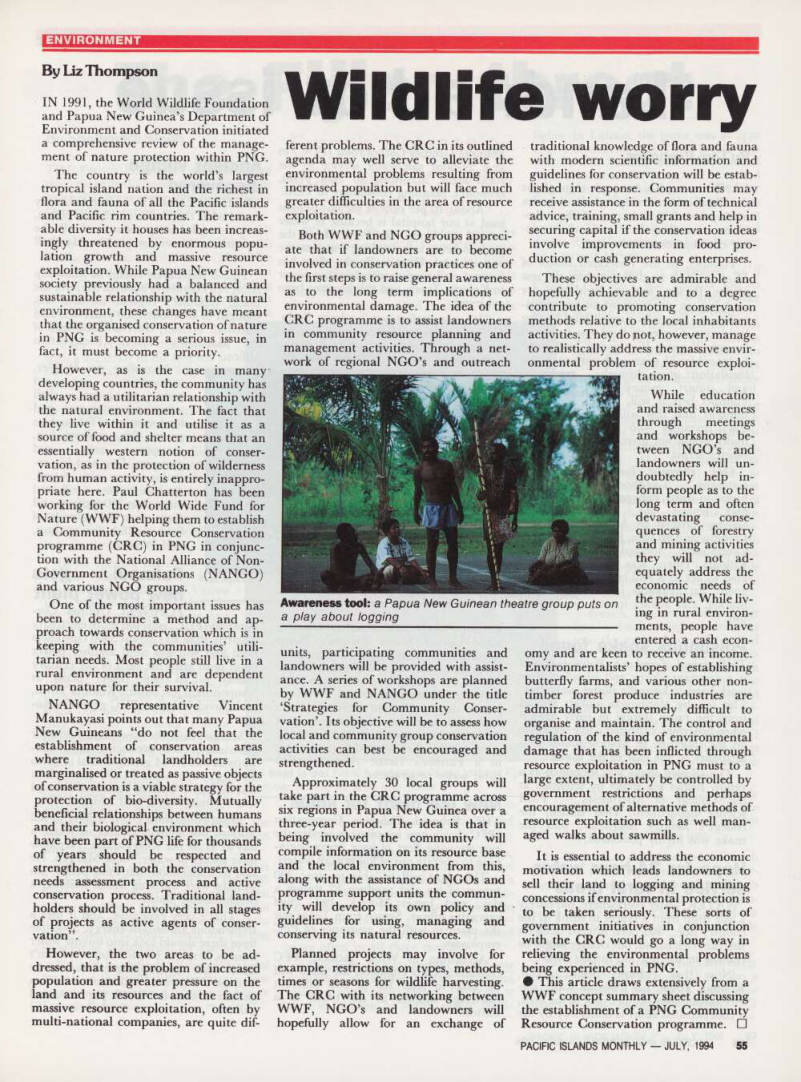
Both WWF and NGO groups appreci ate that if landowners are to become involved in conservation practices one of the first steps is to raise general awareness as to the long term implications of environmental damage. The idea of the CRC programme is to assist landowners in community resource planning and management activities. Through a net work of regional NGO’s and outreach
units, participating communities and landowners will be provided with assist ance. A series of workshops are planned by WWF and NANGO under the title
‘Strategies for Community Conser
vation’. Its objective will be to assess how local and community group conservation activities can best be encouraged and strengthened.
Approximately 30 local groups will take part in the CRC programme across six regions in Papua New Guinea over a three-year period. The idea is that in being involved the community will compile information on its resource base and the local environment from this, along with the assistance of NGOs and programme support units the commun ity will develop its own policy and guidelines for using, managing and conserving its natural resources.
Planned projects may involve for example, restrictions on types, methods, times or seasons for wildlife harvesting.
The CRC with its networking between WWF, NGO’s and landowners will hopefully allow for an exchange of
traditional knowledge of flora and fauna with modern scientific information and guidelines for conservation will be estab lished in response. Communities may receive assistance in the form of technical advice, training, small grants and help in securing capital if the conservation ideas involve improvements in food pro duction or cash generating enterprises.
These objectives are admirable and hopefully achievable and to a degree contribute to promoting conservation methods relative to the local inhabitants activities. They do pot, however, manage to realistically address the massive envir onmental problem of resource exploi
tation.
While education and raised awareness through meetings and workshops be tween NGO’s and landowners will un doubtedly help in form people as to the long term and often devastating conse quences of forestry and mining activities they will not ad equately address the economic needs of the people. While liv ing in rural environ ments, people have entered a cash econ
omy and are keen to receive an income.
Environmentalists’ hopes of establishing butterfly farms, and various other non timber forest produce industries are admirable but extremely difficult to organise and maintain. The control and regulation of the kind of environmental damage that has been inflicted through resource exploitation in PNG must to a large extent, ultimately be controlled by government restrictions and perhaps encouragement of alternative methods of resource exploitation such as well man aged walks about sawmills.
It is essential to address the economic motivation which leads landowners to sell their land to logging and mining concessions if environmental protection is to be taken seriously. These sorts of government initiatives in conjunction with the CRC would go a long way in relieving the environmental problems being experienced in PNG. This article draws extensively from a WWF concept summary sheet discussing the establishment of a PNG Community Resource Conservation programme. □
Awareness tool: a Papua New Guinean theatre group puts on a play about logging