islands
pp. 47-49 · Read in the full issue
Take in all the islands
THE Tourism Council of the South Pacific (TCSP) in conjunction with the Association of South Pacific Airlines (ASPA) has jointly announced another important milestone in the South Pacific aviation history with the implementation of the Visit South Pacific Pass in connection with the Visit South Pacific Year ’95 (VSPY) promotional campaign.
This multiple air pass will give over seas visitors to Australia, New Zealand and the Pacific Islands the opportunity to visit more island countries in the region. The pass will cover selected points in Australia, New Zealand and 10 other Pacific Island ports and will be available on the services of 10 airlines.
These airlines are members of ASPA
and include Air Caledonie, Air Nauru, Air New Zealand, Air Niugini, Air Pacific, Air Vanuatu, Polynesian Air lines, Qantas, Royal Tongan Airlines and Solomon Airlines. ASPA had in itiated the move in response to the
declaration of 1995 by TCSP as Visit South Pacific Year. According to George Faktaufon, secretary general of ASPA, the air pass was a major achievement for the region’s carriers after some years of developing the concept.
While the pass is aimed primarily at promoting the Visit Year, the airlines had decided to make it effective from as early as April this year in order to give the overseas travel
trade the oppor tunity to familiarise themselves with the airline services that are available in the region. The pass will be available to pass
engers originating
from North America and Europe, and will be marketed and promoted by the airlines, their agents as well as TCSP at its overseas promotions.
The chairman of the VSPY ’95
regional planning committee, Sakopo
Lolohea, congratulated the ASPA for its support of the campaign adding the pass boosted the campaign by providing travel options for visitors from Europe and North America to all TCSP member countries during 1994 and 1995. □
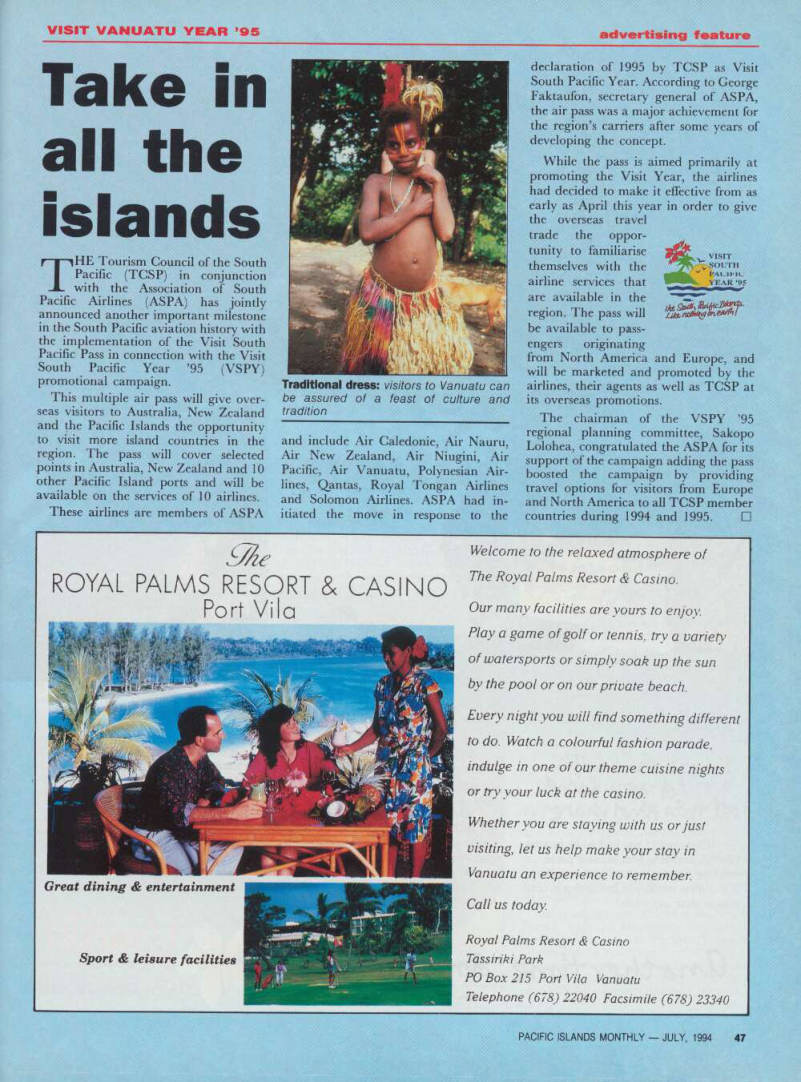
Traditional dress: visitors to Vanuatu can be assured of a feast of culture and tradition
FOLLOWING the response to the adoption of the Regional Market ing Plan 1992-94 by the 1992 Ministers of Tourism Meeting in Suva and approval by the board and annual general meeting in 1993, the Tourism Council of the South Pacific Secretariat officially declared 1995 as Visit South Pacific Year (VSPY).
The year was designated to fall within the Pacific Regional Tourism Develop ment Phase 111 activities aimed at
boosting the region’s collective
promotional efforts in target market areas.
As a new regional tourism initiative VSPY ’95 involves all member countries in an organised programme of special
joint promotional and publicity activities
leading to and including 1995.
As the theme suggests the environment will play an integral role in the develop ment and conservation of the region’s natural resources and is aimed at project ing the message of high environmental quality and attractiveness of the region’s natural and cultural features, and the need to con-
serve and pro tect them.
It’s objec tives are: •to develop and heighten awareness of the South Pa cific as a dis tinct, regional
entity; • to promote the South Pacific as an affordable and value for money tourist destination; • to increase visitor arrivals into the South Pacific from both the short-haul and long-haul markets; • to enhance the image of the South Pacific and promote it as a distinct tourist destination; • in conjunction with its ‘South Pacific Tourism Year’ create awareness and public understanding among citizens of member countries of the importance of tourism; • to highlight the environment (both natural and socio-cultural) as an integral part in the development of tourism in the region; VSPY ’95 will stress environ mental quality and the need to conserve and protect it; • to promote greater utilisation of the tourism resources within the region through sustainable development; • to use VSPY ’95 as a vehicle for economic development in the medium to long-term development of the industry and the economy at large within the TCSP member countries and specially the smaller member states; and • to generate economies of scale and promote greater cohesion amongst the region’s tourism partners through co operative marketing.
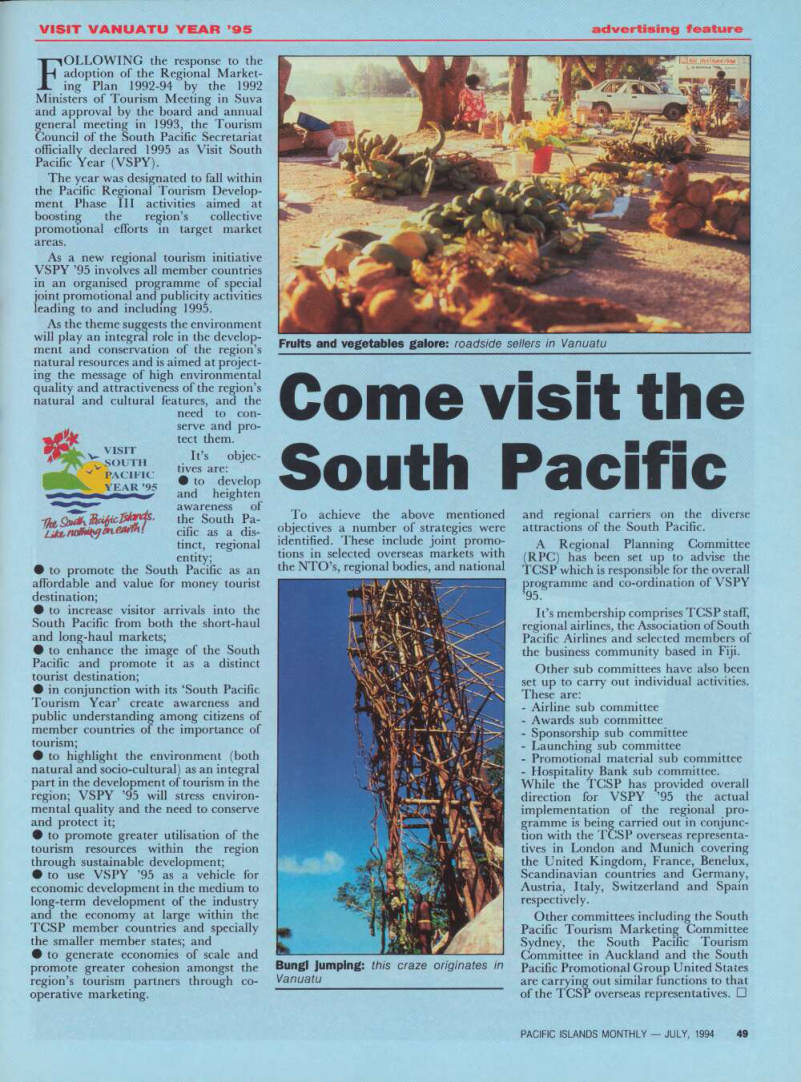
Fruits and vegetables galore: roadside sellers in Vanuatu