Hereniko comes of age
p. 37 · Read in the full issue
People
By Ed Rampell
THE new play by Fiji’s Vilisoni
Hereniko opens on the Bth of this month at the community-oriented Kumu Kahua Theatre’s new Honolulu space.
The Polynesian playwright was born in 1954 on Rotuma, an 18 square mile islet of 2500 people 300 miles north of Viti Levu. Equidistant to the French pos sessions of Wallis and Futuna and Suva, Rotuma is a Polynesian outlier in Melanesia. When Fiji was ceded to Britain in 1881, Rotuma politically became a part of Fiji. London thought this would make it easier to administrate Rotuma, despite its different culture and
language.
Hereniko, the last child of a humble family of 11, grew up in a thatched-roof limestone house in the largely undevel oped isle. His mother “still can not read or write”. Hereniko’s theatrical debut was as a class clown behind his teachers’ backs. “From an early age I was interested in acting ... imitating the teacher, joking ... I was attracted to that type of clowning behaviour ... that likes to mock authority and convention ... which is very much part of Rotuman culture.”
Hereniko attended Rotuma primary and high school until he was 16, when Hereniko left for Suva to study at Queen Victoria School and then the University of the South Pacific (USP), where he
majored in English and history, gradu
ating class of ’77 with a teaching certificate. After teaching for four years at Queen Victoria, Hereniko got his Masters degree in drama in education in 1982 at the University of Newcastle upon-Tyne in England. Then Hereniko worked for Fiji’s ministry of education for two years, and lectured on Pacific literature for six years at the USP, one of the South Seas’ top institutions of higher
learning.
Despite idealistic intentions to devote himself to USP and Fiji, after conflict with another academic there, Hereniko came to Hawaii in 1991. He now teaches Pacific literature for the University of Hawaii’s Center for Pacific Islands Studies (CPIS), where the playwright is coming of age and into his own. “It’s great being in Hawaii, I feel as if my career is really taking off here ... I don’t have as many students and have a lot more time to indulge in writing ... people seem to value what I have to say about the Pacific. Part of the reason is that there aren’t a lot of indigenous Pacific islanders at the university”, including Hawaiians.
Hereniko’s major influences include Wendt, Hau’ofa, Tongan poet Konai Thaman and since he “had a very
colonial education, Shakespeare ... and Ibsen ... but now, I would say I’m more or less interested in finding my own voice than in being a regional. I don’t care so much for influences from other people, I’m more interested in developing a unique voice, a style that is mine.”
Hereniko says that “as a Rotuman, I was often caught in the middle of the conflict between Indians and Fijians”.
The Polynesian is a detached observer who was in it but not of a society dominated by Asians, Melanesians, and their conflicts. Hereniko writes from a unique vantage point as a Pacific islander minority equidistant to two larger ethnic groups.
Don’t Cry Mama, was written when Hereniko was a student in Wendt’s creative writing course at the USP. His first play is about “the impact of materialism, urban values, among the Rotuman community in Suva, as people moved from the island” to the bright
lights of the big city.
His second and third plays, A Child for Iva and Sera’s Choice, have Romeo and Juliet themes, dealing, respectively, with inter-racial marriages between Rotuman-Fijian and Indian-Fijian couples. Sera’s Choice has echoes of Ibsen’s A Doll’s House, but Hereniko says it has a more contemporary meaning.
“Interestingly enough, Sera’s Choice was produced in Fiji about six months before the first coup in 1987. So, in some ways it was prophetic in that it dealt with the issues which were part of the reasons for the coup, according to Rabuka,” asserts Hereniko. “I was very concerned about the racial tensions between the Fijians and the Indians ... the marriage was a metaphor for the Fijian-Indian situation ...” the break-up of Sera and Anil is like a prediction of the military overthrow of
the Bavadra government, although Hereniko holds out hope for racial conciliation with Sera’s closing line: “If you love me Anil, you’ll find me.”
USP has published Hereniko’s plays, including a collection that includes a Genet-like allegory. The Monster deals with the Fiji coup, but in a fairly symbolic fashion,” says Hereniko.
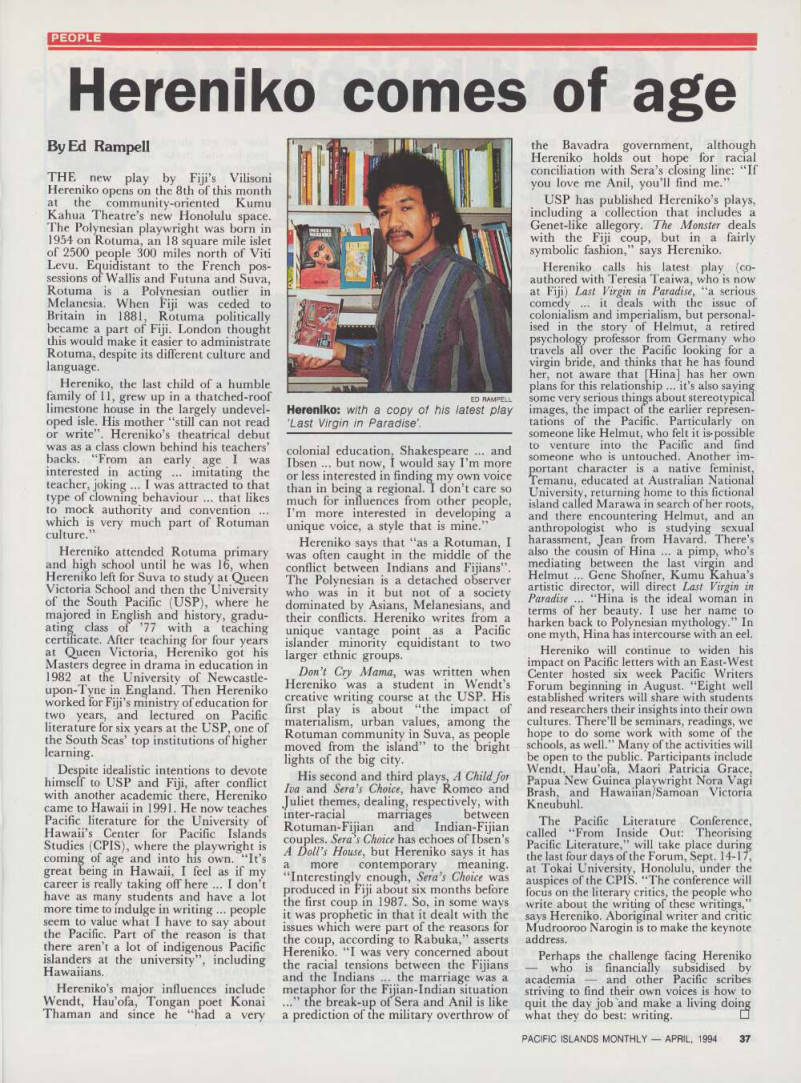
Hereniko calls his latest play (co authored with Teresia Teaiwa, who is now at Fiji) Last Virgin in Paradise, “a serious comedy ... it deals with the issue of colonialism and imperialism, but personal ised in the story of Helmut, a retired psychology professor from Germany who travels all over the Pacific looking for a virgin bride, and thinks that he has found her, not aware that [Hina] has her own plans for this relationship ... it’s also saying some very serious things about stereotypical images, the impact of the earlier represen tations of the Pacific. Particularly on someone like Helmut, who felt it is* possible to venture into the Pacific and find someone who is untouched. Another im portant character is a native feminist, Temanu, educated at Australian National University, returning home to this fictional island called Marawa in search of her roots, and there encountering Helmut, and an anthropologist who is studying sexual harassment, Jean from Havard. There’s also the cousin of Hina ... a pimp, who’s mediating between the last virgin and Helmut ... Gene Shofner, Kumu Kahua’s artistic director, will direct Last Virgin in Paradise ... “Hina is the ideal woman in terms of her beauty. I use her name to harken back to Polynesian mythology.” In one myth, Hina has intercourse with an eel.
Hereniko will continue to widen his impact on Pacific letters with an East-West Center hosted six week Pacific Writers Forum beginning in August. “Eight well established writers will share with students and researchers their insights into their own cultures. There’ll be seminars, readings, we hope to do some work with some of the schools, as well.” Many of the activities will be open to the public. Participants include Wendt, Hau’ofa, Maori Patricia Grace, Papua New Guinea playwright Nora Vagi Brash, and Hawaiian/Samoan Victoria Kneubuhl.
The Pacific Literature Conference, called “From Inside Out: Theorising Pacific Literature,” will take place during the last four days of the Forum, Sept. 14-17, at Tokai University, Honolulu, under the auspices of the CPIS. “The conference will focus on the literary critics, the people who write about the writing of these writings,” says Hereniko. Aboriginal writer and critic Mudrooroo Narogin is to make the keynote address.
Perhaps the challenge facing Hereniko
who is financially subsidised by academia and other Pacific scribes striving to find their own voices is how to quit the day job and make a living doing what they do best: writing. □
Ed Rampell
Hereniko: with a copy of his latest play ‘Last Virgin in Paradise’.