Tonga scores badly
p. 36 · Read in the full issue
Freedom
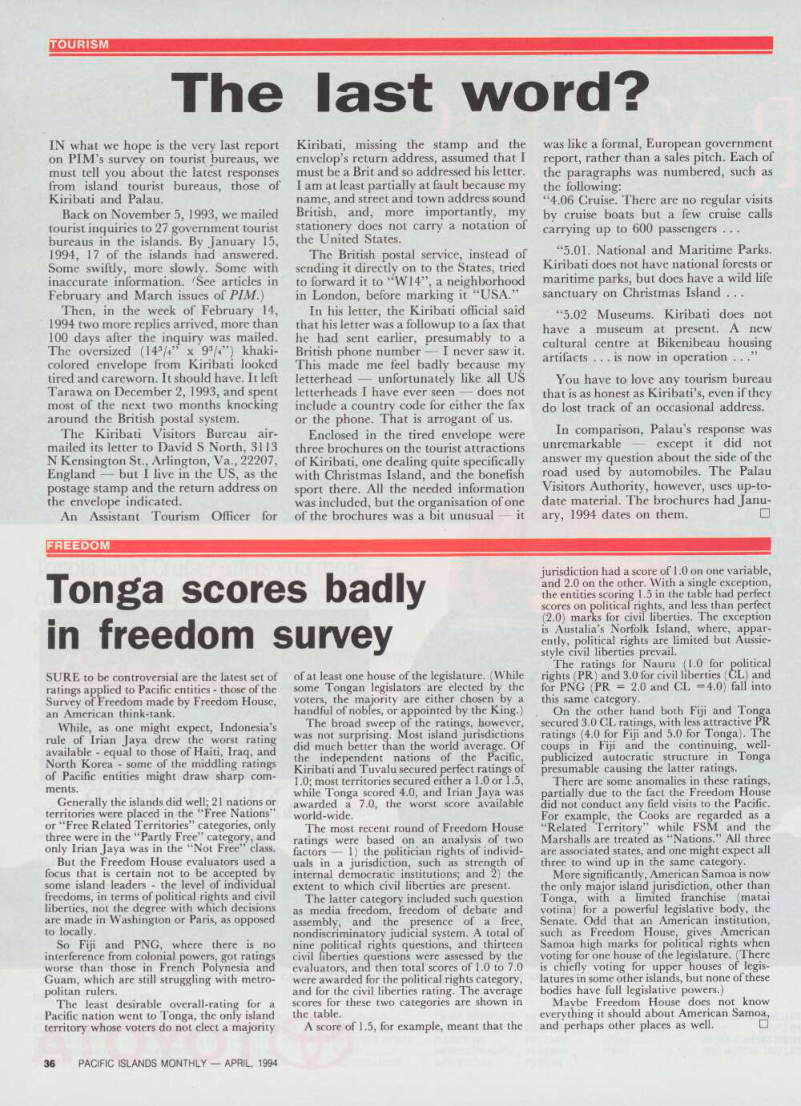
Tonga scores badly in freedom survey
SURE to be controversial are the latest set of ratings applied to Pacific entities - those of the Survey of Freedom made by Freedom House, an American think-tank.
While, as one might expect, Indonesia’s rule of Irian Jaya drew the worst rating available - equal to those of Haiti, Iraq, and North Korea - some of the middling ratings of Pacific entities might draw sharp com ments.
Generally the islands did well; 21 nations or territories were placed in the “Free Nations” or “Free Related Territories” categories, only three were in the “Partly Free” category, and only Irian Jaya was in the “Not Free” class.
But the Freedom House evaluators used a focus that is certain not to be accepted by some island leaders - the level of individual freedoms, in terms of political rights and civil liberties, not the degree with which decisions are made in Washington or Paris, as opposed
to locally.
So Fiji and PNG, where there is no interference from colonial powers, got ratings worse than those in French Polynesia and Guam, which are still struggling with metro
politan rulers.
The least desirable overall-rating for a Pacific nation went to Tonga, the only island territory whose voters do not elect a majority
of at least one house of the legislature. (While some Tongan legislators are elected by the voters, the majority are either chosen by a handful of nobles, or appointed by the King.) The broad sweep of the ratings, however, was not surprising. Most island jurisdictions did much better than the world average. Of the independent nations of the Pacific, Kiribati and Tuvalu secured perfect ratings of 1.0; most territories secured either a 1.0 or 1.5, while Tonga scored 4.0, and Irian Jaya was awarded a 7.0, the worst score available world-wide.
The most recent round of Freedom House ratings were based on an analysis of two factors —1) the politician rights of individ uals in a jurisdiction, such as strength of internal democratic institutions; and 2) the extent to which civil liberties are present.
The latter category included such question as media freedom, freedom of debate and assembly, and the presence of a free, nondiscriminatory judicial system. A total of
nine political rights questions, and thirteen
civil liberties questions were assessed by the evaluators, and then total scores of 1.0 to 7.0 were awarded for the political rights category, and for the civil liberties rating. The average scores for these two categories are shown in the table.
A score of 1.5, for example, meant that the
jurisdiction had a score of 1.0 on one variable, and 2.0 on the other. With a single exception, the entities scoring 1.5 in the table had perfect scores on political rights, and less than perfect (2.0) marks for civil liberties. The exception is Austalia’s Norfolk Island, where, appar ently, political rights are limited but Aussie style civil liberties prevail.
The ratings for Nauru (1.0 for political rights (PR) and 3.0 for civil liberties (CL) and for PNG (PR = 2.0 and CL -4.0) fall into this same category.
On the other hand both Fiji and Tonga secured 3.0 CL ratings, with less attractive PR ratings (4.0 for Fiji and 5.0 for Tonga). The coups in Fiji and the continuing, well publicized autocratic structure in Tonga
presumable causing the latter ratings.
There are some anomalies in these ratings, partially due to the fact the Freedom House did not conduct any field visits to the Pacific.
For example, the Cooks are regarded as a “Related Territory” while FSM and the Marshalls are treated as “Nations.” All three are associated states, and one might expect all three to wind up in the same category.
More significantly, American Samoa is now the only major island jurisdiction, other than Tonga, with a limited franchise (matai votina) for a powerful legislative body, the Senate. Odd that an American institution, such as Freedom House, gives American Samoa high marks for political rights when voting for one house of the legislature. (There is chiefly voting for upper houses of legis latures in some other islands, but none of these bodies have full legislative powers.) Maybe Freedom House does not know everything it should about American Samoa, and perhaps other places as well. □