The healing convention
p. 23 · Read in the full issue
ONCE again, during the weeks before its 13th annual congress (Feb 5-6, Nou mea), the umbrella group FLNKS
(Kanak Socialist Liberation Front)
showed signs of lack of unity and poor motivation. The long existing gap be tween the largest moderate component, the Union Caledonienne (UC), and the more radical Kanak Liberation Party (PALIKA) had come to a head at the time of the annual meeting of the monitoring committee of the Matignon Accords in Paris in December. Paul Neaoytine, leader of the PALIKA and president of the FLNKS, had followed his party’s decision not to attend.
In October, the UC had expressed its desire for a “negotiated independence”, while the PALIKA was in favor of “a UN-type referendum”. One year before the crucial provincial and municipal elections of’9s, the official agenda of the FLNKS congress (“evolution and aim of how the FLNKS can be utilised, strategy for the future”) sounded very much like an incantation.
Finally, Neaoutyine was re-elected,
along with the entire bureau, and unity prevailed once more, especially to say “no” to Jacques Lafleur on two issues.
The president of the anti-independence Rally for Caledonia in the Republic (RPCR) wants to start talks with the FLNKS on the future of New Caledonia after 1995, and he is in favour of a reform of the proportional representation sys tems.
The four components of the FNLKS agreed on starting the discussions about 1998 with “the other forces, the other
pro-independence political organis
ations, the other communities”.
Neaoutyine denounced the RPCR’s “peculiar strategy”, which consists of
“discrediting and minimising the import
ance of the claim for independence from the results of the ’95 elections”. The FLNKS doesn’t want to wait until after the 1995 elections, but wants to begin as soon as possible.
As for the electoral reform, one of the final motions of the congress refused it,
considering that setting small parties
aside from institutional representation “is dangerous and anti-democratic”.
This appears to be a major concession of the UC to the PALIKA for the sake of the movement’s unity. The UC had originally been in favour of the proposed electoral reforms proposed by the RPCR during the December ’93 Matignon Accords meeting in Paris.
The FLNKS also decided to hold a
national convention at the end of March to elaborate a charter for the movement.
Another convention will take place in July, in order to refine the constitution
project of Kanaky (independent New
Caledonia) which was filed with the United Nations in 1987.
The front also called on the French government to conduct an audit on the use of public funds, following the alle gations of Jacques Lafleur of misuse of public monies in the purchase of the pro
independence Islands Province’s ferry.
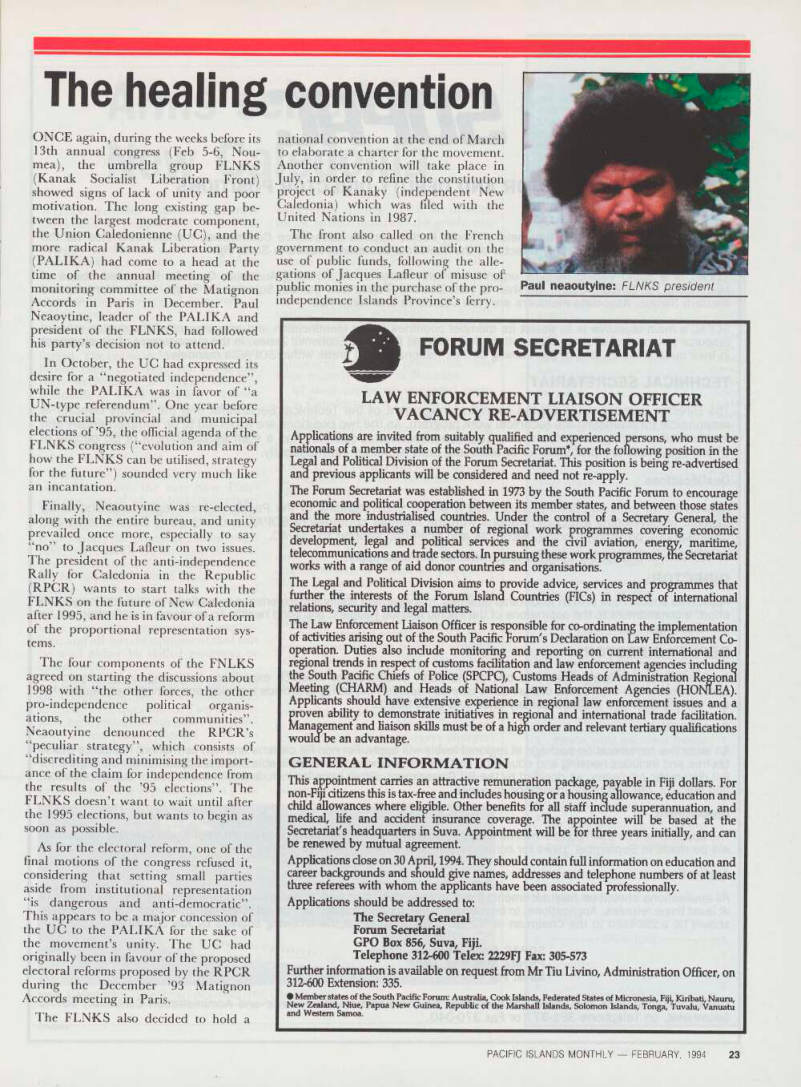
Paul neaoutyine: FLNKS president