healing
p. 22 · Read in the full issue
New Caledonia
The healing visit
WHEN French Minister for Overseas
Departments and Territories (DOM
TOM) Dominique Perben said goodbye
to pro and anti-independence del egations in Paris after the fifth annual meeting of the monitoring committee of the Matignon Accords, he was confident.
The famous consensual spirit was still
working.
Three months later, Perben made his second official visit to New Caledonia, as part of a tour which also took him to the two other French territories, Wallis and Futuna, and Polynesia, to find tension had risen again in the political circles.
The controversial purchase of a ferry by
the pro-independence Loyalty Islands
Province (see PIM Feb) had poisoned
the atmosphere. Jacques Lafleur’s criti cism of the purchase and his allegations of misuse of public funds for its financing even led to a defamation suit by Loyalty Islands president Richard Kaloi.
As soon as Perben arrived in New Caledonia, he flew to the Isle of Pines for a rest. In fact, he met Lafleur there on his boat, for primary unofficial talks, before starting, on the following day, a
long series of meetings with politicians,
industrialists, trade union leaders and religious authorities. Two of the people he met were especially enthusiastic. The first, Kanak Socialist Liberation (LKS) leader Nidoish Naisseline, who co-signed the Matignon Accord in 1988 in Paris, but whose small party doesn’t belong to the umbrella group FLNKS, revealed that no other minister for DOM-TOM had ever met him in Noumea in the past five years. The second, Louis Kotra Ureguie, leader of the Union of Kanak and Exploited Workers (USTKE), also a signatory of the Matignon Accords as a then component of the FLNKS. “We appreciated the fact that Mr Perben had called our December general strike a normal thing in a democracy, while many people here still think a strike is a revolution,” explained Ureguei after the
meeting.
Both men were part of the plane load
of people (including Lafleur and Kaloi)
who flew the next day to Kone, the capital of the pro-independence North ern Province, to attend the first
Matignon Accord “transitory monitor
ing committee” meeting. In December in Paris, 'both RPCR and FLNKS del egations had asked for such meetings to
be held every three months in New Cale donia. The procedure so far has been one large annual meeting each year in Paris.
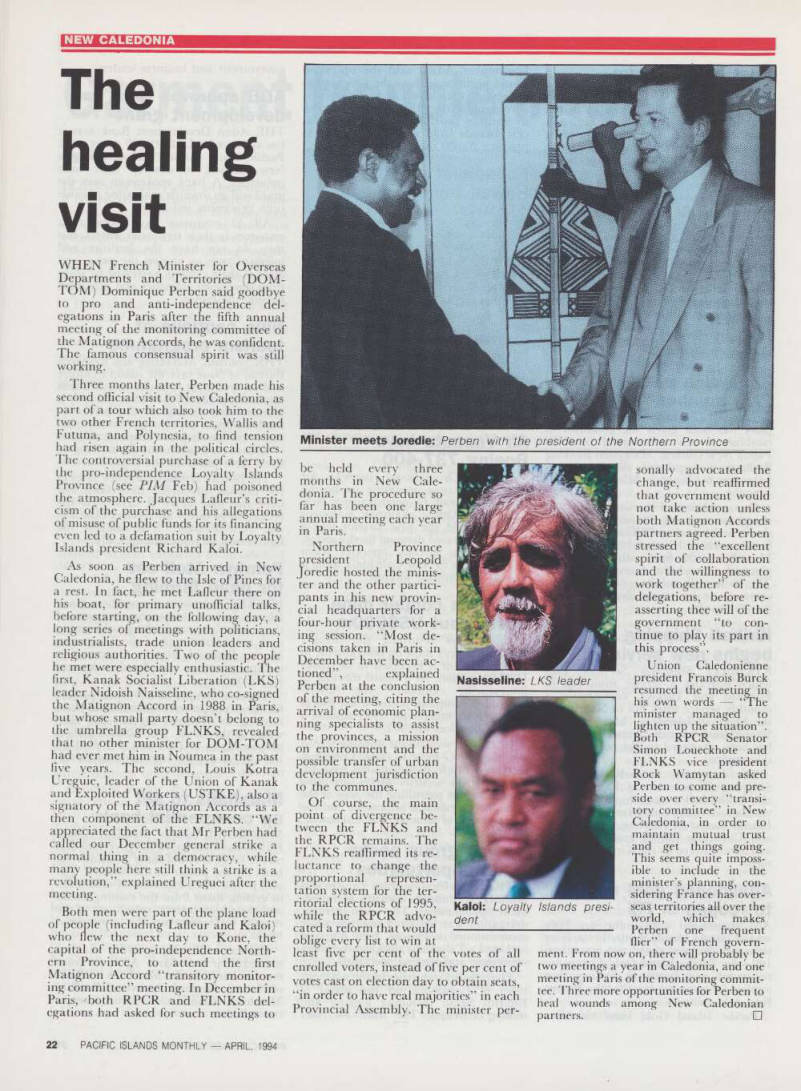
Northern Province
president Leopold
Joredie hosted the minis ter and the other partici pants in his new provin cial headquarters for a four-hour private work ing session. “Most de cisions taken in Paris in December have been ac
tioned”, explained
Perben at the conclusion of the meeting, citing the arrival of economic plan
ning specialists to assist
the provinces, a mission on environment and the possible transfer of urban
development jurisdiction
to the communes.
Of course, the main
point of divergence be
tween the FLNKS and the RPCR remains. The FLNKS reaffirmed its re luctance to change the
proportional represen
tation system for the ter ritorial elections of 1995, while the RPCR advo cated a reform that would oblige every list to win at
least five per cent of the votes of all enrolled voters, instead of five per cent of votes cast on election day to obtain seats, “in order to have real majorities” in each Provincial Assembly. The minister per-
sonally advocated the change, but reaffirmed that government would not take action unless both Matignon Accords partners agreed. Perben stressed the “excellent spirit of collaboration and the willingness to work together” of the delegations, before re asserting thee will of the government “to con tinue to play its part in
this process”.
Union Caledonienne president Francois Burck resumed the meeting in his own words “The minister managed to lighten up the situation”.
Both RPCR Senator Simon Loueckhote and FLNKS vice president Rock Wamytan asked Perben to come and pre side over every “transi tory committee” in New Caledonia, in order to maintain mutual trust and get things going.
This seems quite imposs ible to include in the minister's planning, con sidering France has over seas territories all over the world, which makes Perben one frequent flier” of French govern
ment. From now on, there will probably be two meetings a year in Caledonia, and one meeting in Paris of the monitoring commit tee. Three more opportunities for Perben to heal wounds among New Caledonian partners. □
Minister meets Joredie: Perben with the president of the Northern Province
Nasisseline: LKS leader
Kaloi: Loyalty Islands presi dent