Pacific Business
pp. 27-29 · Read in the full issue
Now where did that minerals boom go?
IT Went Bang!
In 1994, if we are to believe govern ment projections, and they are
usually more optimistic than realistic, the
PNG economy will contract an expected 42 million barrels of oil. It is exporting over 50 tonnes of gold and yet it has foreign exchange reserves in the third quarter of 1993 to cover only 1.8 months of non-mineral imports. This is down from 9 months of non-oil import cover in the mid 1980’s before the minerals and exploration boom had never begun.
While this decline in foreign exchange reserves is in large part a result of massive debt repayments by the mining and oil companies so dramatic a decline remains disturbing despite the fact that it will
probably recover.
PNG has become a victim of its own success. IN 1992 the growth rate was an astounding 11.8 per cent and in 1993 an even more astounding 14 per cent. The boom however is already over and it will be downhill form now on. You should not have blinked because if you did you probably missed what everyone was talking about in PGN for the last ten years. And if you leave aside the shining high rises in Port Moresby, which are only overshadowed in stature by the country’s ballooning debt then there is very little to show for the minerals boom that all and sundry dreamed of in the 1980 s. The PNG economy will, accord ing to the government’s own projections, not again see positive real per capita growth again until 1997. So what
happened?
The huge Porgera gold mine and the Kutubu oil fields of the Southern High lands, which were the as is of the boom in 1992-3 were in effect high graded and drawn down very rapidly and the peak occurred almost immediately. The reason of course is that firms want to earn their revenues as quickly as possible but
the risk of investing in PNG accelerates the high grading. No-one in Waigani could say that they did not have advance notice and they all behaved exactly as expected. Rather than save its mineral wealth Waigani has spent it in the massive orgy of government consump tion that will leave the country paying the bills for years to come.
But the oil and minerals boom is not quite over yet. There are still abundant resources that can be used and still more being discover. However, in the shadow
of Bougainville the exploration that is fuel of oil and gold mining booms has all but stopped.
While oil production and exports have grown to be of major import ant to PNG it still takes second place in terms of exports to minerals which even in 1993, the peak year of oil production was below the value of mineral exports. However, oil and minerals now constitute 79 per cent of total PNG exports. If PNG was before dependent upon the whims of the gold copper market it has now added black gold to its economic addiction.
The developments in mining are
relatively encouraging despite a
year in which a major confrontation occurred between the mining com panies and the government of PNG.
The most important development is the intention of Kennecott to pro ceed with the development of the huge K6OO million Lihir project.
In 1992 total exports of gold were at an all time high of 67 tonnes up from 57 the previous year. It was a large measure the huge and unex pected increase in gold production from the Porgera mine which in 1992 produced a reported 46 tonnes of gold that prompted the govern
ment of PNG to demand a reopening of negotiations with Porgera Joint Venture.
The renegotiation resulted in a tempor ary but downward revaluation of all PNG stocks on the stock markets. The government of PNG finally renegotiated an agreement where its stake in the mine was increased to 25 per cent from the previous equity stake of 10 per cent that had been negotiated by the Namaliu government. The government of Paias Wingti has indicated its intention to continue to seek the maximum possible
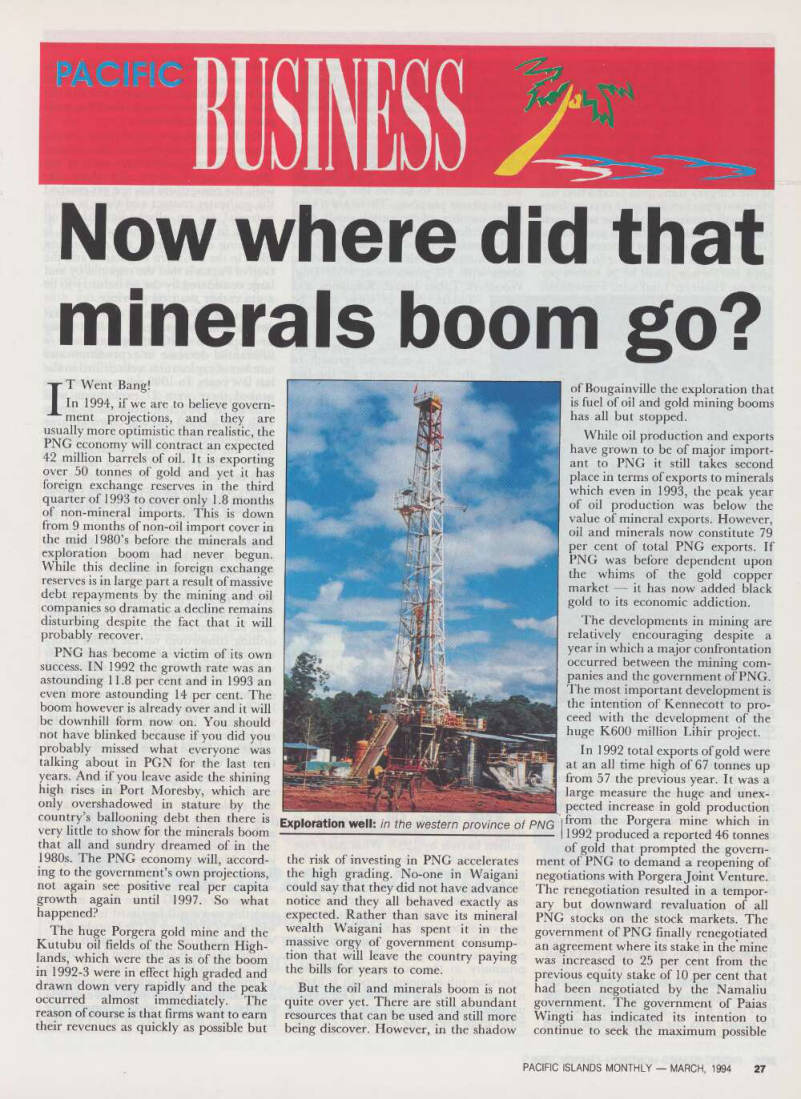
Exploration well: in the western province of PNG
equity in future mining projects, which under the terms of the Mining Act is set at 30 per cent. The Mining Act permits the government of PNG to purchase shares a cost rather than at market value and as a result the equity position is generally taken at a discount to the market valuation.
Due in large measure to high grading at the Porgera mine gold production has effectively peaked and gold exports from PNG will continue to decline until such time as the Lihir mine begins production, Gold output is expected to decrease to 57 tonnes in 1993 and continue to decrease until 1997 when it will be 50 tonnes per annum. However Lihir with a minimum
expected mine life of 36 years and what may ultimately be 50 years will assure that PNG continues to be a major gold producer well into the next century. The Missima gold/silver continues production with an expected life of another seven years. Estimated copper production from the Ok Tedi mine increased sharply in 1993 to 220.4 thousand tonnes from 187.9 thousand tonnes in 1992. ... . .
While mineral production from known and viable deposits is continuing general companies are re-examining important deposits in PNG that had previously been considered to be sub-economic, Most significantly Highlands Gold is reexamining the copper/gold deposits on the Frieda River a tributary of the Sepik.
In recent tests the company has found
new much higher grade ore sections at 4 per cent copper and 4 gr/t gold. This has raised the expectation that this deposit may be developed in the years to come, Of potentially equal importance is the fact that Highlands Gold is also re examining the Ramu Nickel/Chromium deposit which has never been developed, because like the Frieda River deposit, was considered to be too low grade for development purposes. There are a very large number of potential small gold deposits that are likely to be developed in the coming years. The most significant is Tolukuma Deposit in Central province along with 4-5 prospects at Wild Dog, Woodlark Tabar island, Kainantu and
Laloki. Any of these may be developed before the end of the century.
While mining has been the engine of economic growth of the PNG economy for the last two decades exploration for new deposits has decreased dramati cally over the last few years.
From a peak of over 200 active exploration licences in the mid 1980’s the number has de creased to an estimated 70 licences in 1993. This is mir rored in a decrease in explo ration expenditure. However, given the massive boom of the 1980 s it was doubtful that such levels of exploration could be continued indefinitely. More over, many of the deposits discovered throughout the ex ploration boom will carry the PNG economy well into the middle of the next century.
The second most important export sector for 1993 has been petroleum. Petroleum pro duction from the Kutubu field peaked in 1993, just two years
after production began. While
production from the field is likely to extend for 12-15 years
the production will decline by approximately 20 per cent in 1994. Oil production in 1993 peaked at 47 million barrels with an expected export revenue of KB4B million. Oil production is scheduled to decrease gradually to 30 million barrels by 1997. What may ease the transition of the economy is the continued exploration of other minor fields j n thee southern highlands. The most significant of these is the SE Gobi which is a small field with proven reserves of between 30-50 million barrels G f oil. The prospect is considered to be economic already. Given its relative
proximity to the existing pipeline this
otherwise sub-economic deposit is likely to come on stream in 1996. One other prospect that is likely to reach develop ment stage before the end of the century
is the SE Menanda structure which has only recently been drilled but is also quite promising. It is however not the only prospect and several others are quite possible at the moment.
Of much greater significance to the longer term development of the industry are the potential structures such as the Hides structure where after three text wells the consortium has not yet reached the gas/water contact and there is still a potential for an albeit diminished oil deposit in this huge structure. What is becoming evident from the exploration effort in the Southern Highlands and the Gulf of Papua is that the region is by and large considered by the oil industry to be a gas rather than oil province.
What is of concern is the fact that despite a not insignificant oil field being developed in PNG there has been a substantial decrease in expenditure and number of exploration wells drilled in the last few years. In 1989 when exploration peaked there were 27 exploration well drilled. In 1992 this declined to seven wells and in 1993 this was down to three wells. Expenditure on exploration paral leled this decline with a decrease from K 225 million in 1990 to an estimated K 55 million in 1993. This decline is not simply a cyclical phenomenon as PNG is actually losing its share of world explo ration expenditure. It is widely felt by industry sources that drilling will in crease in 1994 though it is likely to remain at levels well below the explo ration boom of the 1980 s.
Several developments in the area of PNG’s clearly substantial gas deposits have occurred recently. The most signifi cant has been the entry into the BP lead drilling consortium on the Hides struc ture of the Japanese giant Marebini as well as Esso. Both have substantial interests in Liquid Natural Gas (LNG) development and there is every likeli hood that a major development of LNG will occur. However, based on the experience of other countries this is unlikely to begin before the early part of the next century.
The other significant development that has occurred has been the entry into the exploration arena of two large Japanese firms that are heavily involved in LNG marketing in the rapidly grow ing Japanese market. Nissho Aiavi has joined Mobil in the huge Gulf of Papua field at Pandora reef. This indicate that with time PNG is very likely to become an exporter of LNG to the Asian market and this move will be timed to coincide with the final closure of the Kutubu field.
What this will mean is that exports in the vicinity of over K5OO million per annum can be expected from a field of seven tcf(trillion cubic feet) which is considered minimal for the development of an LNG facility. At present possible reserves of LNG are in the vicinity of 30 tcf for the
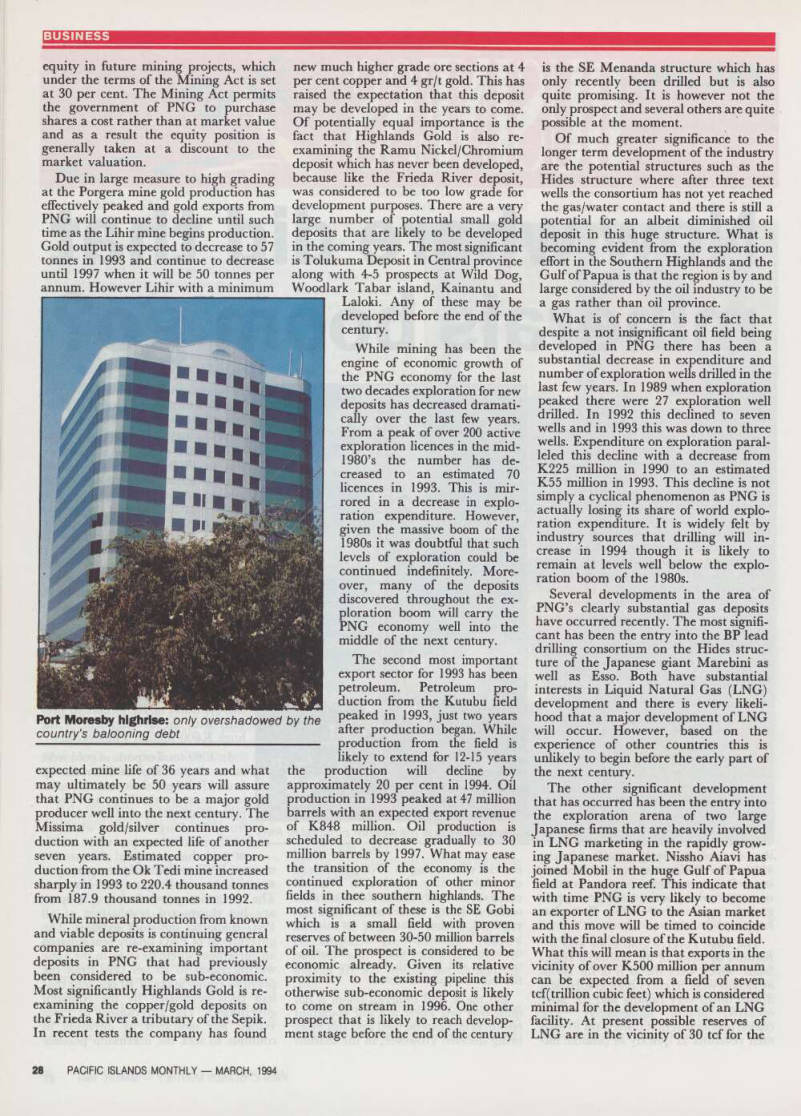
Port Moresby highrlse: only overshadowed by the country’s balooning debt
country as a whole. The most promising structure for development is Pandora.
Total known reserves are 2 tcf but this is expected to increase dramatically with further exploration of the various reef structures in the area. Nissho, Japan’s largest importer of LNG is interested in the Pandora field. This gas field has the ‘advantage’ of being offshore. In most countries this is viewed as a disadvantage as it substantially raises costs. However, in the case of PNG this lowers the risk attendant to such developments from disruption by landowners.
It will be necessary for the government of PNG to enact new legislation to deal with gas development as the existing taxation system is considered to be inappropriate to give necessary incen tives to develop a project will recquire an investment in the vicinity of US$lO billion to develop. However, should the project proceed then it will give PNG the long term financial stability it requires as such projects are normally of 20-25 year duration. The government has engaged consultants to prepare legislation for the gas industry in 1994. □