Fakafanua’s balancing
pp. 25-26 · Read in the full issue
People
act
By Christine Hatcher
One half of this minister belongs with God, the other with the people of Tonga.
The Hon Kinikinilau Tutoatasi Fakafanua, has been described as one of Tonga’s most charismatic politicians. A real force in government.
As Minister of Labour, Commerce and Industry, Tourism, and as Deputy Min ister of Finance, he is probably the most powerful. At 32, he is also the youngest.
He says “I don’t see it as power, but influence. No way can I force anyone I can only encourage or coerce someone to be better off than they are and to do the right thing.” And, holding the Bible in one hand, the Constitution in the other, encourage he does. One half of this minister belongs with God, the other, with the people of Tonga. It is impossible to talk to him about one without him linking it to the other.
Married to a princess, this good looking noble has achieved Tonga’s first Honours Law Degree. He’s a computer whiz, has a good sense of humour and is one of the best squash players in the Kingdom. Some would say he leads a charmed life. Others, that being born into the right family his father is the Hon Fakafanua, the Governor of Ha’apai, has its advantages. How ever, his spiritual commitment produces a humility that almost belies his aristo cratic background, easily justifying his position. “It is only by God’s grace that I am where I am,” he says.
Not surprisingly, he is also a lay preacher of the Free Wesleyan Church.
The spiritual aura that extends well beyond this 1.92 metres, suggests a wisdom beyond his years. The pillars of strength that drive him, are cemented, with that aura.
Suddenly, he sits up straight, stretch arms out either side, so symbolising the Cross of Christ, and says “This, to me, represents balance”. Re-arranging him self, he looks serious. “I need a principle that never fails and I need to use it. I am wary of saying it was a revelation, but verses from the (New International version) Bible, came to me when I thought about the basis for my economic theory . . . “For God so loved the world that he sent His one and only Son that whoever believes in Him shall not perish but have eternal life”. ... I needed a
principle eternal,
where geographi cal didn’t matter”
Biblical medi tations, he says provide a spring board from which to plan political moves.
The appoint ment that began in August 1991, soon after qualify ing at New Zea land’s Auckland University, in itially triggered stinging remarks from the House.
After spending over 20 years in that country, sus picions were voiced that his values had a New Zealand bias and were non- Tongan. But he says his values are neither Kiwi, nor Tongan, but spiri tual. And, being called “naive” or
“baby minister”
have not diverted Fakafanua from a
path he believes will lead the country to prosperity. His strategy with Tonga’s major export crop, squash, also brought harsh criticism last year, imputing short sightedness and favouritism. Growers complained that the individual quota allowance was too small, given 1993’s bumper crop. But Fakfanua says these comments were unfair because the de sires of the majority of exporters were implemented.
He explains that in 1991 the marked opened up and anyone could export. But of 23,000 metric tonnes, seven arrived in Japan spoiled, causing importers to lose millions. The government report ac tioned concluded that the quality must be four times better and the quantity limited.
Cabinet decreed to limit exports in 1992 to 10,000 metric tonnes. However
last year, after discussions with exporters, the Ministry conceded to raise the quota to 13. “But still there was a division. I told them they must work together, if not, a license would not be issued. They would have to divide the quota amongst themselves and come to an agreement.”
Finally, two of the companies, wanting an unlimited quota plus the export of baby pumpkins; voiced dissatisfaction, Fakafanua say the baby pumpkin was to be the cherry on the cream. “However, in reality, this was not the case.”
Instead, baby pumpkins were subsi dised by the larger squash, earning growers only Tsloo per bin 50 per cent less per bin that the standard sized pumpkin. Hence the export of baby squash was disallowed. Government’s stance is that greed shipping too much will create an oversupply situation in Japan,
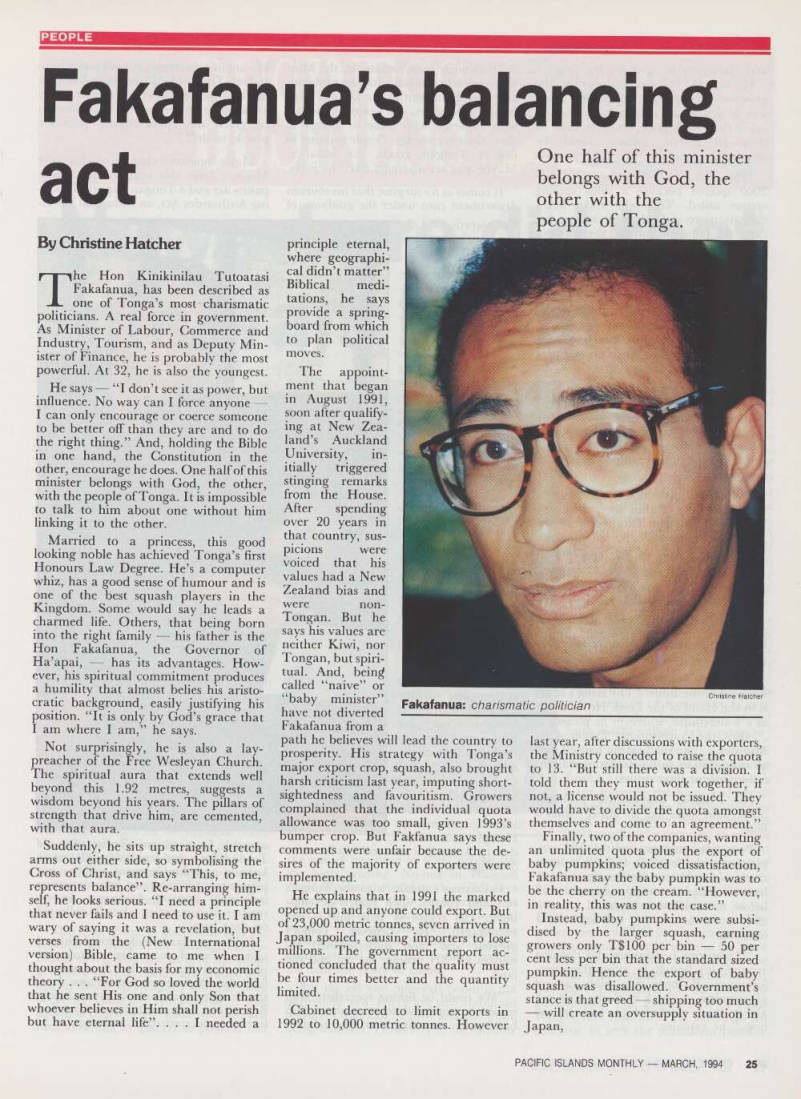
Fakafanua: charismatic politician
and ultimately bring down the price.
He says “It was an injustice, the growers were getting ripped off. There was a gentleman’s agreement that to maintain a high price, no more than 13 thousand metric tonnes would be
shipped.
“However, 17,000 tonnes left, but
2000 spoiled because a ships cooling
system failed. This will make nego tiations more difficult next season be cause the Japanese may feel they can not rely on my word.
“In the end it’s the growers that suffer.
The rich get richer, the poor get poorer.
Exporters have a dog eat dog mentality.
It may appear one sided in the press, because the Ministry doesn’t speak out, just gets on with its work. But the bottom line is that this was an exceptional year of blessings and God’s grace on the
Tongan people.
“Japan had a bad growing season, the Yen was strong, we were blessed with rain in a colder than usual climate which meant the matrix virus was not preva lent. It really all had nothing to do with my Ministry!”
Fakfanua lays the real credit family at the Lords door. Either way, the result was a TSIS million earnings from the 18,000 metric tonnes exported equalling a successful season for the Kingdom.
He looks up and says “If my Ministry is to help, we have to first know
what the day—to —day problems are.
Then, and only then can you make policies. This is the importance of the Cross the Ministry, their relationship with me, mine with them.”
Sermon style, he continues to quote freely from the Bible. “The King’s heart is in the Hand of the Lord. He directs it as a watercourse, wherever he pleases . . .”, then, the Constitution; “Duties of the Minister ... he shall satisfy himself that all subordinates in his department faith fully perform their duties . . .”
His religious pragmatism probably
makes him more like a “father” than a boss.
Providing guidance to the 120 em ployees in his “fold”, he believes attitude changes should start close to “home”. “I have a prayer meeting with my staff before the work day begins. I know if their morale is low, they will not be able to work.
“If someone is drinking and sleeping around, it’s bound to affect their per formance. If there is a high rate of absenteeism, I check out why and ask about their relationships and try to
help,” he explains.
“Following Jesus’s example, the Min ister’s job is to find out what the problems are. Angels are sent in the form of short term aid workers, for example, people with expertise who come to Tonga to share their knowledge. People wanting to import Tongan goods, for instance.
Maybe you are an angel too!” he jokes.
It comes as no surprise that his tourism department runs under the guidance of
the words, “Love your neighbour as
yourself.”
“That is our code.
As for tourism devel opment, the key is that small is beauti ful.
“I would like to see Tonga as the king of small resorts. The largest hotel in Ton gatapu would have a maximum of 400 beds. I don’t want
Fiji type develop
ment but something that is unique.
“Small, exclusive, expensive upper class resorts with the ma jority in the middle to lower price brackets. The King dom is a jewel unique. We will take them out from Ton gatapu to small re sorts on Ha’api and Vava’u.”
Already there is a master-plan on the drawing board for Vava’u. Under the
European Commun
ity Lome HI and IV schemes, a five-year program is planned to upgrade infra structure on the
island. Similarly,
Ha’api will come un
der the Australian aid umbrella for some development.
Fakafanua’s dream is to see Tonga’s run and control such future develop ment. His regret is that this is not encouraged. He believes Tonga’s greatest and most under-utilised re sources are her people, the sea and the land.
“We could be fishing specialists, ship repairers, pearl and aqua ranchers, ship builders anything maritime related.
We are in a strategic position for ships to re-fuel. Traces of oil have been found at marine base and interested oil companies are keeping an eye on it. We just need to
be given the opportunities, persuade
people to drill.”
Major legislative changes will keep the
Minister busy this year. A new Com panies act and a Tongan Export Market ing Authorities Act, an Industrial Devel-
opment Corporation; Registration of Trade Names and legislation relating to Labour and Employment will be im plemented; adding to the information on individual licences, businesses and a register of companies, already collected on data base.
Fakfanua relaxes, looks thoughtful and says “Part of my revolution is to create physical structures so that Tongans can fulfil their aspirations and dreams. I see the changing of attitudes as my main job.
But we can only do that well if we first have a good spiritual foundation.” □