‘Singh The Swing'
pp. 52-53 · Read in the full issue
Sport
By Atama Raganivatu
THERE can be no argument over which Pacific islands sportsman had the highest international profile last year. The name of Fijian Vijay Singh, invariably with his country in brackets alongside it, featured regularly and prominently in the results columns of all the world’s major newspapers
throughout the recently completed
European and North American profes sional golf tours.
Singh, 30, learnt golfs fundamentals on the humble nine-hole course lying adjacent to Nadi Airport where his father, a plane technician, was em ployed. Singh Senior had dabbled in professional golf himself with little success and much anguish. Therefore, when Vijay’s obsession with golf, which had become well and truly established by the age of eight (despite a talent for both cricket and soccer), began to interfere with his education a serious rift between father and son developed.
Vijay’s brothers, Krishna and Mira, also displayed promise but they dutifully followed their father’s directive of educa tion first, golf second. So while they were studying, Vijay was more often than not hitting golf balls. All three Singh boys went on to represent Fiji (the trio made up its Dunhill Cup the world three man championship team one year) and Krishna still features in Australian tournaments.
However, only Vijay went to make a great impact. Unable and later unwilling to call upon his father for instruction, he had no option but to rely upon maga zines and coaching manuals. Even today, Singh shuns aid from others; relying totally upon his own instincts and countless hours of solitary practise to refine his game. He is a rarity in modern sport the truly self-taught athlete.
By the time he was 16, with the newly opened Pacific Harbour, now his home course, Singh had gained recognition as the Pacific islands’ best golfer. One year later, in 1980, he left Fiji to seek fame and fortune on the world stage.
For three years, the young, inexperi enced, lonely, homesick and increasingly impoverished Fijian struggled on the Asian professional circuit. Failure fol lowed miserable failure and, just when it appeared that circumstances could not possibly deteriorate any further, came what is still referred to in whispered tones as “the cheating incident”.
During an Indonesian tournament, Singh was accused of claiming two shots less on his self-marked playing card than he actually achieved. To this day, he protests his innocence whenever inter viewers raise the subject as they continue to insist upon doing and blames a local official.
Fijian golfing star Vijay Singh’s greatest assset is the fluidity and strength of his swing
“The individual who checked my card was the son of an Indonesian VIP and, and, to save themselves embarrassment, they blamed me,” he explains with a long festering mixture of bitterness and weariness. It is a ghost he yearns to exorcise.
Suspended for two years and treated like a pariah when returning to tourna ment play, Singh felt himself compelled to abandon competitive golf and seek appointments on the coaching staff at various leading Asian clubs. All rejected him. Then, in 1985, the powerfully built six-footer finally found employment at one of the most remote and obscure golf courses in the world. Situated in the eastern Malaysian state of Sabah, Keningau is a three-hour drive from the nearest town of any consequence when monsoon rains haven’t made the only road impassable.
For two years he remained there; earned just As6o a week for instructing oil and timber industry executives, brooded over the injustice of his circum stances and practised, practised and practised.
That period of isolation changed his
life and it was a Singh burning with the desire to rehabilitate and prove himself who emerged from the Borneo rainforest in 1987. Another year passed before Africa’s Safari Tour provided the tide turning moment.
This tour is contested predominantly by Europe’s lesser lights, eager to top up earnings during what would otherwise be their “close season”. Nonetheless, it provides a very competitive environment and the ideal barometer for ambitious young players contemplating profes sional careers.
By winning the tough Nigerian Open and finishing the tour as leading money winner, Singh satisfied himself he was, at the very least, capable of being a journeyman pro. The next step was gaining admission to the lucrative Eur opean Tour (second in importance only to its American counterpart). This he accomplished at the first attempt, despite a notoriously arduous qualifying tourna ment.
Since then, Singh’s tally of tournament victories has risen to 12 (including one last year in the USA, where he is now eligible to play due to his European success) and prize money accumulated now tops $A5,000,000. Yet, a win in one of the Majors the world’s four leading annual tournaments is essential if the recognition he craves for is to be achieved. According to many of his peers, this will merely be a natural progression for him.
He came remarkably close to fulfilling their prophesies in the 1993 USPGA Championship at Toledo. A round of 63 equalled the record for a Major and gave him a two stroke lead at the halfway mark. Eventually, Singh finished a highly creditable fourth.
The Fijian was not perturbed by his inability to retain the lead. “I feel my peak is still a few years away. It’ll be a while before I become a real contender for a Major,” he mused. His fellow
professionals disagree.
The great Welsh golfer lan Woosnam recently stated “You can’t underesti mate his talent. I certainly won’t be surprised if he wins a Major and soon”. Woosnam’s admiring comments came after accompanying Singh on a round and observing his technique at close hand.
Singh’s greatest asset is the fluidity and strength of his swing, which inspired the popular nickname of “Singh The Swing”. It is poetry in motion and
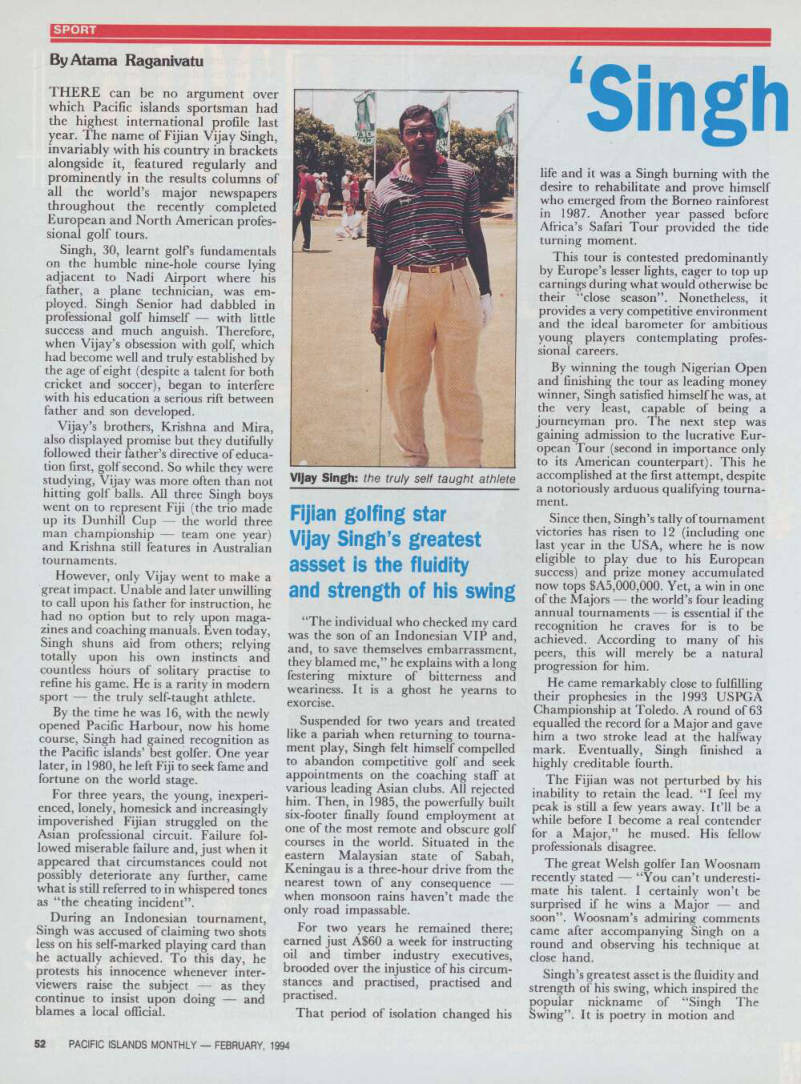
ViJay Singh: the truly self taught athlete
enables him to regularly gain 280 yards off the tee one of the longest drives in mod ern golf.
But his putting, though competent, lacks the clinical efficiency that marks the greats. One of the oldest, and most pertinent, adages in golf is “you drive for show and putt for dough”. Unfor tunately, Singh’s ability on the green is not yet good enough to place him among the cream. However, that is likely to change.
Singh’s dedication has reached legendary pro portions. “Everything I have achieved is through hard work, rather than any natural ability,” he acknowledges. “I love practising on my own. I want to play golf, practice and
not do too much else. Just let me hit balls.
I have one main concern; to reach the very top. I have a family (Malysian wife Ardena and three-year-old son Qass Seth), but golf was always me and I was always golf. I can do nothing really well except play golf and that’s the way it has always been. I wake up thinking about the game and go to sleep thinking about it.”
It is not unknown for him to spend the three hours before a round and the three hours after it practising. An honorary member of the Australasian golf colony resident at Bagshot in southern England, he also takes whatever opportunities that E;nt themselves to hit a ball around the council owned soccer pitch near his home.
Singh’s reluctance to suffer fools gladly is another prominent facet of his character.
This is particularly evident at press confer ences. He finds references to his Fijian background nearly as irksome as attempts to reopen the scars of his Indonesian
misadventure and the consequent close shave with sporting extinction.
Singh much prefers to talk about his ability as an individual, rather than his unique status as the solitary standard bearer of a country in the international golfing arena. Despite this and the fact he asn’t been back to Fiji for over a decade, Singh is proud of his background and regards himself as a pathfinder for the next
generation of Fijian golfers. “There are
many potential vijay Singhs in Fiji,” he recently claimed. “I hope to be an inspiration to them.”
At the same press conference, profes sional golfs most determined player re vealed an ambition to earn sufficient money to purchase one of his native country’s outer islands.
If that ever comes to fruition, it is certain that among his first acts will be the construction of a golf course. Somewhere to practice for countless hours totally alone and isolated deep in the Pacific would be heaven on earth to him. □
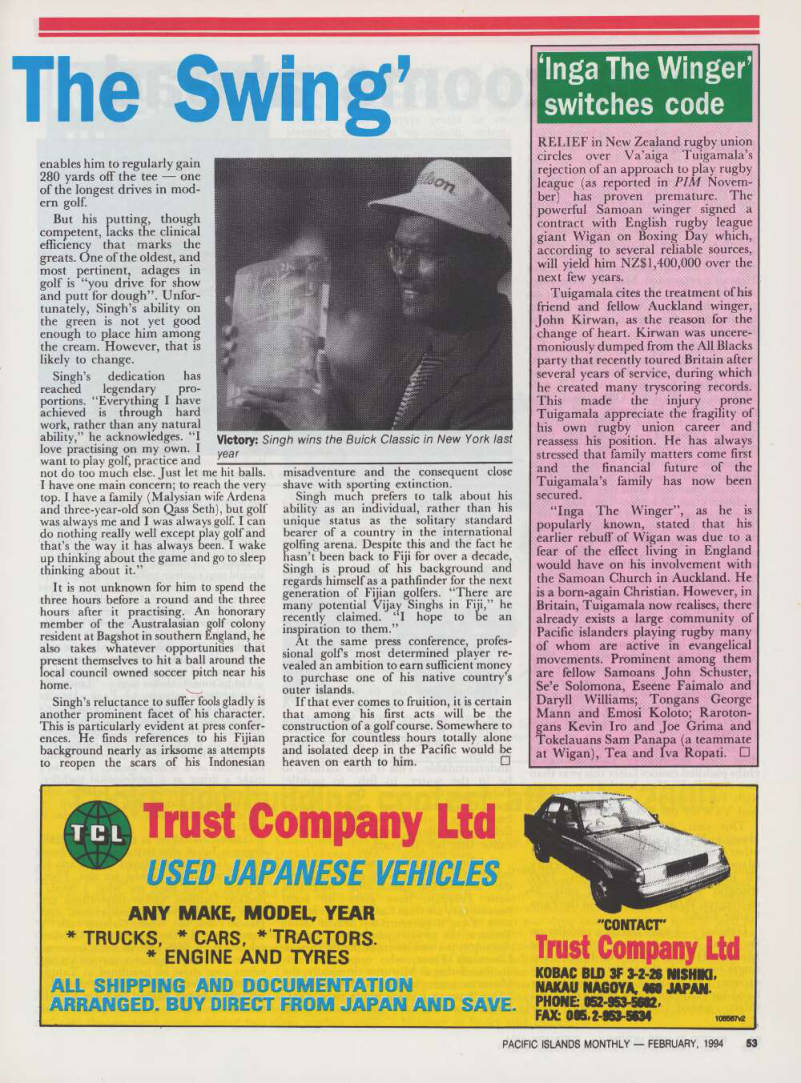
Victory: Singh wins the Buick Classic in New York last year