An historic year
pp. 49-51 · Read in the full issue
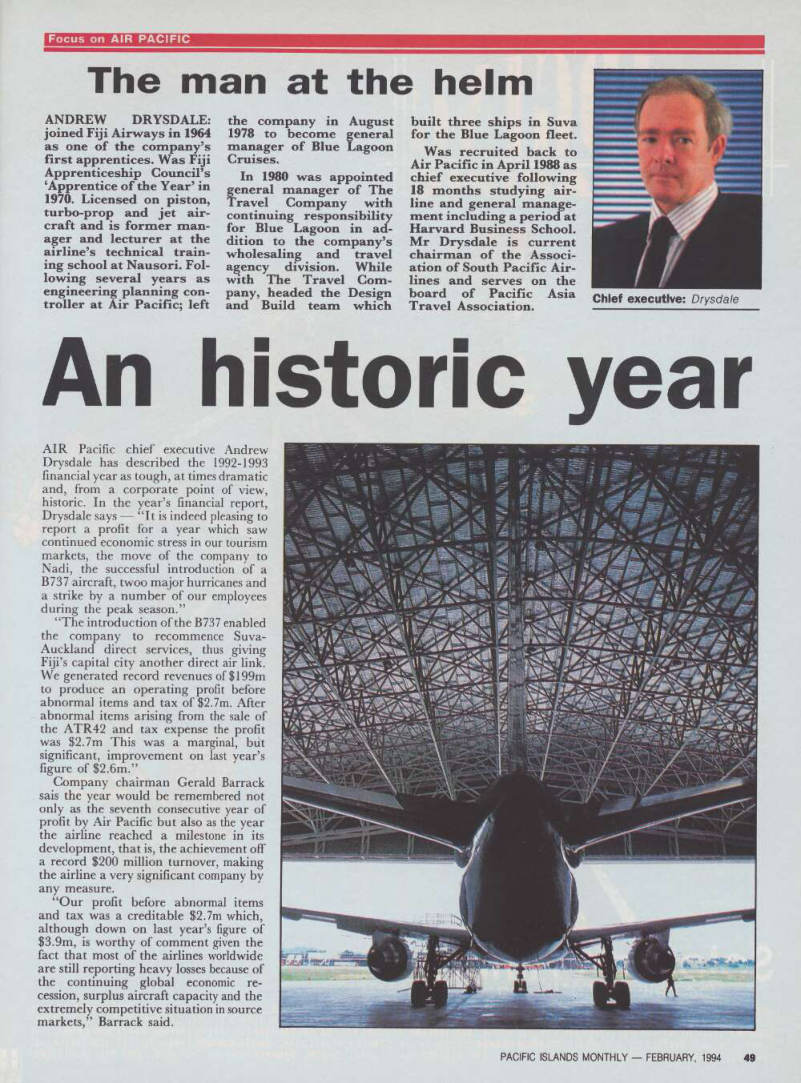
AIR Pacific chief executive Andrew Drysdale has described the 1992-1993 financial year as tough, at times dramatic and, from a corporate point of view, historic. In the year’s financial report, Drysdale says “It is indeed pleasing to report a profit for a year which saw continued economic stress in our tourism markets, the move of the company to Nadi, the successful introduction of a 8737 aircraft, twoo major hurricanes and a strike by a number of our employees during the peak season.”
“The introduction of the 8737 enabled the company to recommence Suva- Auckland direct services, thus giving Fiji’s capital city another direct air link.
We generated record revenues of $ 199 m to produce an operating profit before abnormal items and tax of $2.7m. After abnormal items arising from the sale of the ATR42 and tax expense the profit was $2.7m This was a marginal, blit significant, improvement on last year’s figure of $2.6m.”
Company chairman Gerald Barrack sais the year would be remembered not only as the seventh consecutive year of profit by Air Pacific but also as the year the airline reached a milestone in its development, that is, the achievement off a record $2OO million turnover, making the airline a very significant company by any measure.
“Our profit before abnormal items and tax was a creditable $2.7m which, although down on last year’s figure of $3.9m, is worthy of comment given the fact that most of the airlines worldwide are still reporting heavy losses because of the continuing global economic re cession, surplus aircraft capacity and the extremely competitive situation in source markets,” Barrack said.
“Total expenditure for the year was up 5.6 per cent on the previous year at $197.2m. The airline also made substan tial contribution to government revenue through payment of some $4.6m in income taxes. The continuing rise in costs leads me to raise a note of caution. The company is controlling costs effectively at the moment but unfortunately, with the operating environment we currently find ourselves in, we tread a very fine line between profit and loss. A demonstration of just how fine this line is can be seen from the fact that although we achieved revenues of s2oom for the year, the profit was less than s3m or 1.4 per cent on turnover.
“Traffic levels continue to grow world
wide but yields are down substantially. If we are to expand as an airline and meet the demands of Fiji’s tourism, we will need to achieve much higher profits in the future. The level of profit is not
acceptable from a long-term viewpoint.
Having said that however, I would like to congratulate staff and management on continuing the profit record under what were very arduous conditions.
“We face a number of major chal lenges and hurdles in our immediate future. Air Pacific cannot isolate itself from the impact on ongoing recession and increased competition from other tourist destinations. We can, however, adopt a positive approach to growth and development. I have every confidence in
management’s ability to steer the airline on a successful course over the next five years. Their achievements to date, and for the financial year just ended, vindi cate that confidence.”
After a series of losses which began in 1979 and culminated in the worst loss in Air Pacific’s history of 510,865,000 in 1884/85, the company achieved a small profit in 1985/86, and a record profit of Sl.sm in 1986/87. The record of profit was repeated for the year ending March 31, 1988 at 52.4 m inclusive of abnormal items and in 1989 at s9.lm operating profit. The effects of the Gulf War, extreme fuel price increases and the recession in our major markets resulted in a decline in operating profit for the 1990/91 year to S4m, however, this was supported by the gain on sale of the 8737 to provide a total year end record after tax profit of 517.1 m.
Continued recession and the effects of the Australian aviation deregulation adversely affected the 1991/92 year.
However, a very credible 53.9 m in operating profit was achieved. The company has now fully utilised brought forward tax losses and paid income tax to the Fiji government for the first time in 1990 on the 1989/90 profits. The 1992/93 year saw yet another profit of 52.7 m.
The company’s cash situation is now very positive with in excess of Ssom invested in Fiji, says a background report
prepared by Drysdale. However, the the
cost of the Nadi base (S2om) and the 1996 8767-300 aircraft will require approximately S2l2m in capital invest ment over the next five years. This is a major commitment and the company is currently studying how this can be achieved. This problem of capital needs is one of the two major problems facing the company (the other is the supply of
manpower skills).
At the end of August 1993, Air Pacific had 580 staff in employment (airline operations 377, marketing 109, human resources 12, information systems, chief executive 5, planning and administration 4, corporate administration 11, finance 54.
The management team Drysdale, chief executive; Josephine Yeejoy Bland, acting director of finance and company secretary; Peni Naituku, director of human resources; Ramendra Narayan,
director of marketing; Jesoni
Vitusagavulu, executive director/ re
gional manager New Zealand; Narendra Kumar, general manager commercial;
Tony Wong, general manager oper
ations; Ernie Dutta, director of strategic
planning. □