Melanesia 2010
p. 42 · Read in the full issue
Books
By Bill Morton
EARLIER this year the Australian National University’s National Centre for Development Studies released its first work in the Pacific 2010 series, Challeng ing the Future. This landmark study presented population projections for Pa cific island nations and examined the economic and social consequences of population growth. Its overriding mess age was that in the present context of minimal economic growth, population frowth will place serious strains on acific societies. Most notably, it argues that population growth will cause an “intolerable burden” on the financing of education and that it will mean a serious shortfall in the number of jobs created for
people of working age.
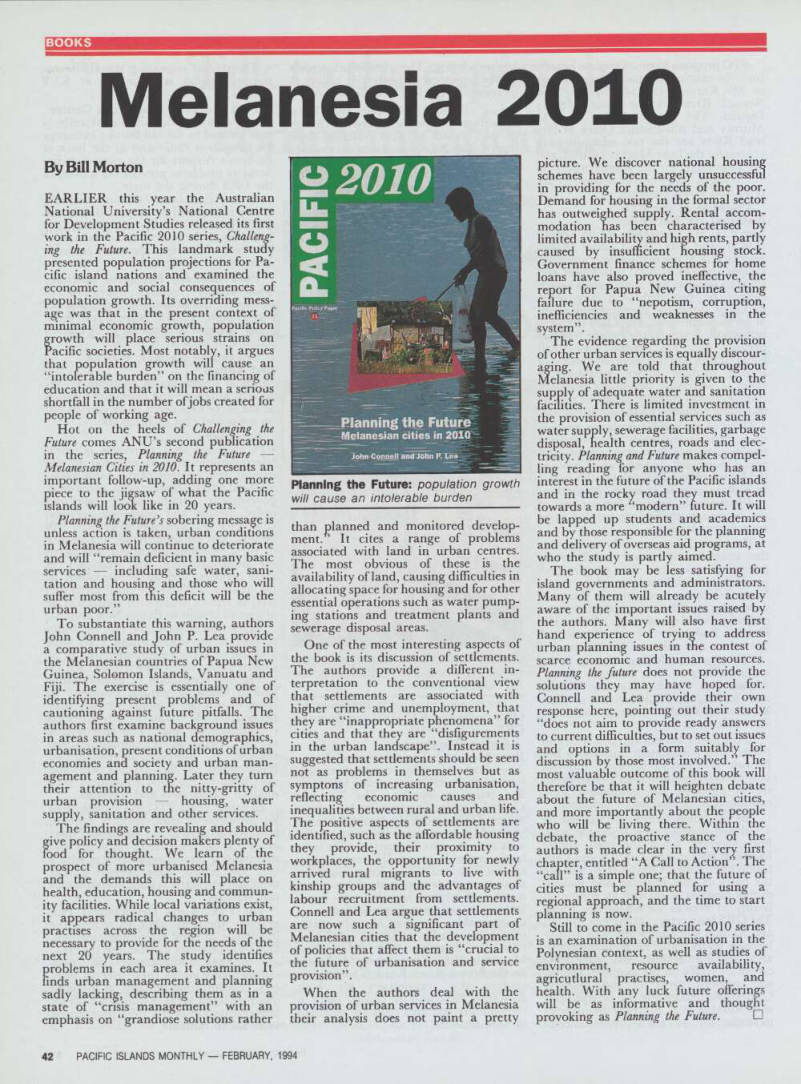
Hot on the heels of Challenging the Future comes ANU’s second publication in the series, Planning the Future Melanesian Cities in 2010. It represents an important follow-up, adding one more piece to the jigsaw of what the Pacific islands will look like in 20 years.
Planning the Future’s sobering message is unless action is taken, urban conditions in Melanesia will continue to deteriorate and will “remain deficient in many basic services including safe water, sani tation and housing and those who will suffer most from this deficit will be the urban poor.”
To substantiate this warning, authors John Connell and John P. Lea provide a comparative study of urban issues in the Melanesian countries of Papua New Guinea, Solomon Islands, Vanuatu and Fiji. The exercise is essentially one of identifying present problems and of cautioning against future pitfalls. The authors first examine background issues in areas such as national demographics, urbanisation, present conditions of urban economies and society and urban man agement and planning. Later they turn their attention to the nitty-gritty of urban provision housing, water supply, sanitation and other services.
The findings are revealing and should give policy and decision makers plenty of food for thought. We learn of the prospect of more urbanised Melanesia and the demands this will place on health, education, housing and commun ity facilities. While local variations exist, it appears radical changes to urban practises across the region will be necessary to provide for the needs of the next 20 years. The study identifies problems in each area it examines. It finds urban management and planning sadly lacking, describing them as in a state of “crisis management” with an emphasis on “grandiose solutions rather
than planned and monitored develop ment.” It cites a range of problems associated with land in urban centres.
The most obvious of these is the availability of land, causing difficulties in allocating space for housing and for other essential operations such as water pump ing stations and treatment plants and sewerage disposal areas.
One of the most interesting aspects of the book is its discussion of settlements.
The authors provide a different in terpretation to the conventional view that settlements are associated with higher crime and unemployment, that they are “inappropriate phenomena” for cities and that they are “disfigurements in the urban landscape”. Instead it is suggested that settlements should be seen not as problems in themselves but as symptons of increasing urbanisation, reflecting economic causes and inequalities between rural and urban life.
The positive aspects of settlements are identified, such as the affordable housing
they provide, their proximity to
workplaces, the opportunity for newly arrived rural migrants to live with kinship groups and the advantages of labour recruitment from settlements.
Connell and Lea argue that settlements are now such a significant part of Melanesian cities that the development of policies that affect them is “crucial to the future of urbanisation and service
provision”.
When the authors deal with the provision of urban services in Melanesia their analysis does not paint a pretty
picture. We discover national housing schemes have been largely unsuccessful in providing for the needs of the poor.
Demand for housing in the formal sector has outweighed supply. Rental accom modation has been characterised by limited availability and high rents, partly caused by insufficient housing stock.
Government finance schemes for home loans have also proved ineffective, the report for Papua New Guinea citing failure due to “nepotism, corruption, inefficiencies and weaknesses in the system”.
The evidence regarding the provision of other urban services is equally discour aging. We are told that throughout Melanesia little priority is given to the supply of adequate water and sanitation facilities. There is limited investment in the provision of essential services such as water supply, sewerage facilities, garbage disposal, health centres, roads and elec tricity. Planning and Future makes compel ling reading for anyone who has an interest in the future of the Pacific islands and in the rocky road they must tread towards a more “modern” future. It will be lapped up students and academics and by those responsible for the planning and delivery of overseas aid programs, at who the study is partly aimed.
The book may be less satisfying for island governments and administrators.
Many of them will already be acutely aware of the important issues raised by the authors. Many will also have first hand experience of trying to address urban planning issues in the contest of scarce economic and human resources.
Planning the future does not provide the solutions they may have hoped for.
Connell and Lea provide their own response here, pointing out their study “does not aim to provide ready answers to current difficulties, but to set out issues and options in a form suitably for discussion by those most involved.” The most valuable outcome of this book will therefore be that it will heighten debate about the future of Melanesian cities, and more importantly about the people who will be living there. Within the debate, the proactive stance of the authors is made clear in the very first chapter, entitled “A Call to Action”. The “call” is a simple one; that the future of cities must be planned for using a regional approach, and the time to start planning is now.
Still to come in the Pacific 2010 series is an examination of urbanisation in the Polynesian context, as well as studies of environment, resource availability,
agricutlural practises, women, and
health. With any luck future offerings will be as informative and thought provoking as Planning the Future. D
Planning the Future: population growth will cause an intolerable burden