Providing a vital link
pp. 37-41 · Read in the full issue
THERE is a wide disparity in availability of rural telephone services between the provinces of Papua New Guinea. Much of this is related to
population or geographical constraints,
however, the end results is that some provinces are much worse off than others.
Central Province for example, has 138 rural telephone services while Western Province has only six.
Provision of rural telephone services to widely scattered locations in remote areas is generally not a viable commerdal proposition, and PTC propose to provide services to some of the more disadvantaged areas under the PTC Rural Telecom Development Programme. t, . , f . , .
Projects proposed for implementation during 1994 have been selected on the basis of several criteria. Firstly, existing rural telephone services to these locations are minimal or non-existent. Secondly, if
the project requires development of
additional sites, these should already have been acquired. Thirdly, wherever possible, provision of rural telephone services should complement other rural development projects within the area, Fourthly, additional telecom equipment required should be available under existing stocks or contracts.
Based on these guidelines, projects selected for inclusion in the 1994 PTC Rural Telecoms Development Programme are as follows - • P rovisl ° n of Mt - Dremsel Rural
Telecom System (Manus Province);
f provision of the Mt. Embogo Rural Telecoms System (Oro Province) f , extensio P °f the Mt - Yu . le R “ ral coms System Garama and Malalaua Districts (Morobo and Gulf
Provinces);
provision of the Lake Murray District Rural Telecoms System (Western Province); upgrade of the PTC National HF Network
Implementation cost of the 1994 PTC Rural Development Programme is esti mated at K 4.18 million. A detailed description of each of these project follows, Manus Rural Telecoms System Manus Province has one of the lowest numbers of rural telephone services in Papua New Guinea, only 1 per cent of the national total. In 1992 and 1993 PTC has committed approximate y K 980,000 m providing a domestic satellite terminal and digital exchange at Lorengau, a microwave radio link to Lombrum naval base and a VHP radio link to Momote airport. While this will dramatically
improve the quality of telephone service
to t b e provincial capital, the majority of whn live in the rural arpas -ij ,• , r .r , ■ , W 1 see no irec ene 1 rom is wor PTC therefore proposes to install a new rural telecommunications system in Manus. This project will rely on the
development of Mt. Dremsel in the southern part of Manus Island as a rural telecoms site. Mt. Dremsel, with a height of 702 m is the highest peak on the island and lies 38 km south-west of Lorengau. at present access to Dremsel is by helicopter, although it is hoped that maintenance of the system will eventu ally be possible by four-wheel drive vehicle from Lorenngau when the planned extension of the trans-island highway is completed to Pelipowai on the south coast. The Manus provincial government has been instrumental both in negotiating with the landowners for acquisition of the Mt. Dremsel site and for early inclusion of the Pelipowai road extension in the provincial roads pro gramme.
Provision of a Rural Subscriber Sys tem (RSS) at Mt. Dremsel will bring automatic telephone service to the ma jority of rural locations on Manus Island and to some of the outer islands. The coverage area from Mt. Dremsel etends from Bipi Island in the west to Rambutyo Island in the east and Baluan Island in the south.
The only area in Manus Island which does not have a good radio path to Mt.
Dremsel in the northern section between Bundralis and Ndramalmal, however these locations are accessible from the existing repeater site at Buyang Hill.
Therefore these two sites, together with the PTC microwave site at Turwalou are
capable of providing high quality auto
matic telephone service to the majority of rural locations in the province.
Implementation cost of the Mt.
Dremsel Rural Subscriber System is estimated at K 720,000.
Mt Embogo Rural
Subscriber System
Provision of this system will require the development of a new mountain top repeater site at Mt Embogo, located some 25 km south-east of Ponpondetta.
This repeater site has already been acquired by the Department of Lands.
The Rural Subscriber System will provide automatic telephone service at up to 20 rural locations in the
Ponpondetta, Oro Bay, Mangalas,
Saiho, Sohe and North Coast areas. The area of coverage of the system will encompass the oil palm development blocks of Ambogo, Arehe, Sorovi, Isiveni, Igora and Waru to the west and north of Ponpondetta, and 153 villages, 35 aid posts, 14 missions and four health centres within an arc of about 60 km radius starting from Saiho and ending at
Managalas.
Also to be included as part of the Mt.
Embogo project will be provision of a separate radio link between Popnondetta and the port of Oro Bay. Provision of telephone facilities to Oro Bay will be important in ensuring the continuing success of the Higaturu oil palm industry, the Safia cattle project and other rural development in the area. PTC estimates that K 560,000 will be required to implement the Mt. Embogo rural tele coms project.
Extension of the Mt Yule Rural Telecoms System PTC at present operates a digital rural radio system between Port Moresby and Bereina and Tapini, the Mt Yule Rural Telecoms System. It is proposed to extend the coverage area of this system
in order to provide rural telephone services to the Garaina District of Morobe Province and the Malalaua District of Gulf Province.
Garaina District The Waria River Valley in the south-east of Morobe Province has no existing rural telephone services although the area has already commenced a 10-year rural development programme which will include provision of a high school at Garasa, a hydro-electric power system, construction of a road between Wau and Garaina, sawmilling, livestock, fish farm ing and other agricultural developments.
In addition, the tea factory at Garaina is now in production again.
Clearly therefore there is a need for telecommunications to this area, and this can be achieved by installing additional repeater equipment at the existing PTC site at Mt. Strong and development of a new repeater side at Mt. Oro. This would enable the existing Mt. Yule Rural
Telecoms System to be extended to provide telephone services to Garaina, Garas, Kira, Bapi and Kipy in the Waria Valley.
The landowners of Mt. Oro have already agreed to make the site available for a rural telecoms repeater and have undertaken site clearing work. They have also obtained through their own resources an equipment shelter and will install it themselves at Mt. Oro so that an interim VHF link can be provided for Garasa.
Malalaua District The Gulf Province is also underdevel oped in terms of rural telecommunica tions and there are no existing rural telephones in Malalaua District. Exten
sion of the Mt. Yule system to Malalaua
District will provide multiple telephone
lines at Malalaua itself and enable VHF radio telephone links to be extended to Kukipi, Lese, Moveave and lokea. The proposed system will be of particular benefit to the people of the Toaripi and Moripi sub-Districts where the bulk of the population of Malalaua District resides.
Within this area there are some 29 villages, two health centres, 12 aid posts and three missions. PTC estimates that the implementation costs of the projects will be K 420,000 for the Garaina portion and K 170,000 for the Malalaua part.
Lake Murray District Rural
Telecoms System
Western Province is the least developed part of the country from a rural telecommunications point of view, hav ing only 0.5 per cent of the national total of rural developoment.
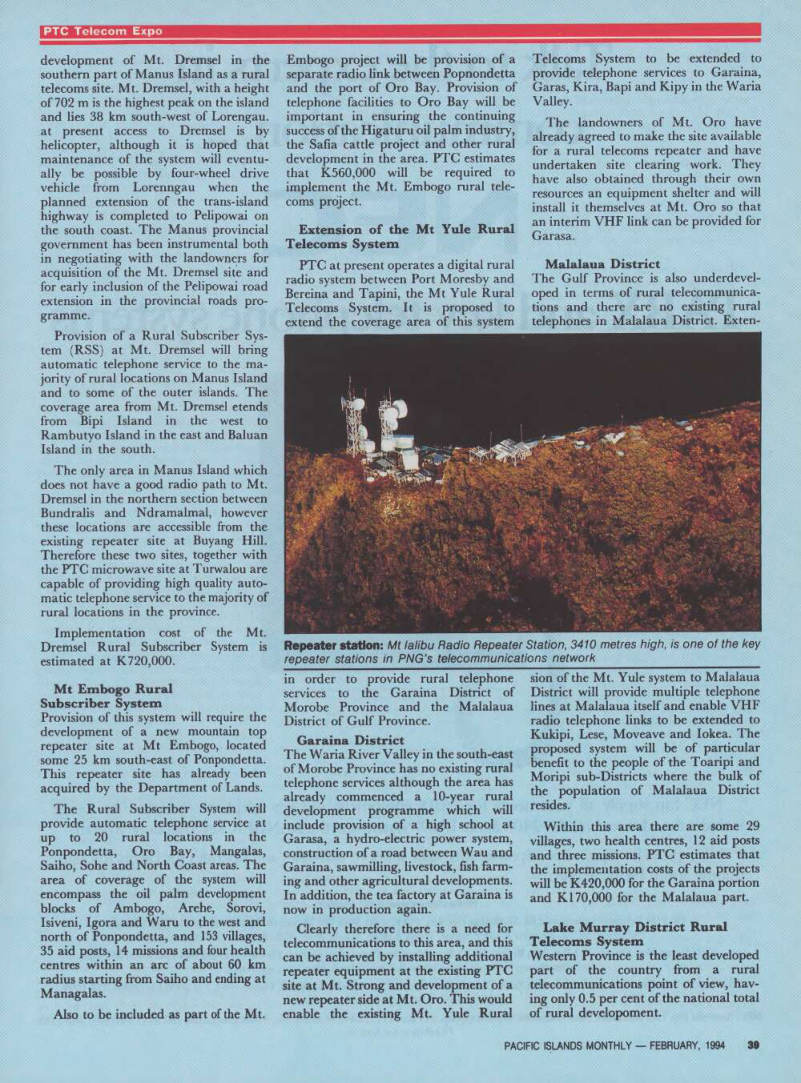
Repeater station: Mt lalibu Radio Repeater Station, 3410 metres high, is one of the key repeater stations in PNG’s telecommunications network
PTC proposes to provide radio bearers from the existing microwave repeater site at Mt Karoma to Lake Murray and Nomad River in the Lake Murray District. The District Office at Lake Murray and sub-District Office at No mad River are the two administrative centres for the Lake Murray District, and are responsible for the administration of 109 villages, seven health centres, 11 aid posts and seven missions.
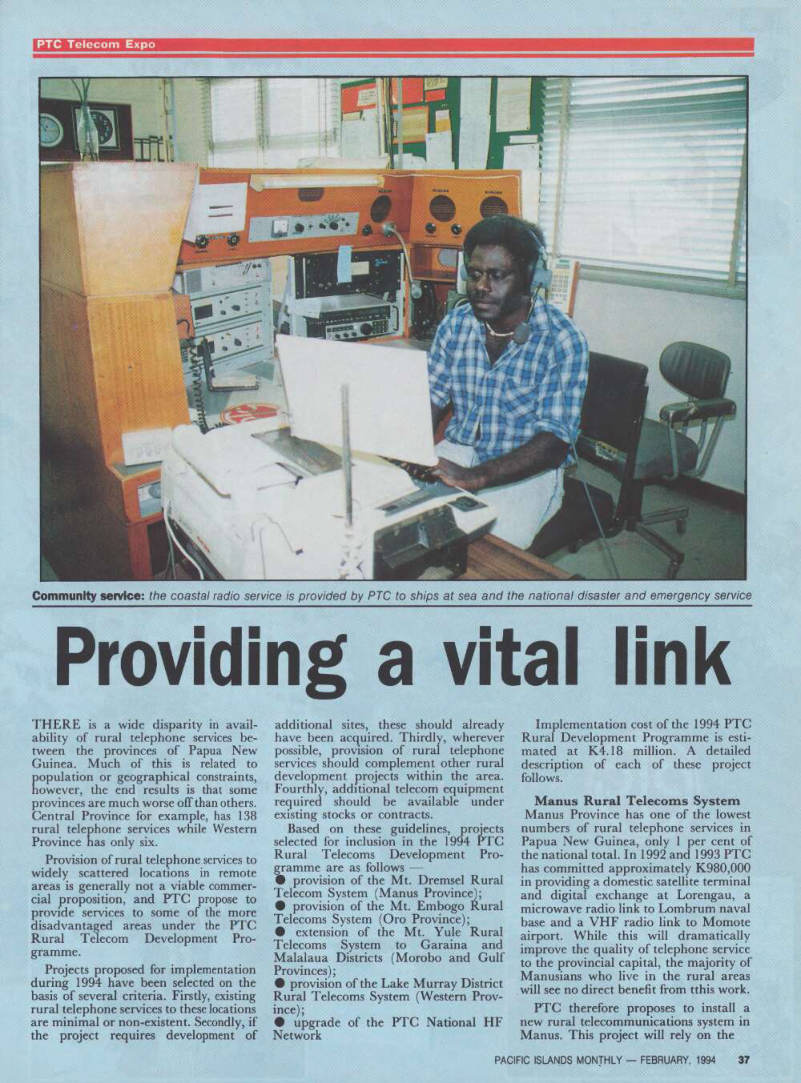
Upgrade of the PTC National HF Network The PTC HF Outstation Radio Service (ORS) and the HF Coastal Radio Service (CRS) are manual telecommuni cations services to rural subscribers and ships in isolated and island areas which cannot be provided with any other means of automatic telecommunications at a reasonable cost. The ORS is a very important service to the people it serves because they are usually very small communities and it is their only means of seeking medical advice, assistance in times of adversity, organising business, transportation (usually by air or sea) or providing contact with the outside world.
Users of the service comprise govern ment departments such as administra tion centres, health centres, schools and postal agencies (which also provide public telephone facilities for the area), as well as private business, plantations and individuals. Seventy-five per cent of the outstation traffic is generated from government stations.
The coastal shipping industry services the coastal and island rural areas, providing transport for people and produce to and from the urban areas.
Coastal shipping is essential for the rural development of the coastal provinces and coastal vessels depend on an efficient HF Coastal Radio Service for commercial operations and safety of life at sea.
PTC operates ORS base stations in the major centres of Port Moresby, Daru, Alotau, Lae, Goroka, Madang, Wewak and Rabaul and CRS bases at Port Moresby and Rabaul with an additional slave station at Wewak.
In the past PTC has also provided and maintained government outstations but because of the costs involved, this will now become the subscriber’s responsibil ity to purchase the equipment from communication equipment suppliers.
The upgraded service will depend on a reduced number of base centres with Port Moresby being the main centre handling all nationwide ORS and CRS traffic after hours. Coastal ships will use the bases at Port Moresby and Rabaul during business hours with an additional facility at Wewak for emergency traffic The ORS base centres at Wewak, Alotau and Rabaul will handle the high density business hours traffic for their respective areas and Port Moresby will provide the centre for traffic on the southern, central and western areas of the country.
Outstations nationwide will be equipped with suitable Port Moresby frequencies to cater for all their traffic outside
business hours. The after-hours service will be equipped with selective calling to increase the efficiency of the service.
Lae, Goroka, Madang and Daru subscribers will be encouraged to change to the Wewak of Port Moresby base centre. The HF service does not provide profit to PTC and is operated as a Community Service Obligation, it’s vital necessity to the rural sector being well recognised. The service returns minimal revenue which does not meet operating costs and, because of this, the equipment at the base stations has not been renewed for many years. Several of the CRS transmitters still in use date back to the 19505. Today the service quality is very poor and, in some cases, unreliable.
The revenue received in 1992 from the ORS traffic was K 155,000 and from the CRS was K 160,000.
Action Required Port Moresby Transmitters The Port Moresby transmitters are located at the HF transmitting station at five miles in Boroko. The National Capital District Commission have been asking PTC to move the station for many years. Due to the developments in the area over the past 30 years, the site is no longer suitable as an HF transmitting station. The area of land remaining is too small to upgrade to provide the required number of services and the radio inter ference to surrounding residences is unacceptable. The Port Moresby trans mitting station has to be relocated to a new site that has been selected at Mountain View Estate, near Mt Lawes on the Brown River Road. The site will contain the transmitters for both outstation radio and the coastal radio so the building and civil costs are common to both services.
The cost of relocating the HF trans mitting station is estimated at K 1.2 million.
Port Moresby Operators Centre The operators centre for Port Moresby is now located in the old Boroko exchange for outstation radio and at the back of Jackson’s Airport for the coastal radio.
Security problems prevent the staffing of the CRS during the night.
A new combined 24 hour operating centre is required to be provided in the PTC Haus Technology complex at four Mile, near the new Boroko exchange.
The cost of the new operating centre is estimated at K 500,000.
Port Moresby Receiving Station This station requires upgrading of antennae, installation of additional re ceivers and removal of operators con soles. The cost of the work to be carried out is estimated at K 50,000.
Upgrading Rabaul, Wewak and Alotau Minimal upgrading of transmitters, re ceivers, antennae and operators consoles at the three sites needs to be carried out an estimated cost of K 250,000.
Summary PTC believes that provision of rural telecommunications is essential to the overall development of the rural areas.
Without telecommunications, progress in government administration, law and order, health and education services, commerce and agricultural projects will be slow. On the other hand, availability of rural telecommunications will boost the implementation and efficiency of these services, and an improvement in the quality of life in the rural areas will tend to reduce urban drift which will be of overall benefit to Papua New Guinea.
In the cast of outstation HF, its ability to operate anywhere within PNG with low cost subscriber equipment and to be rapidly deployed enables it to be used for emergency restoration of telecommuni cations following natural disasters. In times of trouble, national security may depend on HF radio to provide vital communication links. The effectiveness of HF radio as a communications resource is, however, dependant on replacement of the existing old and unreliable base station equipment with modern transmitters and receivers.
In many years PTC has the solutions for provision of rural telecom systems, however because of the isolation of these areas and the expense of installing and maintaining remote repeater sites with a very low return, these projects do not meet the standard criteria for commer
cial viability.
The PTC Rural Development Pro gramme therefore aims to redress the imbalance in rural telecommunications, and PTC proposes to submit to the NEC an annual programme of non commercially viable rural telecom proj ects, concentrating initially on the most disadvantaged areas. Estimated costs for implementation of the 1994 programme total K 4.18 million. □
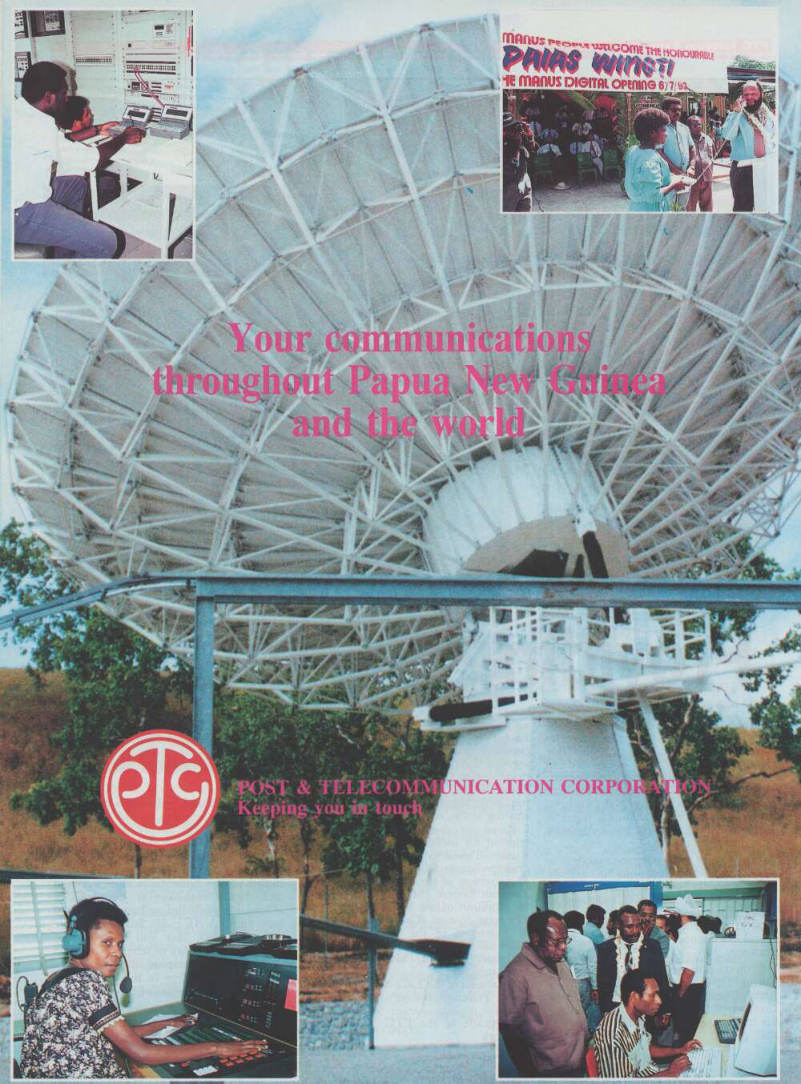
Check: Michael Yandit, satellite technician carries out checks on TV equipment on the full DOMSAT system