An uphill battle
p. 33 · Read in the full issue
After years of easy
bounty, Guam has
today arrived at a
point of introspection
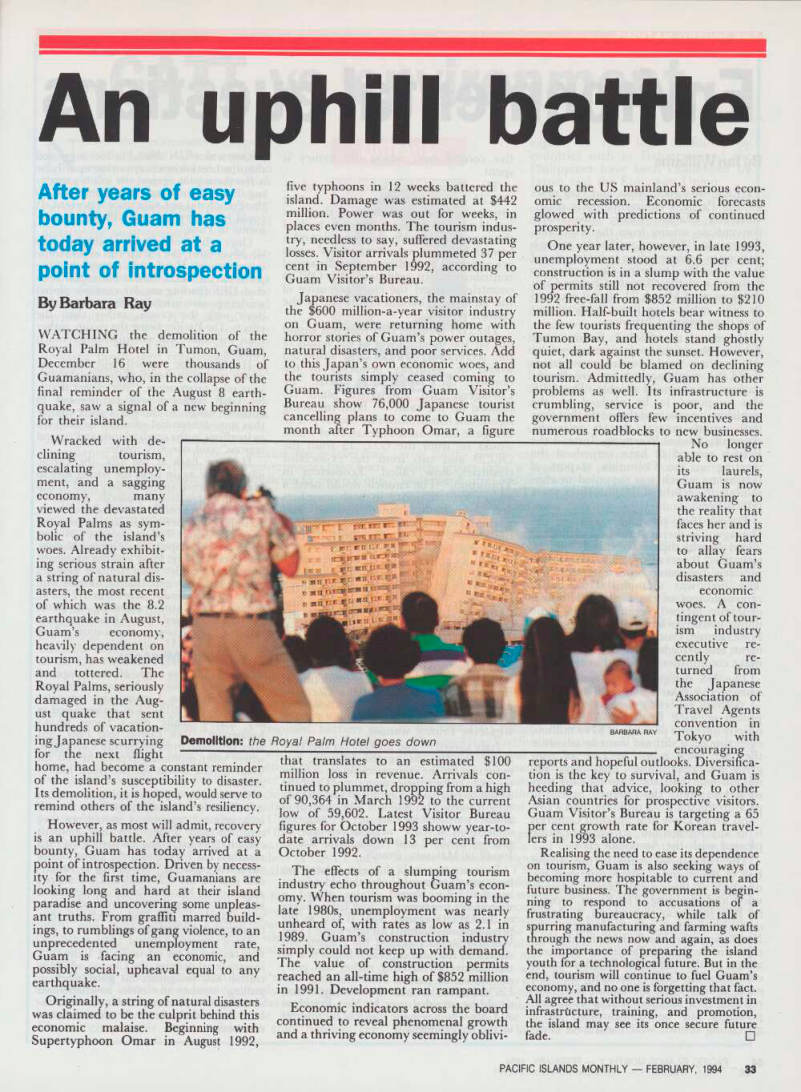
By Barbara Ray WATCHING the demolition of the Royal Palm Hotel in Turnon, Guam, December 16 were thousands of Guamanians, who, in the collapse of the final reminder of the August 8 earth quake, saw a signal of a new beginning for their island.
Wracked with de clining tourism,
escalating unemploy
ment, and a sagging economy, many viewed the devastated Royal Palms as sym bolic of the island’s woes. Already exhibit ing serious strain after a string of natural dis asters, the most recent of which was the 8.2 earthquake in August, Guam’s economy, heavily dependent on tourism, has weakened and tottered. The Royal Palms, seriously damaged in the Aug ust quake that sent hundreds of vacation ing Japanese scurrying for the next flight
home, had become a constant reminder of the island’s susceptibility to disaster.
Its demolition, it is hoped, would serve to remind others of the island’s resiliency.
However, as most will admit, recovery is an uphill battle. After years of easy bounty, Guam has today arrived at a
point of introspection. Driven by necess
ity for the first time, Guamanians are looking long and hard at their island paradise and uncovering some unpleas ant truths. From graffiti marred build ings, to rumblings of gang violence, to an unprecedented unemployment rate, Guam is facing an economic, and possibly social, upheaval equal to any
earthquake.
Originally, a string of natural disasters was claimed to be the culprit behind this economic malaise. Beginning with Supertyphoon Omar in August 1992,
five typhoons in 12 weeks battered the island. Damage was estimated at $442 million. Power was out for weeks, in places even months. The tourism indus try, needless to say, suffered devastating losses. Visitor arrivals plummeted 37 per cent in September 1992, according to Guam Visitor’s Bureau.
Japanese vacationers, the mainstay of the $6OO million-a-year visitor industry on Guam, were returning home with horror stories of Guam’s power outages, natural disasters, and poor services. Add to this Japan’s own economic woes, and the tourists simply ceased coming to Guam. Figures from Guam Visitor’s Bureau show 76,000 Japanese tourist cancelling plans to come to Guam the month after Typhoon Omar, a figure
that translates to an estimated $lOO million loss in revenue. Arrivals con tinued to plummet, dropping from a high of 90,364 in March 1992 to the current low of 59,602. Latest Visitor Bureau figures for October 1993 showw year-to date arrivals down 13 per cent from October 1992.
The effects of a slumping tourism industry echo throughout Guam’s econ omy. When tourism was booming in the late 1980 s, unemployment was nearly unheard of, with rates as low as 2.1 in 1989. Guam’s construction industry simply could not keep up with demand.
The value of construction permits reached an all-time high of $852 million in 1991. Development ran rampant.
Economic indicators across the board continued to reveal phenomenal growth and a thriving economy seemingly oblivi
ous to the US mainland’s serious econ omic recession. Economic forecasts glowed with predictions of continued prosperity.
One year later, however, in late 1993, unemployment stood at 6.6 per cent; construction is in a slump with the value of permits still not recovered from the 1992 free-fall from $852 million to $2lO million. Half-built hotels bear witness to the few tourists frequenting the shops of Turnon Bay, and hotels stand ghostly quiet, dark against the sunset. However, not all could be blamed on declining tourism. Admittedly, Guam has other problems as well. Its infrastructure is crumbling, service is poor, and the government offers few incentives and numerous roadblocks to new businesses.
No longer able to rest on its laurels, Guam is now awakening to the reality that faces her and is striving hard to allay fears about Guam’s disasters and economic woes. A con tingent of tour ism industry executive re cently re turned from
the Japanese
Association of Travel Agents convention in Tokyo with encouraging
reports and hopeful outlooks. Diversifica tion is the key to survival, and Guam is
heeding that advice, looking to other
Asian countries for prospective visitors.
Guam Visitor’s Bureau is targeting a 65 per cent growth rate for Korean travel lers in 1993 alone.
Realising the need to ease its dependence on tourism, Guam is also seeking ways of becoming more hospitable to current and future business. The government is begin ning to respond to accusations of a frustrating bureaucracy, while talk of
spurring manufacturing and farming wafts
through the news now and again, as does the importance of preparing the island youth for a technological future. But in the end, tourism will continue to fuel Guam’s economy, and no one is forgetting that fact.
All agree that without serious investment in infrastructure, training, and promotion, the island may see its once secure future fade. □
Barbara Ray
Demolition: the Royal Palm Hotel goes down