Political hope
p. 32 · Read in the full issue
Guam
Political hope lingers on
By Barbara Ray
THE future political status of Guam is once again on the minds of island residents with the December 9 visit of I. Michael Heyman, the Clinton ad ministration’s representative in the Commonwealth Act talks.
Heyman, former chancellor of the University of California, was appointed by Interior Secretary Babbit to move the talks on commonwealth status forward into congress. After three days of infor mal political meetings and numerous tours, Heyman departed for Washington optimistic that a Bill could land before congress by the end of 1994.
He may be too optimistic. The history of the Commonwealth Act has been fraught with difficulties. The Act has languished for much of the 1980 s in negotiations between the Guam Com mission on Self-Determination and the Bush administration’s Committee on Interior and Insular Affairs. At one point, 10 of the 12 articles in the Act were points of contention.
While the new administration has made considerable progress on the public relations level Heyman was the first Washington representative to visit Guam the expected stubling blocks remain self-determination and control over internal affairs.
The impetus for commonwealth status began in 1979 when voters opposed a federally authorised constitution that did not address self-government. By 1982, the people of Guam had voted in a plebiscite to pursue commonwealth status, and by 1984, a law was on the books (P.L. 17-42) that mandated a draft of federal-territorial relations be submit ted to Congress.
Drafts were proposed and presented, and in 1989 a final draft was presented to the Committee on Interior and Insular Affairs. A congressional hearing was held in Hawaii to hash out compromises between the Bush task force and the Guam committee. The difference, how ever, could not be readily resolved.
Another issue, not
of equity but of
power, is the federal
govt’s unwillingness
to relinquish control
of the island
The main issue then, as it is today, was the Commonwealth stipulation that only Chamorros or residents of Guam since 1950 could vote on the resolution. The position on self-determination adopted by the Guam delegation was founded on a United Nations charter entitled, Declar
ation Regarding Non-Self-Governing Terri
tories. That charter provided the basis to limit the exercise of self-government to those inhabitants of Guam at the time of adoption of the UN Charter in 1950.
“To allow other inhabitants who have moved to Guam since 1950 to participate would dilute Chamorro self
determination,” notes a report from the Commission on Self-Determination.
The Commission argued further that a 1981 study, Special Rapporteur of the Sub- Committee on the Prevention of Discrimination and Protection of Minorities, supported this position in its suggestion that for the purpose of self-definition, the term “people” should apply to “peoples occu pying a geographical area which, in the absence of foreign domination would have formed an independent state.”
With nearly 20 per cent of Guam’s population US mainlanders, whose right to vote is a Constitutional guarantee, and another 33 per cent non-Chamorro residents, this mandate poses difficulties.
As Heyman noted in his departing remarks, “it becomes a question of equity and equality”.
Another issue, not of equity but of power, is the federal government’s un willingness to relinquish control of the island.
The Bush administration in 1989 staunchly opposed the mandate that current federal laws that pertain to Guam, for example, laws on trade and immigration, be reviewed and, if necess ary, modified to reflect Guam’s unique situation.
The Bush administration also opposed extending the Tenth Amendment to the US Constitution to include Guam, as proposed under Article II of the Com monwealth Act. The Tenth Amendment states that “the powers not delegated to the United States by the constitution, nor prohibited by it to the States, are reserved to the States respectively, or to the people.”
The extension of the Tenth Amend ment to Guam effectively limits Con gress’ powers over Guam’s internal affairs. Although not explicitly stated, another purpose of Article II of the act is to void Congress’ authority under Article IV of the US Constitution, better known as the Territories Clause. That clause gives congress the power to “make all needful rules and regulations respect ing the territory ... belonging to the United States”.
As the last remaining strategic outpost of the United States in the Pacific, it is unlikely that the US government will readily relinquish control over Guam.
Whether compromises can be worked out with an apparently more receptive Democratic administration remains to be seen. In the end, it is not a question of what Guam wants as much as it is a question of what the United States wants. As an editorial in the Pacific Daily News noted, “it would be nice for Washington to leave us completely alone and just send us money ... but it doesn’t work that way”. □
Barbara Ray
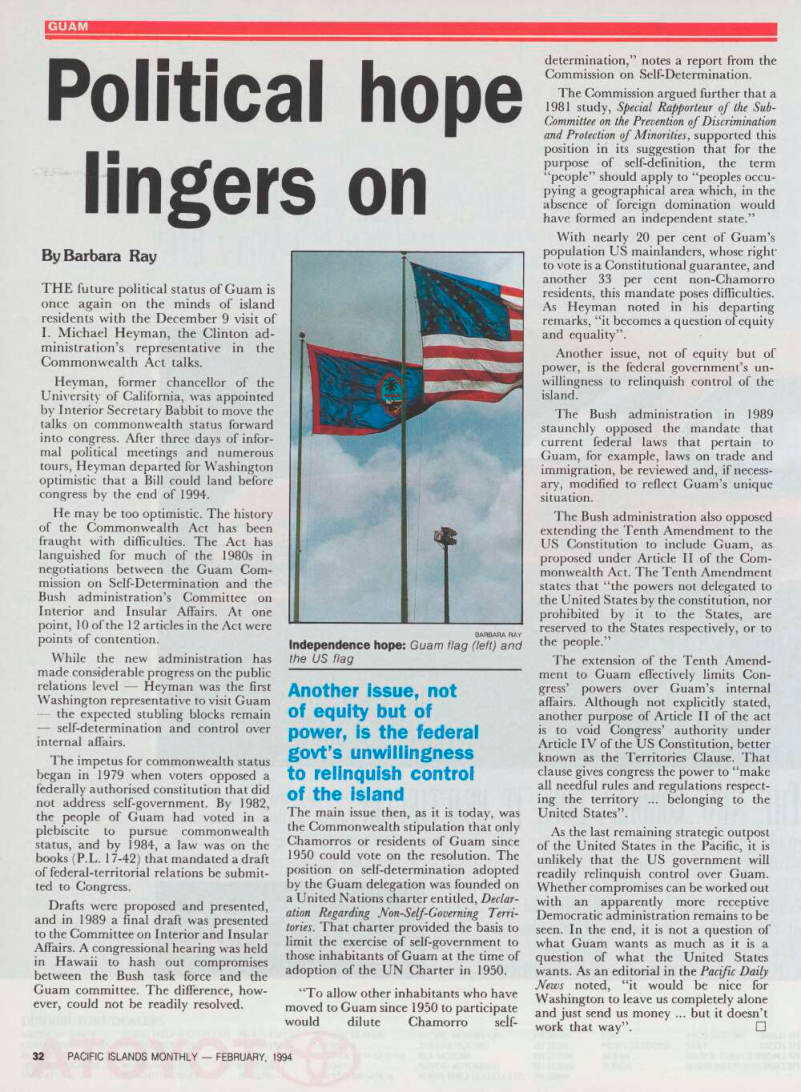
Independence hope: Guam flag (left) and the US flag