The cross & the gospel
p. 23 · Read in the full issue
[Religion
ON December 20, 1843, the French
warship Bucephale dropped anchor on the
north east coast of New Caledonia. She had left the French harbour of Toulon, in the Mediterranean sea, eight months before. Several officers, sailors and five missionaries landed on the shore of this island, named “New Caledonia” some 67 years earlier by James Cook, the first European who had sailed in this part of
the world.(l)
Contacts were made with the chief of the local tribe, named Paima. Five days later, it was Christmas. The Marist
missionary, Guillaume Douarre (Bishop
of Amata since October 1842), Philippe Viard, Pierre Rougeyron, Balise
Marmoiton and Jean Tarangnat, aged
from 26 to 35, celebrated the first Catholic Mass under a big banyan tree on the Mahamata beach, near what was going to be the village of Pouebo. Several natives, impressed with the rolls of the drums, attended, along with the crew.
Hard times were ahead for these five young missionaries. After the French warship left on January 20, they chopped wood, grew vegetables, built huts and a chapel, learned the language of the tribes
nearby and gradually tried too evangel
ise the “natives” to turn them into Christians.
They suffered from hunger, diseases, their food was stolen several times. In January 1847, the mission was attacked and burnt by angry tribespeople. Balise Marmoiton was killed and beheaded. His four companions ran away and were saved by another French Warship, La Bri/lante, which happened to be passing by.
They fled to Sydney, then made several attempts to come back between 1948 to 1950 in the south of the island and on the isle of Pines. Finally, in 1851, they were able to settle again in this part of the island. Douarre died from the plague in 1853 (the year Napoleon HI ordered Admiral Febvrier-Despointes to take possession of New Caledonia in the name of France). His remain were buries in balade, then, in 1881, the church of Pouebo.
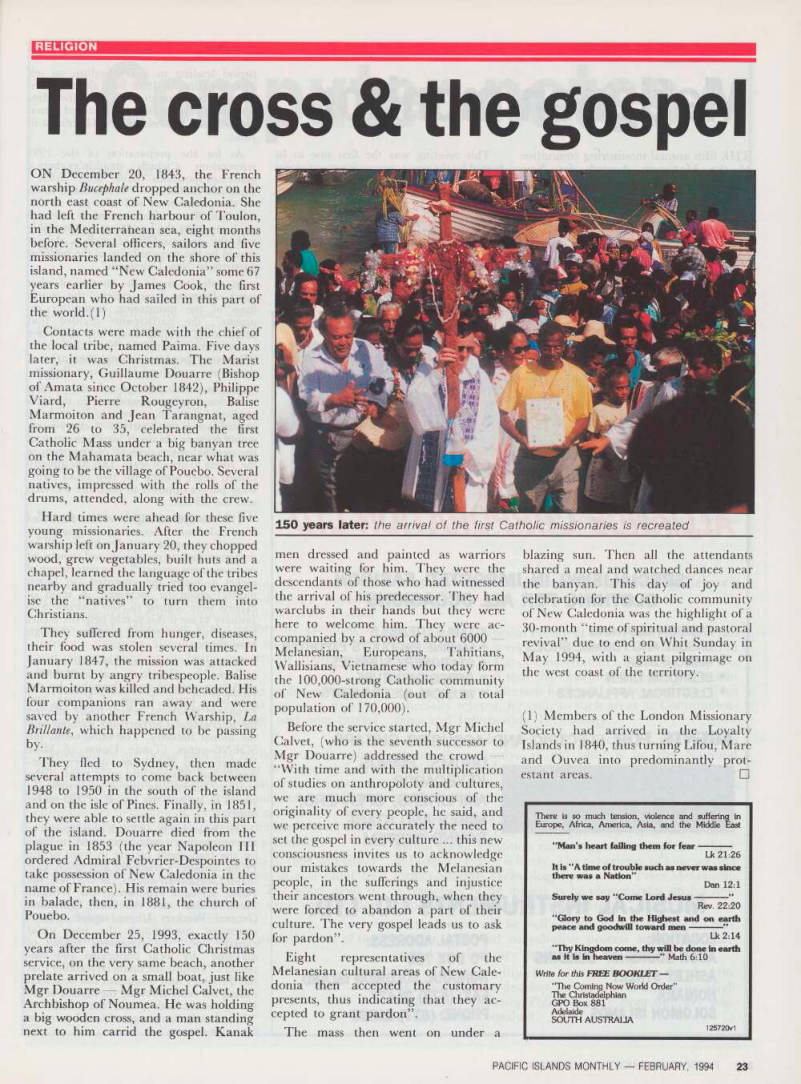
On December 25, 1993, exactly 150 years after the first Catholic Christmas service, on the very same beach, another prelate arrived on a small boat, just like
Mgr Douarre Mgr Michel Calvet, the
Archbishop of Noumea. He was holding a big wooden cross, and a man standing next to him carrid the gospel. Kanak
men dressed and painted as warriors were waiting for him. They were the descendants of those who had witnessed the arrival of his predecessor. They had warclubs in their hands but they were here to welcome him. They were ac companied by a crowd of about 6000 Melanesian, Europeans, Tahitians, Wallisians, Vietnamese who today form
the 100,000-strong Catholic community
of New Caledonia (out of a total
population of 170,000).
Before the service started, Mgr Michel Calvet, (who is the seventh successor to Mgr Douarre) addressed the crowd - “With time and with the multiplication of studies on anthropoloty and cultures, we are much more conscious of the originality of every people, he said, and we perceive more accurately the need to set the gospel in every culture ... this new consciousness invites us to acknowledge our mistakes towards the Melanesian
people, in the sufferings and injustice
their ancestors went through, when they were forced to abandon a part of their culture. The very gospel leads us to ask
for pardon”.
Eight representatives of the
Melanesian cultural areas of New Cale donia then accepted the customary presents, thus indicating that they ac cepted to grant pardon”.
The mass then went on under a
blazing sun. Then all the attendants shared a meal and watched dances near the banyan. This day of joy and celebration for the Catholic community of New Caledonia was the highlight of a 30-month ‘"time of spiritual and pastoral revival” due to end on Whit Sunday in May 1994, with a giant pilgrimage on the west coast of the territory. (1) Members of the London Missionary Society had arrived in the Loyalty Islands in 1840, thus turning Lifou, Mare and Ouvea into predominantly prot estant areas. □
150 years later: the arrival of the first Catholic missionaries is recreated