Hawaiian lands
pp. 20-21 · Read in the full issue
Hawaii
Hawaiian lands Hawaiian hands
Hawaii Tourism Congress raises disturbing questions
By Ed Rampell
CARRYING picket signs and
chanting “Keep Hawaiian Lands
In Hawaiian Hands,” 30 natives march into Hawaii’s Tourism Congress at the Sheraton Waikiki. Up to 500 delegates from as far away as Manila and Washington watch as Bumpy Kanahele leads Ghana Council activities, wearing black shirts bearing their group’s name and the word “security,” to the front of the hotel ballroom. Nestor Garcia, an ex newscaster who works for US Senator
Daniel Inouye, explains to the surprised
government and visitor industry rep resentatives “This is not a real, unscheduled demonstration it’s a
teaching tool.”
Garcia then conducts a mock interview about Hawaiian sovereignty with Bumpy.
The ex-con tells the tourism delegates about his criminal record and, “Some thing’s going to creep up into your life soon.
Sovereignty is full autonomy over land and natural resources ... A wrong was done ...
In 1959 our international rights were wronged ... Imagine if you own lands you thought were bought legally from the state [and Natives contest it] ... ‘Aloha spirit’ can’t be confused with service. You can’t sell Aloha Spirit without the main ingredi ents. us. You’re lucky Hawaiians have not shut Waikiki down ...”
But instead of shutting down the tourism
overdevelopment juggernaut an outspoken
advocate of independence sits down as a co panelist of the Hawaiian Culture Task Force of the Tourism Congress. This is the first time in nine years that the Hawaii Visitors Bureau (HBV) and the state Department of Business, Economic Devel opment & Tourism (DBEDT) convenes the Congress. According to DBEDT director Mufi Hannemann the purpose of the December 14-15, 1993 Tourism Congress is to look into “What to do to bring about a tourism recovery? ... This Congress is a very definite call to action” to reverse the drastic decline in Hawaii’s top industry.
At the core of restrategising Hawaii’s sagging tourism is a new approach to indigenous people. The Hawaiian Culture panel is the first of six task forces to address the congress. Nalani Olds opens the congress with a Polynesian creation chant and Hawaiian immersion students (who learn in the Native language) speak in
Hawaiian through an interpreter.
Governor John Waihee notes “There’s a change in the travelling public’s attitudes towards culture and environment.”
Waihee, Hannemann, and others observe that sun, sand, sea, and skin are no longer enough to lure tourists to Hawaii, since these elements are available at many destinations. Increasing sophistication means many no longer are content to be beach potatoes annd seek eco-tourism, adventure travel, and cultural tourism.
Waihee pronounces “The travel industry must recognise it operates within the framework of a larger community ...
The industry must move away from exploitation to collaboration ...Just as the industry moved away from cellophane leis it must move away from cellophane aloha.”
Waihee warns not doing so could lead to
tourism’s worst nightmare “negative
local reactions to tourists, like at Florida,” where a murder spree has led to countries like Germany issuing travel advisories regarding American’s other sub-tropical
playground.
After speeches by Hannemann, HVB president Tom Sakata, Waihee, and the mock demo, the Hawaiian Culture Task Force kicks off panel discussions. DJ/Ohana Council member laukea Bright says at hotel gift shops he “saw products with Hawaii logos but are made in Japan, Hong
Kong, Korea, and China.” He decries the use of postcards featuring bare bums “We have a sense of humor but we don’t want this to be the dominant image of Hawaii ... Where do benefits from products go? Use local stuff first.”
Co-panelist Nestor Garcia, of Filipino ancestry, continues with an audio-visual presentation “Sexy postcards have an offensive overuse of skin to promote Hawaii.” “We want to see the use of more Native models. Get away from emphasizing golf courses and other manicured proper ties. Stimulate mail order of Hawaiian products and send Hawaiian arts troupes around to promote Hawaii.”
After the Hawaiian Culture Task Force’s presentation, the
panel takes questions
written on index cards, selected by and filtered through a committee. When asked about other eth nic groups, the Office of Hawaiian Affairs’
Linda Colburn points out “This is the
only place where we
can be Hawaiian and home.” Bumpy de clares: “Recognise the first culture here.”
Harvard-educated Mufi Hannemann of
Samoan background
closes the first session ,‘T took heat for reaching out to Ghana Council, and so did they come un
der scrutiny by the
sovereignty move
ment.” Indeed, the
foray of Ghana Council’s “Daniel” into tourism’s “lions’ den” highlights the grow ing schism in the sovereignty movement, and has detractors charging Ghana Coun cil consorting with the enemy.
Hannemann responds to accusations the Council is being co-opted and selling out “Obviously it’s a new experience for Ghana Council to be asked to be part of a dialogue with the industry. Why should they go to Waikiki? Reaching out is a gamble. What if there’s a massive demonstration and the rhetoric is out of control? Other Congress organizers said can’t we just ask the Polynesian Cultural Center or Bishop Museum instead...
As for co-optation we’re just trying to deal with reality, 10 to 15 years ago you could ignore sovereignty. But with the 100th anniversary of the overthrow, it’s absolutely appropriate. We’re trying to head off a Florida-type situation...”
Politics and violence damage and even destroy tourism at numerous destinations besides Florida Fiji’s coups were a set back; Sri Lanka is no longer a tourist Nirvana due to the kind of ethnic violence that now devastates former Yugoslavia, where the Adriatic Coast was once a sun worshipper mecca. The private and public powers that be in Hawaii, with so much
hinging on already suffering tourism, look
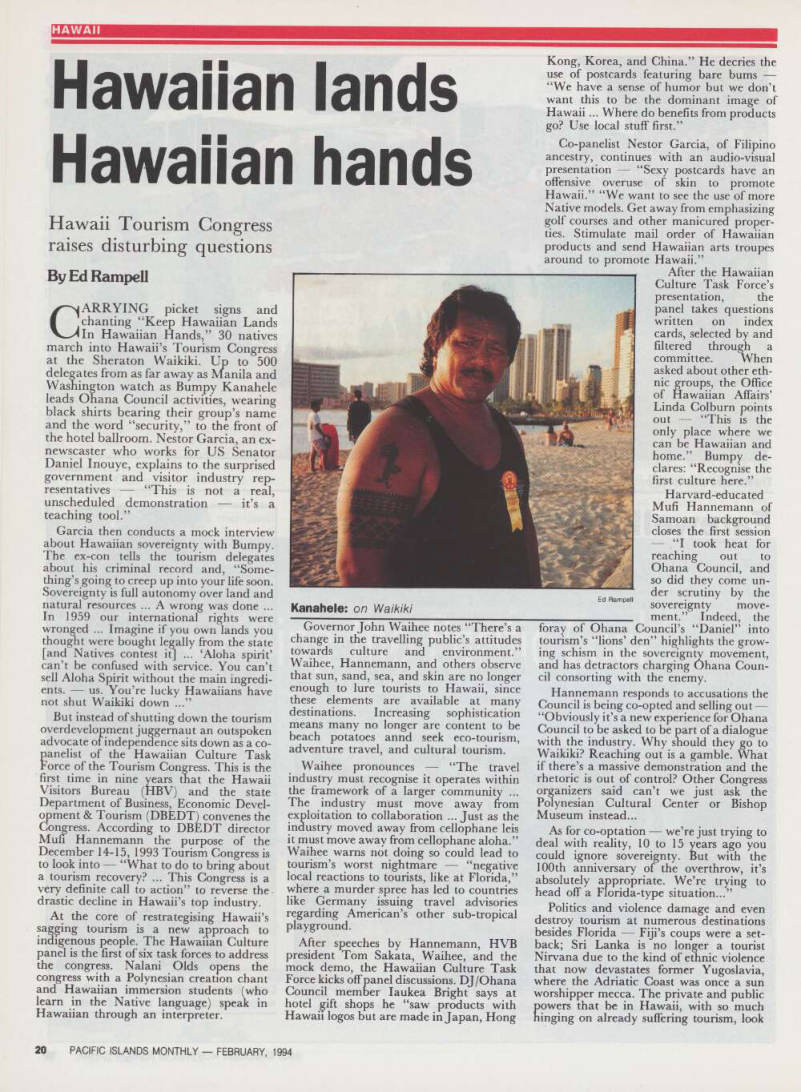
Kanahele: on Waikiki
Ed Rampell
at the Hawaiian sovereignty movement apprehensively. What if the wild card of Hawaii politics goes wild? What if the landless, restless natives take their griev ances into the streets and really do shut Waikiki down? Enter Ghana Council, a group with a history of land occupations and about 200 adherents advocating inde pendence. Led by a man who speaks of his '‘criminal background,” the Council says its represented by a PLO attorney and invites Black Muslim Louis Farrakhan to speak. Actions such as participating in the
tourism Congress and possibly providing it
with security, has sovereignty leaders asking, is Ghana Council for real?
Dr Kekuni Blaisdell, head of the Pro-
Hawaiian Sovereignty Working Group -
which led a real demonstration against the Congress, calling for a tourism boycott contends “Ghana Council gets selective treatment by the state. Attorney Mililani Trask, governor of ka LaHui Hawaii, the Sovereign Hawaiian Nation, which claims to be the biggest sovereignty group with more than 18,000 enrolled “citizens,” cites examples of apparent Council collabor ation. “Other sovereignty groups were not invited to the Tourism Congress; Ka LaHui advocates giving Waikiki back to the Hawaiian. Ghana Council has a close working relationship with the state. In late 1992, the Council had a meeting with state representatives, union leaders, Samoan chiefs, and an alleged underworld figure, and cut a deal, Ghana Council will work with the state if they get land.
Ka LaHui refuses to cooperate with the state in any way, like sitting on the
sovereignty advisory commission most
other groups participate with, leading to charges of sectarianism or praise for being principled. Ghana Council sees things differently. Nathan Brown, a Council
international law researcher,says “They
feel we’re compromising. But we’re trying to educate them - the community as a whole, including the tourism industry. If you continue to have separation, nothing will be done.” Council media liaison Rolf Nordahl denies the allegation that they met with the alleged organised crime figure. But Council leader Kawehi Gill responds to the accusation by saying “So?” “No one has approached the hierarchy in the manner we have - they know we’re a danger. Going on the offensive, Gill asserts,“The problem with Mililani and Ka LaHui is they’re history. We’re in a new period, we’re
making history...Ka LaHui’s charges are
fear-based because they’re losing a lot of members.”
For years, tourism devastated Hawaiian culture and ecology. Now that Hawaii’s economy is as endangered a species as natives, the very forces that displaced Hawaiians are turning to them to save tourism. Fearful a sovereign Hawaiian movement and nation could create political upheavals dealing death blows to HVB
promoted “paradise” images and destroy
tourism, is the state trying to take over the cause? Or does the state and industry genuinely want Hawaiians to benefit from tourism? Are Mufi Hannemann and Waihee velvet gloves of colonialism or farsighted enlightened leaders? Is Ghana Council for sovereignty or for sale?
Will the real Hawaiian sovereignty activists please stand up! □