end of the alphabet
pp. 15-16 · Read in the full issue
Business
Z-not just the end of the alphabet
By Roman Grynberg
UNLESS you are in the tuna business the letter Z is just the end of the alphabet but to those who know the business, Z Fishing is the largest purse-seining com pany in the US and is responsible for 100,000 tonne catch per annum or about 8 per cent of the world’s tuna. The new cannery about to be opened by the company in Madang Province in PNG represents a major shift in focus for the fishing company into down stream pro cessing and it will mark a very important step in the maturing of the PNG economy as it develops export markets for fully processed raw materials.
For all the talk downstream, process ing the cannery represents a major movement from an industry where the product never even touched the shores of PNG to full integration.
To establish a cannery in a relatively high cost country like PNG is by no means an obvious business venture and so I asked Lawrence Zaunich, the president of Z Fishing and son of the founder of the fishing giant why. “I am in this because I want my own cannery because Thailand was simply controlling the trade. To be quite frank with you PNG was last on my list.” So why PNG?
Zaunich went through the list of potential locations. “FSM no water, Kiribati no water, Western Samoa no fish, Vanuatu wages too high, Solomon Islands had no oil storage.
What PNG has is water and in normal fishing years about 40 per cent of the region’s tuna.”
The Z cannery will be located in Alexishafen and will be paying wages of about K 27 per fortnight. The 1992 minimum wage decision which elimin ated the rural/urban wage differential and thereby effectively cut urban mini mum wages in quarter, would not have effected the company as it is already located in a rural area. The cannery will work on a two-shift basis with 1200 workers and will be moving 100 tonnes of fish per shift. The real problem with the cannery, as Zaunich admits, is whether it achieves the level of labour productivity that he expects. Tuna canneries in the region have not nor-
mally achieved such high levels of output
and productivity.
This is the beginning of one of the largest investments in the manufacturing sector in the South Pacific for many years. The ground breaking ceremony for the Z cannery at Alexishafen in December was considered to be a major breakthrough for PNG because while PNG has been able to attract some foreign investment into the manufactur ing sector it has only been in cases where the government has been willing to offer high levels of protection. The Z cannery tuna is meant for the export high levels of protection. The Z cannery tuna is meant for the export market and beyond the pioneer industry status which grants tax free status for five years and the right to fish in the PNG territorial sea, there will be need for input from the govern ment.
The project is not only an investment by the Z Fishing but has the backing of some very substantial players. The most prestigious is the International Finance Corporation, an investment arm of the International Monetary Fund which has taken a USD 1 million equity position in
the cannery. It has also provided loans for the venture include the Common
wealth Development Corporation which
has provided US$l million in equity as well US$5 million in debt. There will also be investments by a consortium of
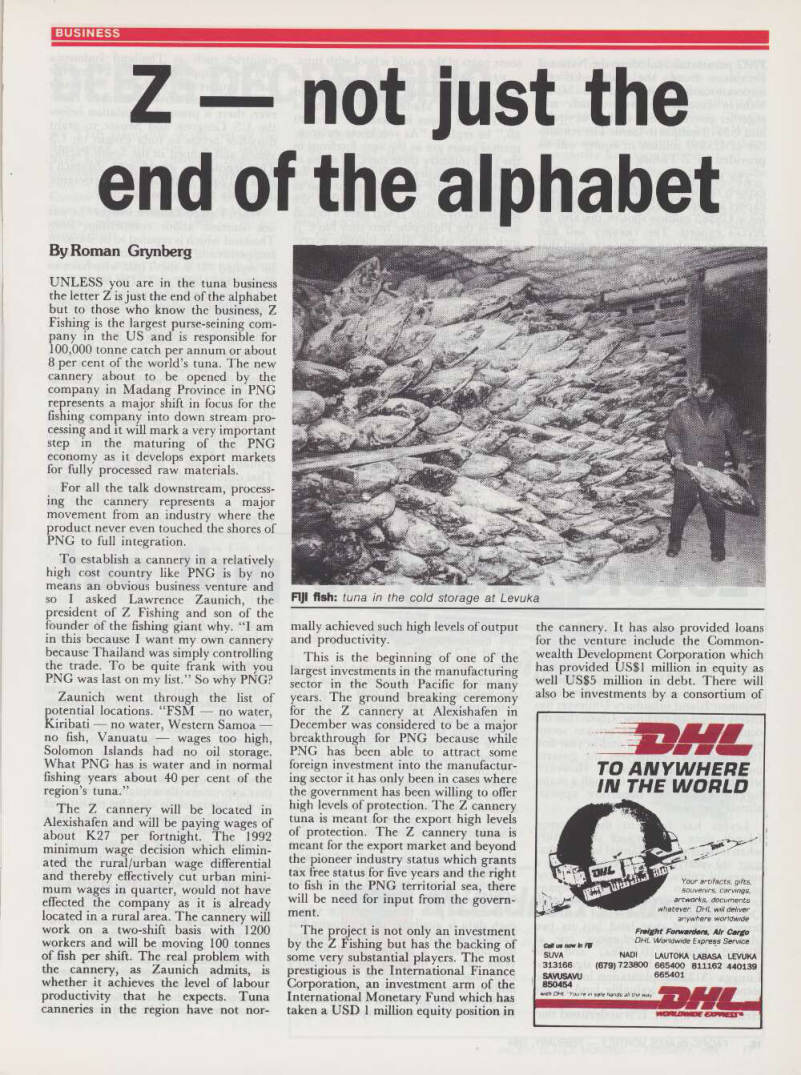
FIJI fish: tuna in the cold storage at Levuka
PNG parastatals including the National Provident Fund, the Public Officers Superannuation fund and the Motor Vehicle Insurance Trust which will together provide US$4 million in equity and US$lO million in loans. The remain der of US$l9 million in equity will be provided by Z Fishing.
The K 55 million project will result in exports of some 3.5 million cases of tuna export at some US$2B per carton making for a US$B5 million shot in the arm for PNG’s exports. The cannery will also have a can making facility attached that will produce cans for James Barnes meat cannery in Madang as well as the Z cannery. John Leahy, of Deloittes in Porrt Moresby which brokered the deal with the government, was delighted and said “This shows that it is possible, despite what is so frequently said to establish a large labour intensive indus tries that uses the country’s natural resources here in PNG and that the government will co-operate”.
The canning of tuna has in the past few years become increasingly associated with environmental pollution as was the case with the canneries in American Samoa. Tuna fishing has also come into its fair share of criticism as it has also become associated with fishing practices that are considered to be dangerous to other species such as dolphins which, in
some parts of the world school with tuna.
PIM asked Zaunich whether we can expect a degradation of the harbour and waters around Madang that are one of PNG’s best hopes for tourism. “Not at all,” he replied. “As you know environ mental issues are at the very forefront in the tuna industry these days. In terms of fishing techniques our companny for example uses 10’ mesh on our nets so as to minimise as much as possible the incidental by-catch. If you have a look at some of the Philippine nets they have '/ 2 inch mesh which drags literally every thing along with the tuna. We moved to the western Pacific in 1981 in part because of the dolphin issue. In the Western Pacific the dolphins do not school with tuna so there is no dolphin issue.”
According to Zaunich the cannery itself will use state of the art technology.
“We will use scrubbers so that as you approach the cannery you will not even be able to smell it. We will be recycling the water through a waste treatment plant which will not result in marine
pollution.”
The canned tuna will be marketed in the UK initially. Under the Lome IV Convention tuna canned in PNG and other African Carribean and Pacific (AGP) states such as the Solomon Islands enters the UK duty free. Tuna from
countries such as Thailand Indonesia and the Philippines attracts a 24 per cent rate of import duty in the EC. As a result this is the most obvious market. How ever, there is presently legislation before the US Congress and Senate to grant duty-free access to tuna caught on US vessels and canned in the South Pacific.
This legislation would give Zaunich’s tuna a 12 per cent margin of preference over tuna that has to pay duty.
When I asked Zaunich whether he was not worried about competition from Thailand which is reputed to be the most competitive of producers in the market he replied “It is the Thais who have to be worried about me”. The boast of an overly confident entrepreneur about to lose his shirt? Not necessarily. One of the main determinants of what makes a canner is how cheaply he gets his fish.
This is the bulk of the cost. Zaunich’s company has one of the most efficient fishing fleets in the world. The fish that the Thais use for canning often comes from PNG waters and often from Z
Fishing Company purseiners. If Zaunich
does not have to pay international prices when the price of tuna is high he may actually be able to put a big dent in the Thai canning industry and in the process propel PNG, formerly just a fee collector in the world tuna market into the big league of tuna canning. □