Solbrew sets up
p. 13 · Read in the full issue
Business
Solbrew sets up niche in Solomons
By Roman Grynberg
FOR years Nauruans have dreamed of having their own brewery but the economics of such a venture on an island where beer and water sell at about the same price was not obvious. Now finally Nauru has a brewery but it is located in Honiara. The Solomon Breweries is joint venture between Nauru and the German brewing giant Brauhaas. The firm is 70 per cent owned by the Nauru government and 30 per cent owned by rauhaas together with other European interest.
The government of Nauru’s invest ment policy has been under much public scrutiny in the last year because of alleged scandals. However, the underly ing economics of the brewery in Honiara are not likely to give Nauru any serious headaches.
The German company Brauhaas is also involved in the Western Samoan brewery that produces Vailima. The introduction of Solbrew is the last link in the region’s chain of breweries and now all major Melanesian and Polynesian countries have their own breweries. The government of the Solomon Islands did not take an equity position in the brewery as it is undertaking a policy of privatisation of its existing assets.
This also makes Solbrew one of the few breweries in the region without some investment by the government. Gener ally speaking governments have either directly or indirectly through their provi dent funds taken positions in these breweries. This is also preferred by the foreign joint venture partner because it means that governments will have even more incentive to give the company a competitive edge over generally much larger importers of beer from Australia and New Zealand.
The brewery which was opened in April, 1993 25 million German Marks, according to the new incoming general manager Rainer Goldbeck. The com pany was granted an eight year tax holiday by the Solomon Islands govern ment. Goldbeck has just recently re placed the original manager Jerry Hope who has retired to live in Western Samoa. The company has a production capacity of 40,000 hectoliters and cur rently employs 100 workers. Solbrew expects that its year end 1993 sales will be in the vicinity of 23,000 hectoliters.
Clearly the firm has a great deal of room for growth.
According to Goldbeck, Solbrew has
already managed to capture 70 per cent of the Solomon Islands market. Import ers of Carlton and United Breweries products, which before Solbrew had, in 1991 almost 80 per cent of the Solomon islands market did not wish to comment on whether the claim was true.
In Honiara it is difficult to ascertain whether such claims are correct or not but the beer certainly has won the hearts of Solomon Islandenrs who, despite the Nauruan ownership, have taken to it with a nationalist fervour that would certainly be the envy of neighboring Vanuatu Breweries which has not been able to attract as much brand loyalty as Solbrew though it has definitely im proved its position with the introduction of Vanuatu Bitter.
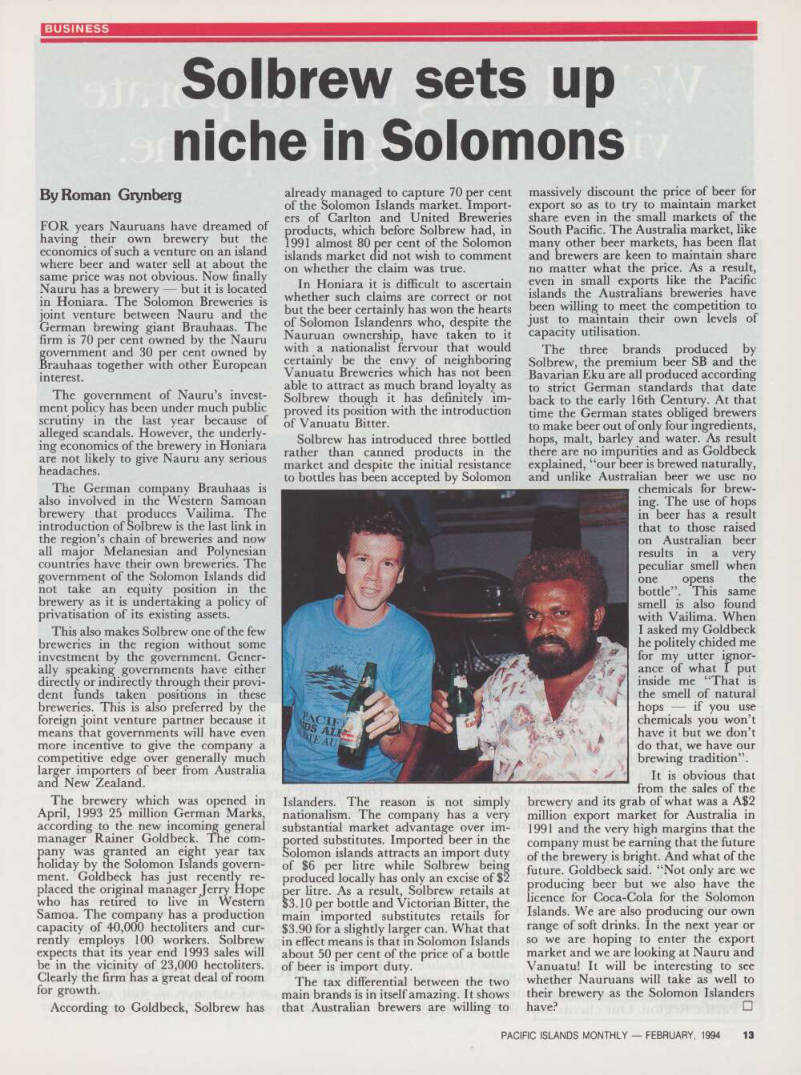
Solbrew has introduced three bottled rather than canned products in the market and despite the initial resistance to bottles has been accepted by Solomon
Islanders. The reason is not simply nationalism. The company has a very substantial market advantage over im gorted substitutes. Imported beer in the olomon islands attracts an import duty of $6 per litre while Solbrew being produced locally has only an excise of $2 per litre. As a result, Solbrew retails at $3.10 per bottle and Victorian Bitter, the main imported substitutes retails for $3.90 for a slightly larger can. What that in effect means is that in Solomon Islands about 50 per cent of the price of a bottle of beer is import duty.
The tax differential between the two main brands is in itself amazing. It shows that Australian brewers are willing to
massively discount the price of beer for export so as to try to maintain market share even in the small markets of the South Pacific. The Australia market, like many other beer markets, has been flat and brewers are keen to maintain share no matter what the price. As a result, even in small exports like the Pacific islands the Australians breweries have been willing to meet the competition to just to maintain their own levels of
capacity utilisation.
The three brands produced by Solbrew, the premium beer SB and the Bavarian Eku are all produced according to strict German standards that date back to the early 16th Century. At that time the German states obliged brewers to make beer out of only four ingredients, hops, malt, barley and water. As result there are no impurities and as Goldbeck explained, “our beer is brewed naturally, and unlike Australian beer we use no
chemicals for brew ing. The use of hops in beer has a result that to those raised on Australian beer results in a very peculiar smell when one opens the bottle”. This same smell is also found with Vailima. When I asked my Goldbeck he politely chided me for my utter ignor ance of what I put inside me “That is the smell of natural hops if you use chemicals you won’t have it but we don’t do that, we have our
brewing tradition”.
It is obvious that from the sales of the
brewery and its grab of what was a As 2 million export market for Australia in 1991 and the very high margins that the company must be earning that the future of the brewery is bright. And what of the future. Goldbeck said. “Not only are we producing beer but we also have the licence for Coca-Cola for the Solomon Islands. We are also producing our own range of soft drinks. In the next year or so we are hoping to enter the export market and we are looking at Nauru and Vanuatu! It will be interesting to see whether Nauruans will take as well to their brewery as the Solomon Islanders have? □