Van Lierop dismissed
p. 33 · Read in the full issue
By Ian Williams
AFTER a year of specu-lation, at the beginning last month, Vanuatu Prime Minister Maxime Carlot Korman has finally dismissed Robert Van Lierop, Vanuatu’s long standing ambassador to the UN. Whatever the domestic reasons, the decision could not have come at a worse time for the Pacific and other small island states. Van Lierop has played a key role in representing the islands on the Commission for Sustainable Development, and above all as chairman — and the guiding hand behind AOSIS, the Alliance of Small Island States.
It was AOSIS which secured the
forthcoming UN Glo bal Conference on the Sustainable Develop ment of Small Island States in Barbados next year, and unless some type of arrange ment can be made quickly, Van Lierop will be sadly missed at the preparatory committee meeting which reconvenes in Jamaica this month.
Some of the Pacific
diplomats expressed
their regret, since they felt that Vanu atu had made a com mitment not to change until after the Small Islands Sum mit.
Indeed some of the
island envoys wonder whether the decision to remove him may not have been inspired by Paris, since his effective advocacy at the talks on restructuring the UNDP/World Bank Global Environmental Facility. Cer tainly his seeming replacement is a Francophile as well as a Francophone.
Jean Ravou-Akii has spent the years since the Santo rebellion in New Caledonia. When, in preparation for his posting, he was sent to Britain for an English course he never actually ar rived. It is believed that he spent the time in Paris. Other Pacific diplomats report that during the months Ravou- Akii has spent at the United Nations, he has showed little or no interest in the South Pacific Forum Group’s regular meetings.
As a result, it is difficult to get clear information, since he was in Vanuatu when the change was announced al though it seems very likely that the
Melanesian Spearhead will be some what blunted by the move.
It also seems likely that one early move would be to move the Vanuatu mission to Mid-Town Manhattan, in a move allegedly financed by the French.
At present, it is Harlem, the African American quarter of Manhattan, a sitting whicn has hitherto earned the gratitude of the influential congressmen from the district.
Van Lierop himself was philosophi cal and restrained when PIM spoke to him. “Je ne reegrette rien he quoted the famous French son by Edith Piaf, adding “Countries change ambassa dors all the time, and I had offered to sign several times before to let someone else from Vanuatu take over. I think
he’s a very intelli gent and capable person — I wish him and the country the very best.”
It is not surprising that Korman, a fa natical Francophone and a member of the World Anti Com munist League, should have been unhappy with Van Lierop, an African Amencan of liberal
politics recruited
originally by Walter Lini. But the timing of his dismissal and the short notice has left the islands in confussion. Some of the island diplomats
have begun to consider ways to main tain Van Lierop’s diplomatic creden tials and the conti-nuity of AOSIS. It has been suggested that he could be accredited to the UN as ambassador in order to see the Small Islands Summit to a successful con-clusion.
December saw another loss for the Pacific, and indigenous people every where, with the announced departure of Bishop Paul Reeves. The first Maori governor general and archibishop of New Zealand, Sir Paul is leaving his position as head of the Anglican communion’s mission to the United Nations to return to New Zealand where he will head St John’s seminary.
It is possible that he will keep his hand in since his name has been mentioned, along with Fetaui Mata’afa as a possible member of the Panel of Eminent Persons for the Small Islands Summit. m
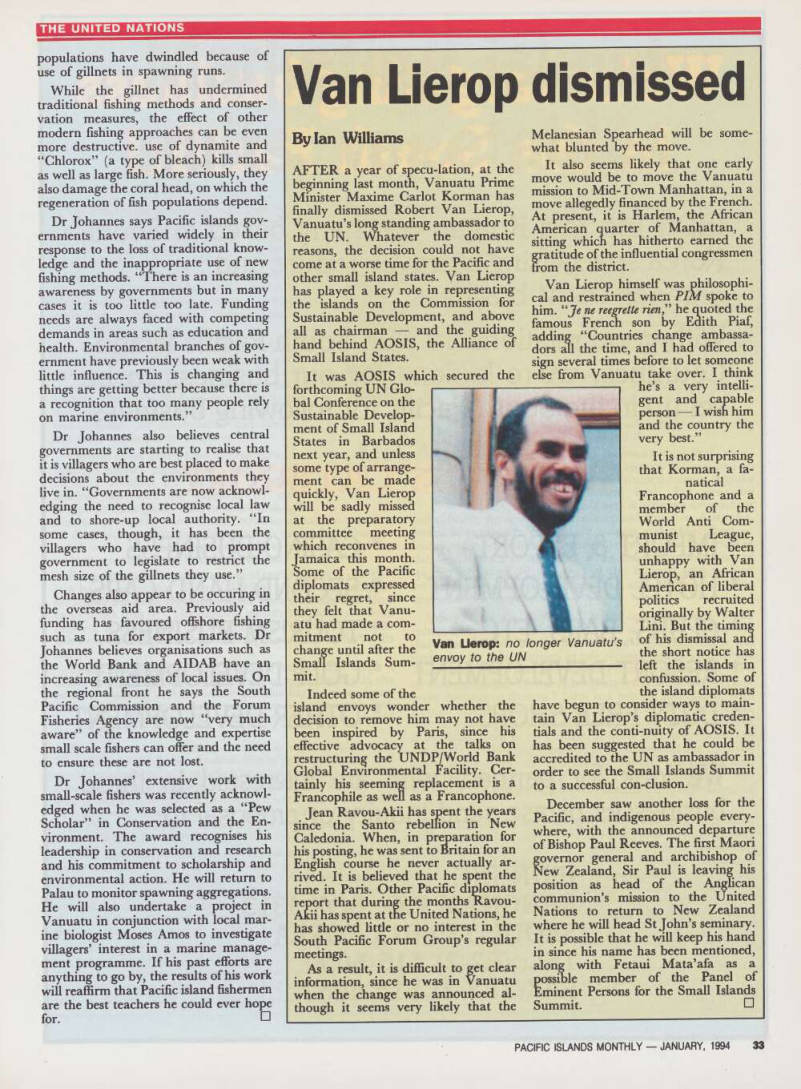
Van Lierop: no longer Vanuatu’s envoy to the UN