Fishing tales
pp. 32-33 · Read in the full issue
Fishing
The key to essential knowledge about Pacific islands fishing lies with the people who have been doing it for centuries
By Bill Morton
EACH year Pacific governments and overseas aid organisations spend vast amounts of money on fisheries research and development. Local and overseas “experts” use the funds to find better ways to increase yields while preserv ing the precious marine environment.
Australian marine biologist Dr Bob Johannes has a different approach to fisheries in the region. He believes the real “experts” are old, often illiterate Pacific island fishermen. These fishermen
have developed “encyclopaedic know
ledge” about their marine environment because their livelihood, and often their meal, has depended on it.
Johannes describes small-scale fisher men as those whose average investment in boats and fishing gear is less than $2500. He states, “It surprises many people to learn that these fishermen account for almost one half of the world’s catch of food fish, and that there are roughly 12 million of them about 25 times as many as there are engaged in large-scale fishing. One doesn’t hear much about them however, because they are usually poor, live in small third and fourth world villages and lack the political clout to call attention to them selves and their needs.”
Dr Johannes’ experience with small scale fishermen spans most corners of the Pacific islands. He has been in Papua New Guinea, the Solomons, Guam, Pohnpei, the Northern Marinas, Kiribati and Western Samoa. In these places he has worked directly with the local fishers, sometimes living with them. He says these people have taught him knowledge “previously unknown to science”. This includes such things as seasonal mi grations, and the precise locations and the timing of the spawning of many important food fish.
This knowledge has implications both for the scientific community and for Pacific Island nations. Johannes says when he began his work with small-scale fishers some of his colleagues thought he had “gone troppo”. Now their scepticism is waning as they realise that through local fishermen they can discover infor mation about bio diversity, rare or endangered species and fish behaviour.
For Pacific island nations the real
importance of this work is in the area of fisheries man agement. Small scale fishers have successfully achieved the fine balance modern day fisheries still strive for to
realise high yields
while protecting
marine resources
for the needs of the future. Dr Johannes says the limits of these resources became obvious to the islanders hundreds of years ago. “They responded by devising almost all the basic fisheries conservation measures that we employ in the west today. These included closed seasons, closed areas, size limits, and, most
importantly, traditional fishing rights.”
The message from Dr Johannes’ studies is clear the key to essential knowledge about Pacific Islands fishing lies with the people who have been doing it for centuries. With this knowledge, however, comes a warning. It is that this specialised knowledge is being lost as young islanders move from village to town and lose interest in their traditions.
“Fishing knowledge is not taught at
school in the towns, so young people don’t see the relevance of it. There’s also the implied assertion that if its not taugh t at school, its not worth learning about.”
The problem continues when young people travel overseas to further their education. “Tomorrow’s influential people in the Pacific are getting their education away from home”, says Dr Johannes. “When they come back they are dismissive of local knowledge.” There needs to be more concern for traditional knowledge in school curricula. And universities need to make students more aware of its value.”
New fishing methods also spell bad news for traditional knowledge and methods. Use of the Japanese manufactured “gillnet” is one example.
Dr Johannes states “It is a very effective way to catch fish so old methods have dropped off.” He recognises the gillnet can be a useful resource for islanders when used properly and in moderation. On the other hand when it is used indiscriminately and small mesh sizes catch small as well as large fish, fish numbers will suffer. Use of gillnets in locations where fish spawn has “deci mated” populations. Dr Johannes re ports this has been the case in Kiribati where bonefish
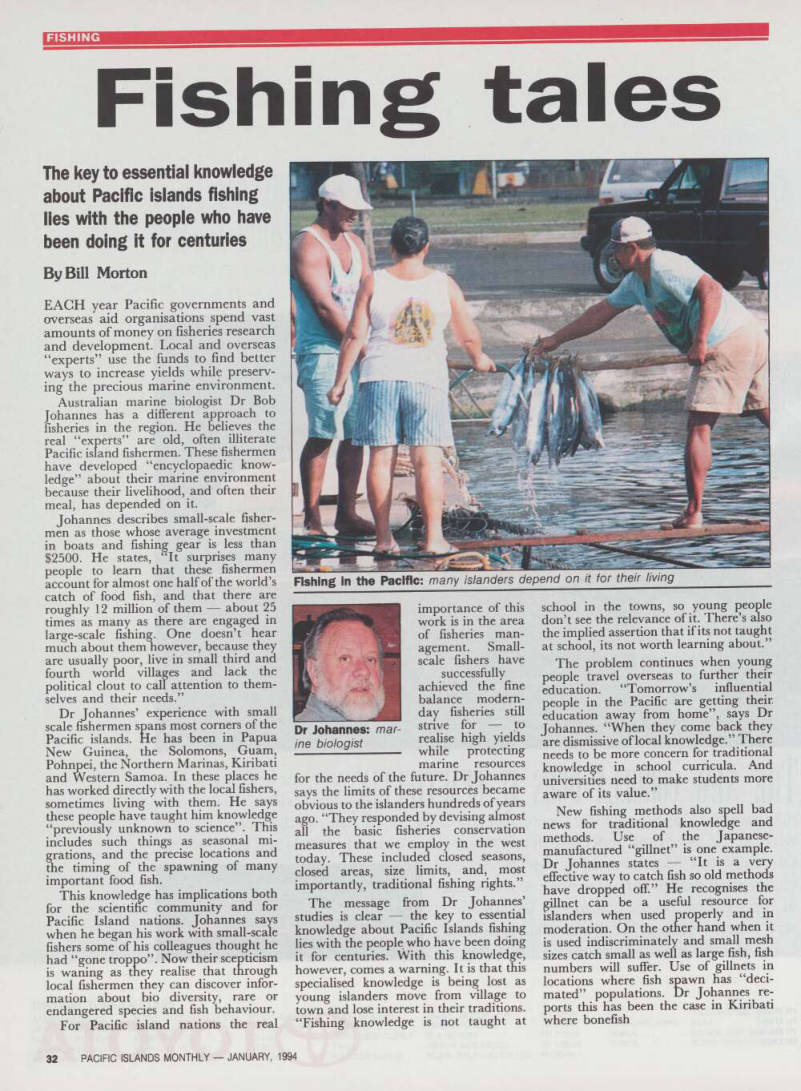
Fishing In the Pacific: many islanders depend on it for their living
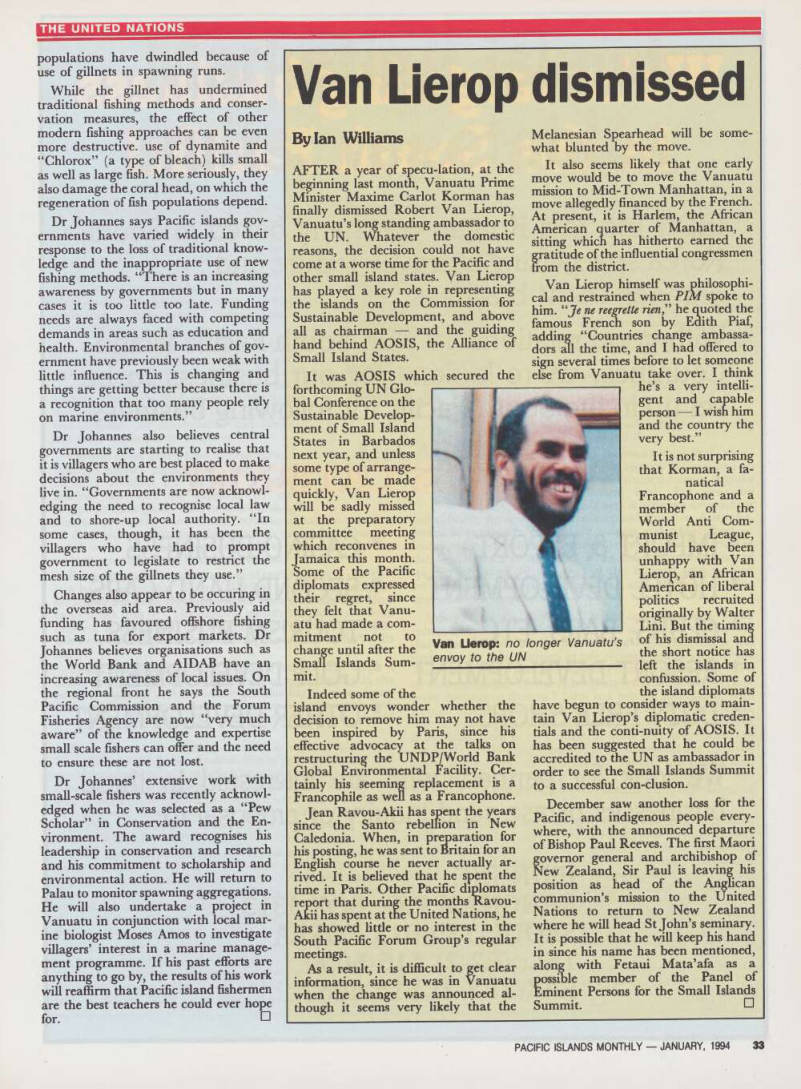
Dr Johannes: mar ine biologist
The United Nations
populations have dwindled because of use of gillnets in spawning runs.
While the gillnet has undermined traditional fishing methods and conser vation measures, the effect of other modern fishing approaches can be even more destructive, use of dynamite and “Chlorox” (a type of bleach) kills small as well as large fish. More seriously, they also damage the coral head, on which the regeneration of fish populations depend.
Dr Johannes says Pacific islands gov ernments have varied widely in their response to the loss of traditional know ledge and the inappropriate use of new fishing methods. “There is an increasing awareness by governments but in many cases it is too little too late. Funding needs are always faced with competing demands in areas such as education and health. Environmental branches of gov ernment have previously been weak with little influence. This is changing and things are getting better because there is a recognition that too many people rely on marine environments.”
Dr Johannes also believes central governments are starting to realise that it is villagers who are best placed to make decisions about the environments they live in. “Governments are now acknowl edging the need to recognise local law and to shore-up local authority. “In some cases, though, it has been the villagers who have had to prompt government to legislate to restrict the mesh size of the gillnets they use.”
Changes also appear to be occuring in the overseas aid area. Previously aid funding has favoured offshore fishing such as tuna for export markets. Dr Johannes believes organisations such as the World Bank and AIDAB have an increasing awareness of local issues. On the regional front he says the South Pacific Commission and the Forum Fisheries Agency are now “very much aware” of the knowledge and expertise small scale fishers can offer and the need to ensure these are not lost.
Dr Johannes’ extensive work with small-scale fishers was recently acknowl edged when he was selected as a “Pew Scholar” in Conservation and the En vironment. The award recognises his leadership in conservation and research and his commitment to scholarship and environmental action. He will return to Palau to monitor spawning aggregations.
He will also undertake a project in Vanuatu in conjunction with local mar ine biologist Moses Amos to investigate villagers’ interest in a marine manage ment programme. If his past efforts are anything to go by, the results of his work will reaffirm that Pacific island fishermen are the best teachers he could ever hope for. D