Moore Stephens
p. 27 · Read in the full issue
Politics
report rocks Vanuatu
BY the rough and tumble standards of Vanuatu politics the November session of parliament began inauspiciously enough.
The Minister of Finance rose to present his budget and, unlike neighbouring Fiji, the usual balanced budget was pres ented.
True enough the minister had to pass an extra appropriation of 291 million (under 1.5 per cent of GDP) to finish off 1993 but by comparison with Fiji where the deficit for 1993 was a projected 4.8 per cent of GDP the raised eyebrows among some of Port Vila’s accountants seemed hardly justified. Fiji had used cyclone Kina to justify its present situation. Vanuatu by way of contrast had three major cyclones in the 1992-93 season.
However, the budget was extraord inary if only for the fact that the Finance Minister, Willie Jimmy, was on the verge of rejecting his own budget. When the finance minister rose to speak in the house on December 3 after the Moore Stenphens report had been circulated to parliamentarians the day before Vanu atu politics entered an entirely new domain. The minister had been impli cated by the report in the purchase of a property for the Vanuatu National Provident Fund at twice the market value.
The minister said in open session of the house that he would find it difficult to support the government’s budget if the Prime Minister Maxime Carlot Korman would permit a report that would in effect sully his name.
Jimmy wanted the commissioner re sponsible for the report, Clarence Marae sacked and there was no doubt what was going to happen to the budget if the minister did not get the commissioner’s head. And he did get the commissioner’s head. Following a one-hour interruption of parliament the NUP’s Minister of
Justice Sethy Regenvanu rose to tell the house that the commissioner was sacked.
Even in Port Vila, a town where over the past year the population has grown to accept a clear diminution in public morality of their politicians the move by the justice minister shocked most people.
The sacking, however, is not without precedent. In Vanuatu the government has embarked on a policy of political sackings of public servants who are believed to be opposed to the govern ment.
There was much about the sacking of the commissioner that had a very political ring to it. The report was surprisingly circulated in parliament without first being presented to the council of ministers (cabinet). The prime minister, according to commissioner Marae, who granted PIM an exclusive interview immediately following his sack ing, had the report for at least two months. “The fact that he chose to
circulate the report to
parliamentarians just
when the South Pacific Mini Games is on and the city is full of the region’s media must surely be an indication of what Korman is up to,”
Marae said.
Sources close to the prime minister indicate that the PM has long wanted to get rid of his finance minister but with his shaky coalition has
never felt in a position to do so. He has always felt that if you give Jimmy enough rope he will hang himself — said one of the PM’s close confidants.
Just like China in the Maoist period it was possible to judge official views of government in Vanuatu from reading between the lines of the highly censored press. The fact that the normally bland Vanuatu Weekly, the official government newspaper, ran a front page report the next day on what the finance minister had done was in itself sufficient proof that the Jimmy’s head was on the block. The newspaper must submit all its articles to the PM’s office for approval before publication. Clearly the PM has had enough of his finance minister.
Between all the politics the actual content of Commissioner Marae’s report on the Moore Stephens affair can be easily lost. The report is a scathing attack on the handling of the purchase of Moore Stephens house in Port Vila. The
waterfront commercial property was owned by Thi Than Goiset, sister of prominent Vanuatu businessman Dihn Van Tan. According to the report the minister of finance had sacked the board of the National Provident Fund for political reasons. The minister then in the absence of a board, and in contravention of the NPF Act, authorised the purchase of the property for 120 million vatu.
There was no independent valuation of the property, according to the com missioner; and the actual value of the property was between 61-70 million vatu, according to two private valuations done for the commissioner.
The commissioner also said Goiset had offered commissions to those who would help her purchase the property. Accord ing to the report Goiset offered com missions as well as protection from politically inspired sacking to Mr Ailelee, the General Manager of the Vanuatu NPF if he assisted her in selling the property.
Some two months following the min ister’s agreement to buy the property at twice the market value the minister received a loan from Dinh Dominque of 2.25 million vatu to pay off the minister’s
mortgage on his home. Dihn Dominique is the brother of Goiset. The commission could find no direct evidence of bribery of minister. The commissioner did rec ommend that the prime minister con sider sacking Jimmy for his part in the affair.
And the upshot of the affair? There is a pending vote of no-confidence in the government (see update on page 11) and thus the outcome will have to await on the moral authority of the numbers game. And the commissioner Clarence Lawry Marae-is he about to roll over and play dead? Not according him. “I will challenge the legality of the sacking.
What is more there are at least two other investigations I want to complete one into the transactions surrounding Santo stevedoring and the contracts for the construction of the stadium for the South Pacific Mini Games.”
Marae may yet have a lot of work ahead of him. □
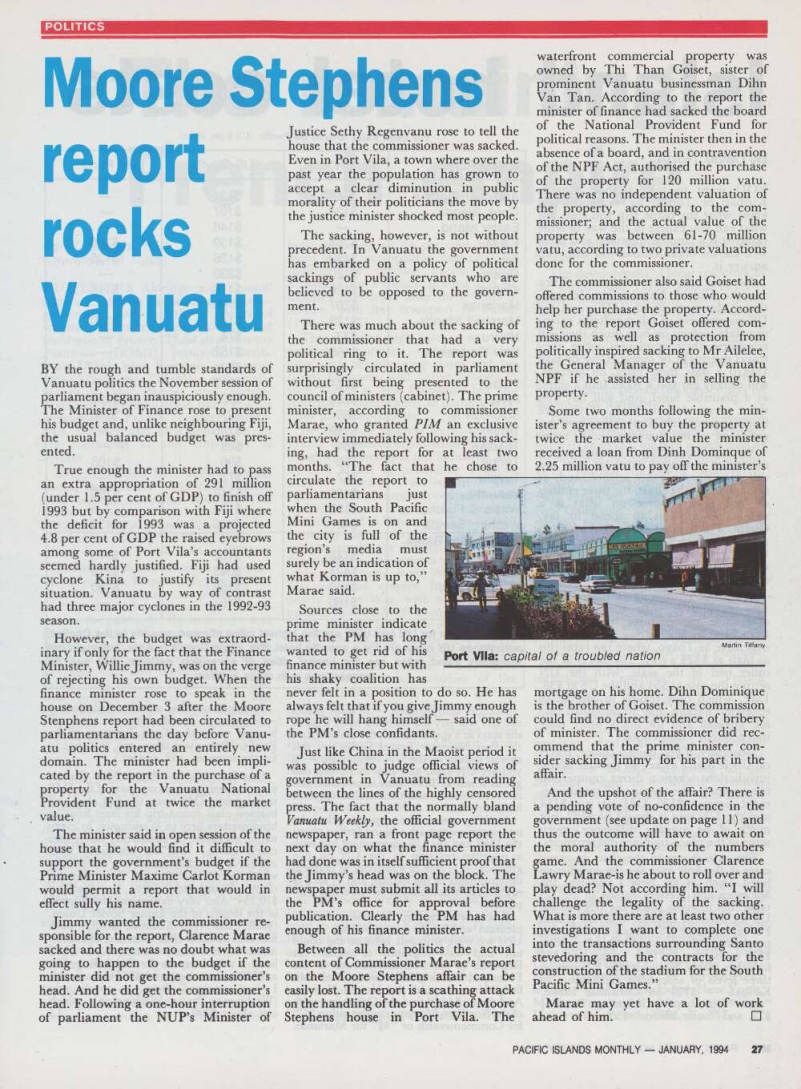
Martin Tiffany Port Vila: capital of a troubled nation