Takaku’s mission
p. 25 · Read in the full issue
Environment
By Liz Thompson
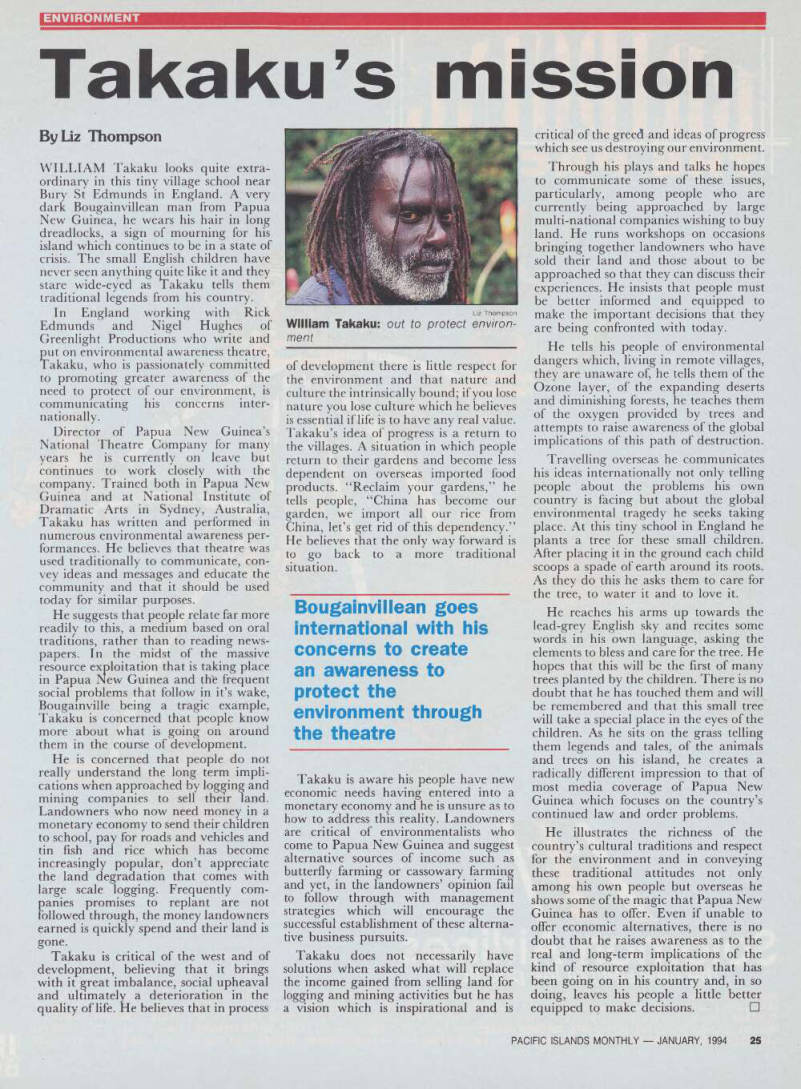
WILLIAM Takaku looks quite extra ordinary in this tiny village school near Bury St Edmunds in England. A very dark Bougainvillean man from Papua New Guinea, he wears his hair in long dreadlocks, a sign of mourning for his island which continues to be in a state of crisis. The small English children have never seen anything quite like it and they stare wide-eyed as Takaku tells them traditional legends from his country.
In England working with Rick Edmunds and Nigel Hughes of Greenlight Productions who write and put on environmental awareness theatre, Takaku, who is passionately committed to promoting greater awareness of the need to protect of our environment, is communicating his concerns inter
nationally.
Director of Papua New Guinea’s National Theatre Company for many years he is currently on leave but continues to work closely with the company. Trained both in Papua New Guinea and at National Institute of Dramatic Arts in Sydney, Australia, Takaku has written and performed in numerous environmental awareness per formances. He believes that theatre was used traditionally to communicate, con vey ideas and messages and educate the community and that it should be used today for similar purposes.
He suggests that people relate far more readily to this, a medium based on oral traditions, rather than to reading news papers. In the midst of the massive
resource exploitation that is taking place
in Papua New Guinea and the frequent social problems that follow in it’s wake,
Bougainville being a tragic example,
Takaku is concerned that people know more about what is going on around them in the course of development.
He is concerned that people do not
really understand the long term impli
cations when approached by logging and
mining companies to sell their land.
Landowners who now need money in a monetary economy to send their children to school, pay for roads and vehicles and tin fish and rice which has become
increasingly popular, don’t appreciate
the land degradation that comes with
large scale logging. Frequently com
panies promises to replant are not
followed through, the money landowners earned is quickly spend and their land is gone.
Takaku is critical of the west and of
development, believing that it brings
with it great imbalance, social upheaval and ultimately a deterioration in the quality of life. He believes that in process
of development there is little respect for the environment and that nature and culture the intrinsically bound; if you lose nature you lose culture which he believes is essential if life is to have any real value.
Takaku’s idea of progress is a return to the villages. A situation in which people return to their gardens and become less dependent on overseas imported food products. “Reclaim your gardens,” he tells people, “China has become our garden, we import all our rice from China, let’s get rid of this dependency.”
He believes that the only way forward is to go back to a more traditional situation.
Bougainvillean goes international with his concerns to create an awareness to protect the environment through the theatre
Takaku is aware his people have new economic needs having entered into a monetary economy and he is unsure as to how to address this reality. Landowners are critical of environmentalists who come to Papua New Guinea and suggest alternative sources of income such as
butterfly farming or cassowary farming
and yet, in the landowners’ opinion fail to follow through with management strategies which will encourage the successful establishment of these alterna tive business pursuits.
Takaku does not necessarily have solutions when asked what will replace the income gained from selling land for logging and mining activities but he has a vision which is inspirational and is
critical of the greed and ideas of progress which see us destroying our environment.
Through his plays and talks he hopes to communicate some of these issues, particularly, among people who are
currently being approached by large
multi-national companies wishing to buy
land. He runs workshops on occasions bringing together landowners who have sold their land and those about to be approached so that they can discuss their experiences. He insists that people must be better informed and equipped to make the important decisions that they are being confronted with today.
He tells his people of environmental
dangers which, living in remote villages,
they are unaware of, he tells them of the Ozone layer, of the expanding deserts and diminishing forests, he teaches them of the oxygen provided by trees and attempts to raise awareness of the global implications of this path of destruction.
Travelling overseas he communicates
his ideas internationally not only telling
people about the problems his own country is facing but about the global environmental tragedy he seeks taking place. At this tiny school in England he plants a tree for these small children.
After placing it in the ground each child scoops a spade of earth around its roots.
As they do this he asks them to care for the tree, to water it and to love it.
He reaches his arms up towards the
lead-grey English sky and recites some
words in his own language, asking the elements to bless and care for the tree. He hopes that this will be the first of many trees planted by the children. There is no doubt that he has touched them and will be remembered and that this small tree will take a special place in the eyes of the children. As he sits on the grass telling them legends and tales, of the animals and trees on his island, he creates a radically different impression to that of most media coverage of Papua New Guinea which focuses on the country’s continued law and order problems.
He illustrates the richness of the country’s cultural traditions and respect for the environment and in conveying these traditional attitudes not only among his own people but overseas he shows some of the magic that Papua New Guinea has to offer. Even if unable to offer economic alternatives, there is no doubt that he raises awareness as to the real and long-term implications of the kind of resource exploitation that has been going on in his country and, in so doing, leaves his people a little better equipped to make decisions. □
Liz Thompson William Takaku: out to protect environ ment