future ... again
pp. 17-21 · Read in the full issue

Cover Story
Fiji: back to the future ... again
Govt budget defeated,
PM Rabuka calls for
snap national election
FIJI Prime Minister Sitiveni Rabuka’s calling of a snap election for February is a high risk strategy. At stake are not only Rabuka’s personal political future but the prospect of further schisms in
the indigenous Fijian community and
the ramifications of a struggle between Fiji Indian leaders Jai Ram Reddy and
Mahendra Chaudhry.
Rabuka came to the prime ministership after national elections in May last year amid a power play with leadership aspirant Josevata Kamikami ca. When his government in November crashed on the rocks of internal dissent, Kamikamica was again the focus of rebellion. While the catalyst was an unpopular budget which saw in creased duty on some basic food items as well as a blow-out in the deficit underlying tensions had been building for some time. The Prime Minister got himself into a terrible mess over the so
called Tony Stephens Affair.
A commission of inquiry found that Rabuka had acted improperly and prima facie illegally in agreeing to pay compen sation, for claimed wrongful imprison ment, to Stephens a businessman with a criminal history. An inexperienced cabinet was at times wracked by inde cision, typified by a long drawn out saga involving reversal after reversal on choosing a consortium to run a perma nent television service. Personal conflicts in cabinet and strains over allegations of corruption on the waterfront and in the government owned telecommunica tions sector complicated the political
landscape.
Defenders of Rabuka maintain he was not given a fair go because he always had to watch his back. They blame a lack of firm government on what they see as destabilising tactics by the Kamikamica group. When the 1994 calendar year budget came to a vote in parliament, shockwaves were felt on the government side. Kamikamica, one minister, a min-
ister of state and six backbenchers defected. It appeared the dissidents hoped that acting president Ratu Sir Kamisese Mara would see the loss as a no-confidence vote in Rabuka and ap point a new prime minister who could command majority support in the House
of Representatives.
At one stage, there was a plan to put foward longserving MP Ratu William Toganivalu as a compromise PM. The hardline Taukei Movement, emerging from a long period of dormancy, implied that there would be civil strife if Rabuka was unseated. This followed earlier warnings by the Taukei Movement when notice was given of a parliamen tary no-confidence motion - that Ra buka supporters could be moved to try and burn down the parliament building.
When it came to the crunch, Rabuka went to Mara and sought the dissolution of parliament so new national elections could be held.
Arguably, it was the first occasion for some time that Rabuka had made a smart political decision and moved decisively on it. Ratu Mara accepted constitutional ad vice that he had no practical option other than to grant the request. Ratu Mara, in doing so, enhanced his status by being seen to act impar tially despite the fact that Kamikamica had always been his perferred choice as prime minister.
One evening, following
the budget defeat and a televised announcment of new elections, Rabuka was sitting outside the National Video Centre in Suva relax ing with colleagues around the kava bowl. “On well,
these things happen,” he
said in a classic piece of understatement. Rabuka likes a bit of drama, and has a former military man’s passion for the heat of battle.
Critics might feel that this
preference contrasts with a lack of enthusiasm for the hard slog of day-to-day government, with its need for careful evaluation and attention to detail.
In effect, in the lead-up to the February elections, two major battles will be fought, and several smaller ones.
On the one hand, there will be a struggle for support amongst the indigenous
Fijian community. There are already
signs of deepening splits - something which poses a threat to wider stability.
For a start, the dissidents who have been expelled from Rabuka’s Soqosoqo ni Vakavulewa ni Taukeui Party(SVT) are taking about forming a new political grouping. And an old political warhorse, Apisai Tora, has re-emerged with his All National
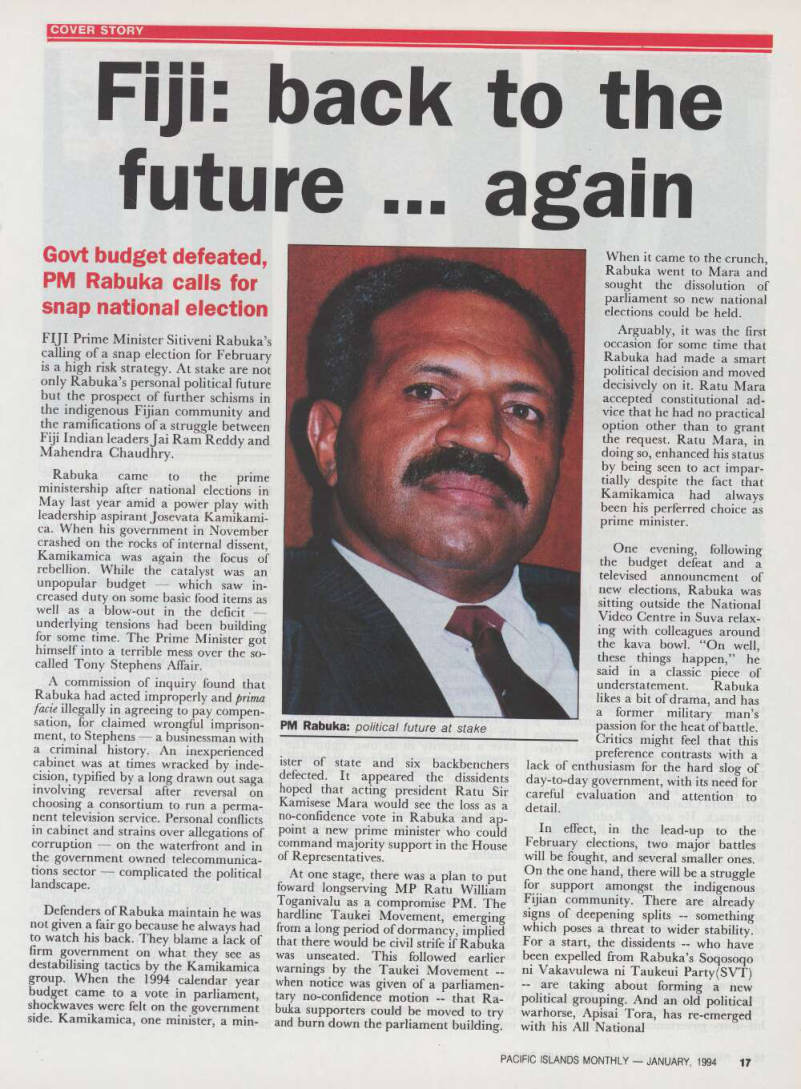
PM Rabuka: political future at stake
Congress (ANC) to campaign on a platform of multi-culturalism (despite Tora himself have a very mixed past record on such issues). Before the last elections, which were the first since Rabuka’s 1987 military coups, Rabuka had raised high expectations among the Fijian community.
Now he will be judged on his record in office. While that record has been very much up and down, Rabuka can fairly lay claim to having been a moderate leader. Anti-Indian witchhunts, envis aged by the most pessimistic, did not materialise.
Early in December, Rabuka re-raised the spectre of a post-election unity government. And he signalled a willingness to look towards opposition leader Jai Ram Reddy’s National Feder ation Party (NFP) as a coalition partner.
Reddy’s political foe on the Indian side of politics, Labour Party Leader Mahendra Chaudhry, was quick to go on the attack. He accused Reddy of effec tively becoming an ally of Rabuka and warned that, during the campaign, he would pursue the NFP on this basis.
Reddy sought to neutralise this strat egy by stating publicly that Rabuka had not broached an alliance with him, and added that the prime minister’s floating of the idea through the media was not a good start to developing greater cross racial unity.
Rabuka has called meetings of his party, the traditional Great Council of Chiefs and provincial councils to discuss his unity government plan and related
issues. This comes at a time of doubts over future viabilit of the relationship between the Great Council of Chiefs and the SVT, which the chiefs created with the failed aim of fostering greater indigenous unity. The post coup consti tution’s assigning of a central role in party affairs to provincial councils is also under something of a cloud. The effect of this link has been to encourage regionalism in national politics, some thing which has been a thorn in side of the Rabuka government.
Once the elections are out of way, manoeuvring will instensify. It appears likely, that the SVT will form the core of any new government. But partly because of division on the Fijian side of politics, the party created to rule is unlikely to have a majority in its own right. The present government has been comprised of 30 SVT members* two nominal independents and representatives of the General Voters Party (GVP), which in the last elections won all five of the seats reserved for for ethnic minorities such as Europeans, Chinese and other Pacific islanders.
There are a total of 37 seats allocated to Fijians, but last year the hardline Fijian Nationalist United Front (FNUF) led by veteran firebrand activist Sakeasi Butadroka took five of these seats.
Moderates in the SVT, including Kami kamica, would not tolerate an alliance with the FNUF, even though Rabuka was favourably disposed towards them.
With the dissidents presently expelled, the possibility of a new coalition includ ing Butadroka can’t be ruled out. The
Indian community would grimace at the prospect. Alternative combinations, might include an alliance with Reddy or the Tora’s ANC, if he can win a few seats.
The GVP, which has traditionally sided with the Fijian side of politics, faces the unhappy prospect of losing one of two of its seats because both Labour and the ANC are going to field candidates in general voter constituencies.
So, the May 1987 coup which ousted the Fiji Labour/NFP coalition of the Late Dr Timoci Bavadra failed to simplify
Fiji’s politics. Big questions remain
unanswered. By the mid-1990s land leases of thousands of Indian cane farmers will start running out. Unless there is some sort of realistic powershar ing, dealing with the inherent sensitivies of this issue with be greatly complicated.
Sugar remains a central pillar of the nation’s economy. And as Chaudhry pointed out in a speech earlier this year, investment has remained largely stag nant. "We have not yet succeeded in
providing either political stability or
investor confidence,” he said.“As a result, liquidity levels continue to be high in the banking system and the economy is not moving.” In a recent interview
with Australia’s Special Broadcasting
Service (SBS) Dateline television pro gram, Rabuka was asked if potential investors would still come to Fiji despite
the political upheaval arising from the
budget’s defeat. “Well, I think this whole episode would make me come here because the constitution is workable,” he said. “We have taken the constitutional way. The country has remained' calm.
How many parts of the world can you have a
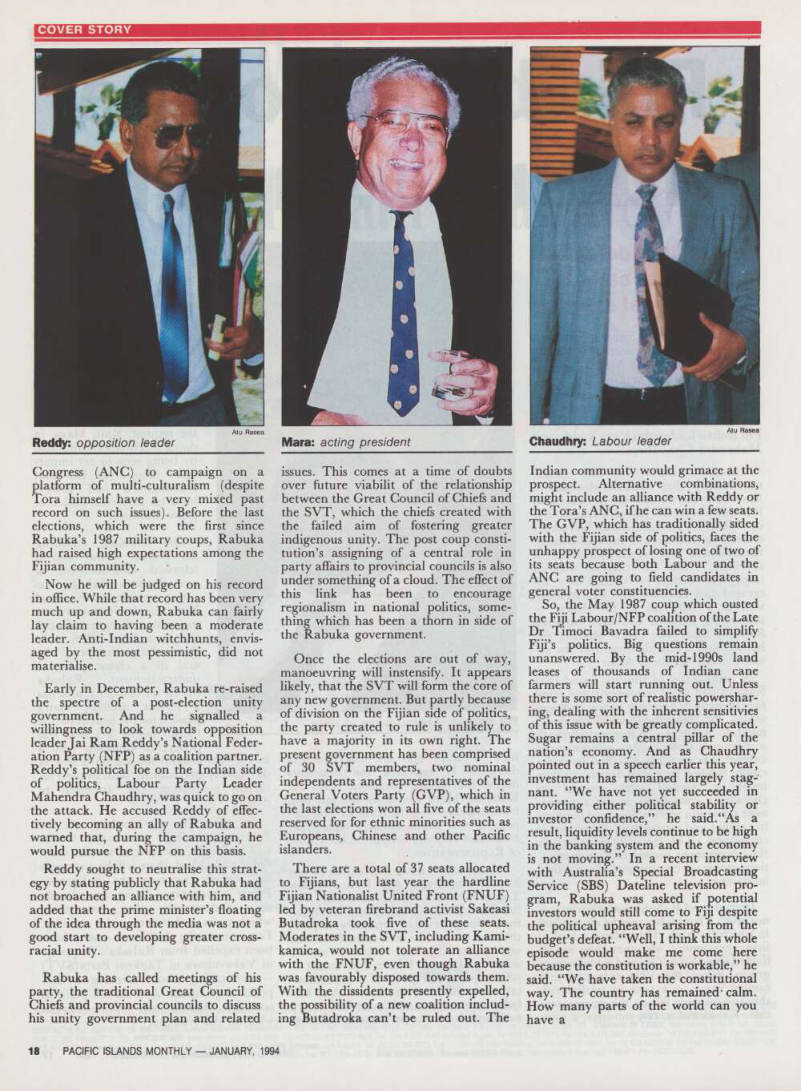
Atu Rasea
Reddy: opposition leader
Mara: acting president
Atu Rasea
Chaudhry: Labour leader
political crisis such as we have had and continue as if nothing had happened.”
Rabuka predicted that the NFP would increase its Indian seats in parliament, currently 14 compared with Labour’s 13.
This followed a period in which Reddy, an urbane lawyer, has apparently ben efited from pursuing a moderate political line. Labour was trounced by the NFP this year in local councils elections as well as in a national by-election. “We must do away with that failed style of politics which is based on destructive and confrontational urges, which seems to thrive on dispute,” Reddy told a lunch eon organised by the GVP. He sought an end to constant verbal warfare and insistence that only one kind of agenda was right.
Ironically, it was Chaudhry who after the last election quickly jumped in to back Rabuka for the prime ministership when Reddy preferred Kamikamica, given that the constitution insists that leadership of government go to an indigenous Fijian. Chaudhry fell out with Rabuka over the slow pace of reviewing the post-coup constitution, which restricts Fijian Indian rights. The forthcoming elections will test the popu larity of Chaudhry’s return to a more confrontational approach. Labour did
it’s likely that the SVT will form the core of any new govt.
But partly because of division on the Fijian side of politics, the party created to rule is unlikely to have a majority in its own right
better than expected in the last elections, winning virtually all the western cane belt seats. There remains a divide between the concerns of rural Indian voters and their urban counterparts, throwing yet another wildcard into the island nation’s political fabric.
There is also a widening gulf between the perceptions of urban and rural Fijians. In hundreds of scattered villages, what goes on Suva political circles often seems remote. Bread and butter issues are what count. Failure to achieve a more workable system of government can only exacerbate the problems of a widening disparity between services available to city dwellers and what is on offer to people in outlying areas. Urban drift, combined with high overall population growth and low economic growth in hibiting the creation of new jobs, leads to social tensions and disillushionment.
Such dynamics in turn challenge preser-
vation of traditional values. These values, including communal problem
sharing and inter-dependence, have
helped Fiji in the past to overcome divisive forces of the kind which had ripped apart other nations. As Reddy noted recently, Fiji in its first year’s of nationhood was a tinderbox, with enough flamable material to engulf people of all races.
Unfortunately, election campaigns al ways produce sparks. A saving grace of what has turned out to be a largely failed post-coup constitution is that it tends to concentrate tensions within ethnic com munities rather than intensify strains between them. This is because voters are restricted to casting ballots for candidates from their own ethnic communities. And the demands of elections can on occasion pressure disparate blocs to regroup. For example, it may yet be that the split in
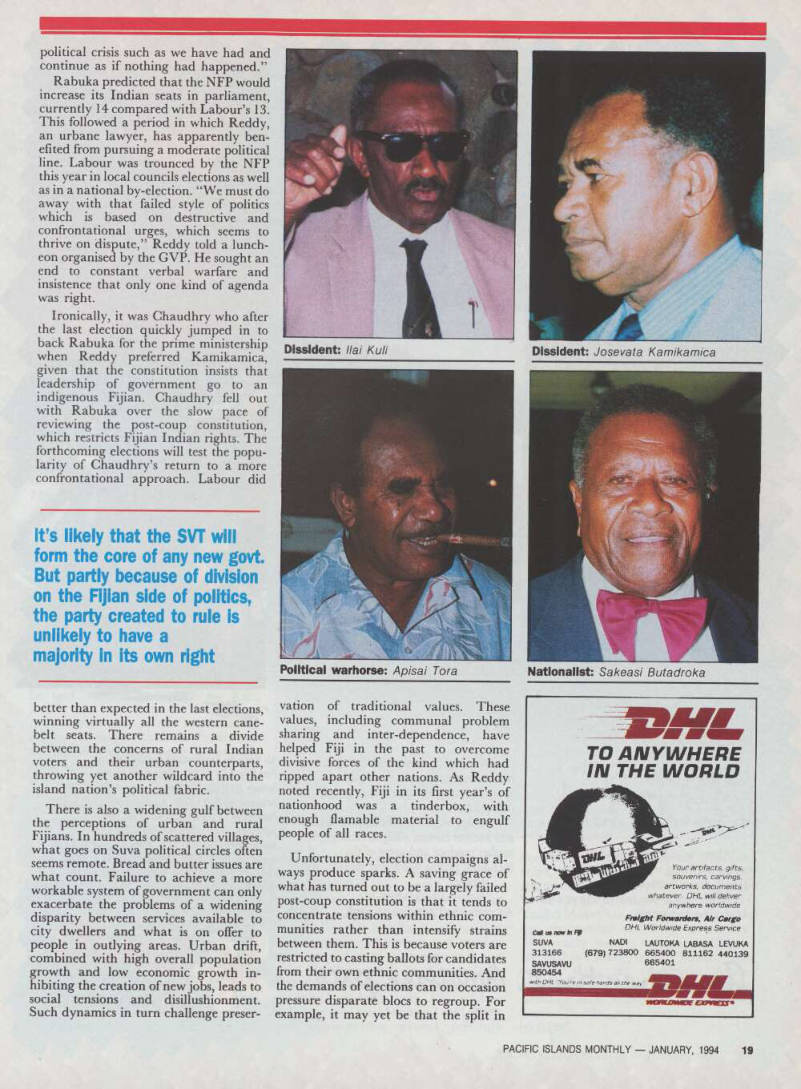
Dissident: llai Kuli
Political warhorse: Apisai Tora
Dissident: Josevata Kamikamica
Nationalist: Sakeasi Butadroka
Rabuka’s SVT will be papered over until after the elections. That would mean a repeat of the situation before the last elections. Then, the question of SVT leadership was put-off until after polling when the numerical situation in parlia ment was clear. In this way, respective public support for Rabuka loyalists and the dissidents, as well as of the competing Indian political parties, would be on the table for all to see.
Rabuka notes that Fiji has been the lowest regional receiver of foreign aid
assistance per head of population. He maintains also that Fiji, in relative terms, has shown the best overall economic performance of Pacific island countries during the past five years. ”We should all be proud of this because it tells us that our success in progressing and moving our country foward in its economic and social development is to a very large degree through our own efforts and resources,” Rabuka said. Fiji, with a large educated workforce and well devel oped administrative network, certainly
does have potential for future advance ment. And at times an underlying reasonableness belies the sort of high blown rhetoric demonstrated in a recent Taukei Movement advertisement brand ing government dissidents as traitors.
The coming election campaign will be a test of Fiji’s maturity as a nation. The country is at the crossroads. Future generations may look back to the 1994 elections as a watershed in a unique South Pacific experiment in multi racialism. □