Land of the falling
p. 15 · Read in the full issue
yen
When the Japanese boom went bust Hawaii felt the impact with a double whammy. Not only did overseas investment fall off, but there was less money for travel.
HAWAII’S tourism industry has
been troubled since the Gulf War.
Honolulu newspapers routinely print headlines like “June a big bust tor tourism; Arrivals and length of stay plummeted from a year ago.” Of par ticular concern is the dramatic decline of Asian visitors. In June, there were 16.4 per cent less eastbound tourists (originat ing in Asia) in Hawaii than there were
last June. During the same period,
westbound travel to Hawaii (originating in North America) dropped by 8.5 per cent. Lengths of stay are also significantly down.
In particular, the decrease in Asian travellers for more than two and a half years means Hawaii’s number one indus try is in crisis. Why are hundreds of thousand less Asian tourists coming to Hawaii? A Japan expert from Osaka, of the State and private sector funded Hawaii Visitors Bureau, who asked that her name not be used, says “Tokyo’s economy went down... After the bubble burst, people said, ‘Oh, we shouldn’t
spend money.”
By the late 1980 s, Japanese investment in real estate, resorts, golf courses etc, was so extensive that a Honolulu bank claimed 45 per cent of Hawaii’s economy was Japan
fenerated. Tokyo businessmen literally
nocked on the doors of local homes asking owners if they wanted to sell their houses for hefty profits. Hundreds of millions were spent per resort. Honolulu Mayor Frank Fasi asked a $lOO million “impact fee” (tax) per golf course. Japan Inc.’s invest ment was so widespread that Hawaii was called an “economic colony of Japan.” Six million tourists a year visited, many from Japan - which had a yen for Hawaii.
' Inevitably, when the Japanese boom went bust Hawaii felt the impact with a double whammy. Not only did overseas investment radically fall off, but there was less money for travelling. HVB’s Osakan says after the downturn, “Japanese tended to travel shorter distances to closer, cheaper destinations. ‘Why go all the way to Hawaii?’ they asked. Going to Hawaii was a travel trend 10, 20 years ago; it was a major place to go. Now, many places compete with Hawaii.”
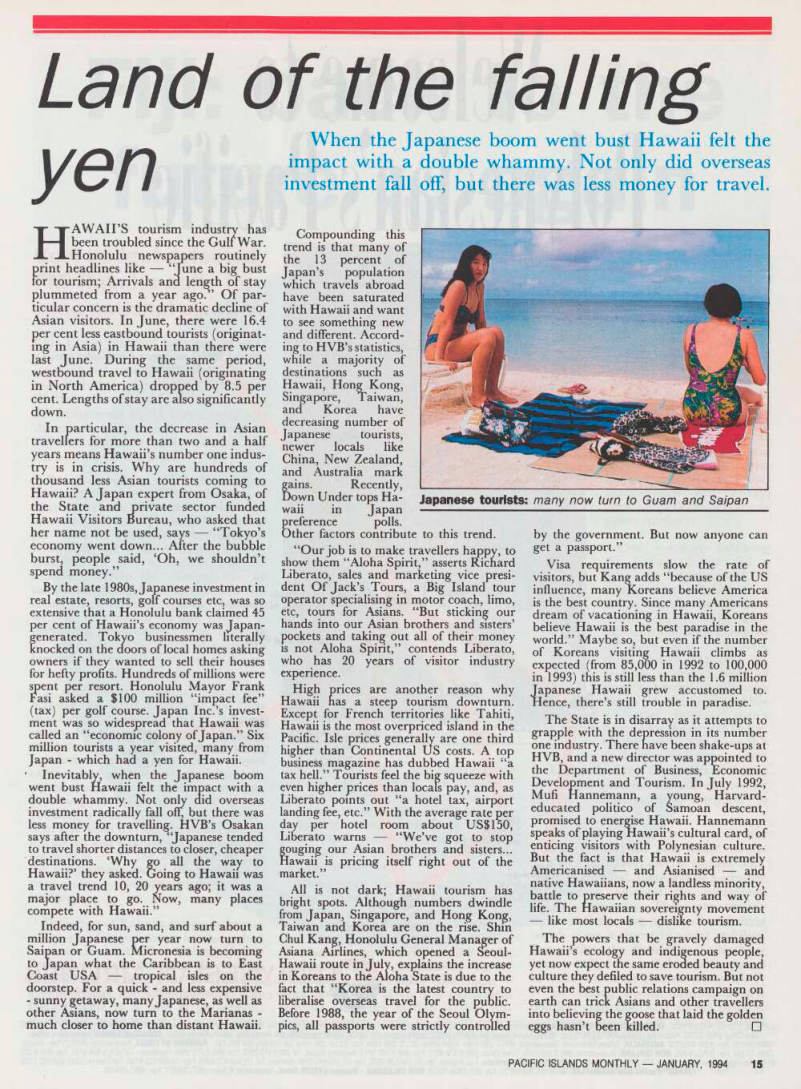
Indeed, for sun, sand, and surf about a million Japanese per year now turn to Saipan or Guam. Micronesia is becoming to Japan what the Caribbean is to East Coast USA tropical isles on the doorstep. For a quick - and less expensive - sunny getaway, many Japanese, as well as other Asians, now turn to the Marianas much closer to home than distant Hawaii.
Compounding this
trend is that many of the 13 percent of
Japan’s population
which travels abroad have been saturated with Hawaii and want to see something new and different. Accord ing to HVB’s statistics, while a majority of destinations such as Hawaii, Hong Kong, Singapore, Taiwan, and Korea have decreasing number of
Japanese tourists,
newer locals like China, New Zealand, and Australia mark
gains. Recently,
Down Under tops Ha waii in Japan
preference polls.
Other factors contribute to this trend.
“Our job is to make travellers happy, to show them “Aloha Spirit,” asserts Richard Liberate, sales and marketing vice president Of Jack’s Tours, a Big Island tour operator specialising in motor coach, limo, etc, tours for Asians. ‘ But sticking our hands into our Asian brothers and sisters pockets and taking out all of their money is not Aloha Spirit, contends Liberate, who has 20 years of visitor industry experience.
High prices are another reason why Hawaii has a steep tourism downturn.
Except for French territories like Tahiti, Hawaii is the most overpriced island in the Pacific. Isle prices generally are one third higher than Continental GS costs. A top business magazine has dubbed Hawaii “a tax hell.” Tourists feel the big squeeze with even higher prices than locals pay, and, as Liberate points out “a hotel tax, airport landing fee, etc.” With the average rate per day per hotel room about US$l5O, Liberate warns “We’ve got to stop gouging our Asian brothers and sisters...
Hawaii is pricing itself right out of the market.”
Al , . 1 1 xy .. . , All is not dark; Hawaii tourism has bright spots. Although numbers dwindle Hs S ‘"S a P° re ’ and Hong Kong, laiwan and Korea are on the rise. Shin Chul Kang, Honolulu General Manager of Asiana Airlines, which opened a Seoul- Hawaii route in July, explains the increase in Koreans to the Aloha State is due to the fact that “Korea is the latest country to liberalise overseas travel for the public.
Before 1988, the year of the Seoul Olympics, all passports were strictly controlled
by the government. But now anyone can get a passport.”
Visa requirements slow the rate of visitors, but Kang adds “because of the US influence, many Koreans believe America is the best country. Since many Americans dream of vacationing in Hawaii, Koreans believe Hawaii is the best paradise in the world.” Maybe so, but even if the number of Koreans visiting Hawaii climbs as expected (from 85,000 in 1992 to 100,000 in 1993) this is still less than the 1.6 million Japanese Hawaii grew accustomed to.
Hence, there’s still trouble in paradise.
The State is in disarray as it attempts to grapple with the depression in its number one industry. There nave been shake-ups at HVB, and a new director was appointed to the Department of Business, Economic Development and Tourism. In July 1992, Mufi Hannemann, a young, Harvard educated politico of Samoan descent, promised to energise Hawaii. Hannemann speaks of playing Hawaii’s cultural card, of enticing visitors with Polynesian culture.
But the fact is that Hawaii is extremely Americanised and Asianised and native Hawaiians, now a landless minority, battle to preserve their rights and way of life. The Hawaiian sovereignty movement like most locals dislike tourism.
The powers that be gravely damaged Hawaii’s ecology and indigenous people, yet now expect the same eroded beauty and culture they defiled to save tourism. But not even the best public relations campaign on earth can trick Asians and other travellers into believing the goose that laid the golden eggs hasn’t been killed. □
Japanese tourists: many now turn to Guam and Saipan