Fiji’s
pp. 58-59 · Read in the full issue
Sport
Fiji’s league hero
By Atama Raganivatu
FIJI has its first rugby league superstar and Noa Nadruku’s emergence could not have come at a more opportune time.
Although organised rugby league only commenced in Fiji in March, 1992, Fijian involvement goes back several decades. Older fans of the historic English club Rochdale Hornets reserve special places in their hearts for Josefa Levula and Orisi Dawai, who brightened up many drab Saturday afternoons in the early 19605. Of the numerous New Zealand or Australia raised Fijians to take up the game Manoa Thompson, often the wager of one-man battles to maintain South Sydney’s competitiveness, is the most ac complished.
Yet, no Fijian has matched the impact made by Nadruku in just one season of senior rugby league. Like Levula and Dawai, Nadruku had already established himself as a rugby union player of rare ability before switching to the profes sional code.
He overcame the early ignominy of being sent off from Twickenham’s hal lowed turf, against England in 1989, to make 25 appearances for the Fijian
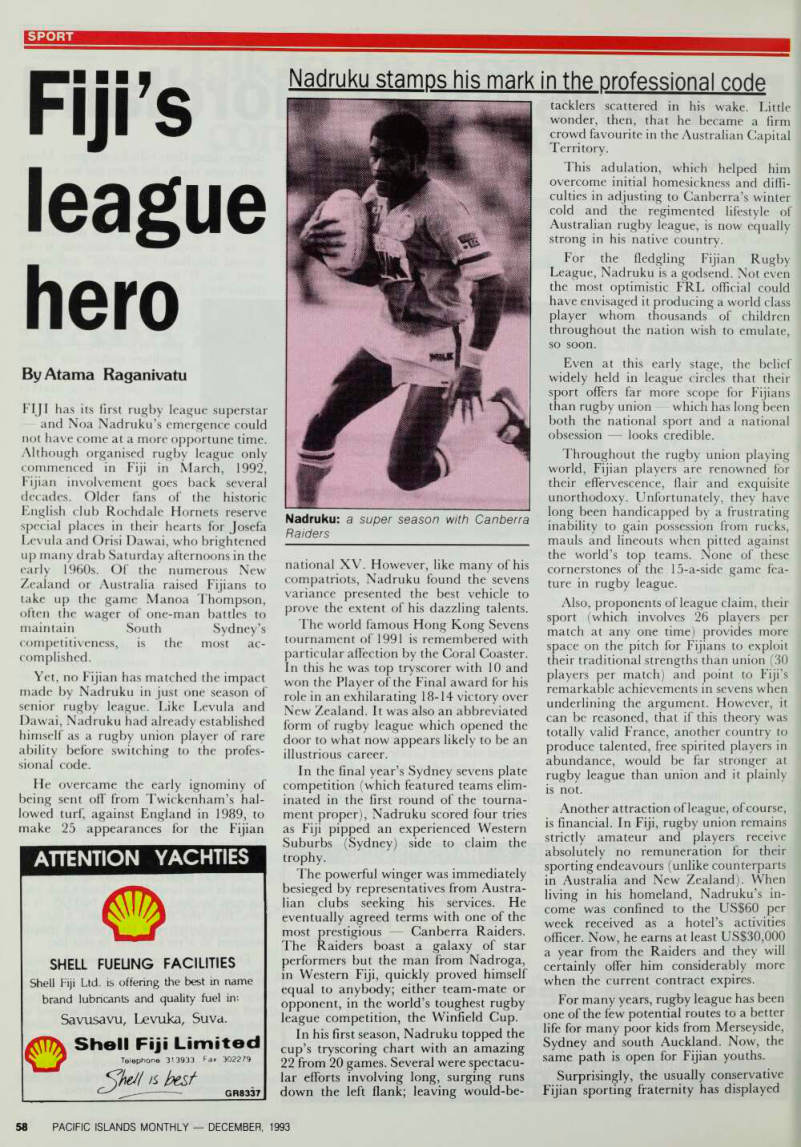
Nadruku stamps his mark in the professional code
national XV. However, like many of his compatriots, Nadruku found the sevens variance presented the best vehicle to prove the extent of his dazzling talents.
The world famous Hong Kong Sevens tournament of 1991 is remembered with particular affection by the Coral Coaster.
In this he was top tryscorer with 10 and won the Player of the Final award for his role in an exhilarating 18-14 victory over New Zealand. It was also an abbreviated form of rugby league which opened the door to what now appears likely to be an illustrious career.
In the final year’s Sydney sevens plate competition (which featured teams elim inated in the first round of the tourna ment proper), Nadruku scored four tries as Fiji pipped an experienced Western Suburbs (Sydney) side to claim the trophy.
The powerful winger was immediately besieged by representatives from Austra lian clubs seeking his services. He eventually agreed terms with one of the most prestigious Canberra Raiders.
The Raiders boast a galaxy of star performers but the man from Nadroga, in Western Fiji, quickly proved himself equal to anybody; either team-mate or opponent, in the world’s toughest rugby league competition, the Winfield Cup.
In his first season, Nadruku topped the cup’s tryscoring chart with an amazing 22 from 20 games. Several were spectacu lar efforts involving long, surging runs down the left flank; leaving would-be
tacklers scattered in his wake. Little wonder, then, that he became a firm crowd favourite in the Australian Capital
Territory.
This adulation, which helped him overcome initial homesickness and diffi culties in adjusting to Canberra’s winter cold and the regimented lifestyle of Australian rugby league, is now equally strong in his native country.
For the fledgling Fijian Rugby
League, Nadruku is a godsend. Not even the most optimistic FRL official could have envisaged it producing a world class player whom thousands of children throughout the nation wish to emulate, so soon.
Even at this early stage, the belief widely held in league circles that their sport offers far more scope for Fijians than rugby union which has long been both the national sport and a national obsession looks credible.
Throughout the rugby union playing world, Fijian players are renowned for their effervescence, flair and exquisite unorthodoxy. Unfortunately, they have long been handicapped by a frustrating inability to gain possession from rucks, mauls and lineouts when pitted against the world’s top teams. None of these cornerstones of the 15-a-side game fea ture in rugby league.
Also, proponents of league claim, their sport (which involves 26 players per match at any one time) provides more space on the pitch for Fijians to exploit their traditional strengths than union (30 players per match) and point to Fiji’s remarkable achievements in sevens when underlining the argument. However, it can be reasoned, that if this theory was totally valid France, another country to produce talented, free spirited players in abundance, would be far stronger at rugby league than union and it plainly is not.
Another attraction of league, of course, is financial. In Fiji, rugby union remains strictly amateur and players receive absolutely no remuneration for their sporting endeavours (unlike counterparts in Australia and New Zealand). When living in his homeland, Nadruku’s in come was confined to the US$6O per week received as a hotel’s activities officer. Now, he earns at least US$3O,OOO a year from the Raiders and they will certainly offer him considerably more when the current contract expires.
For many years, rugby league has been one of the few potential routes to a better life for many poor kids from Merseyside, Sydney and south Auckland. Now, the same path is open for Fijian youths.
Surprisingly, the usually conservative Fijian sporting fraternity has displayed
Nadruku: a super season with Canberra Raiders
little animosity to the high profile the obvious threat of lost players, remains stoical. Undoubtedly Sitiveni Rabuka, in his role as FRL president, has given league a great deal of credibility.
Hopefully, the relationship between the two codes in Fiji will evolve into something akin to the situation existing in Australia and New Zealand. There they have learnt to live alongside each other; not exactly amicably but with a begrudging respect, and rugby union administrators in both countries realised long ago the best way of countering league’s attractions was to offer the highest quality of playing and social facilities feasible to participants in their sport.
Rugby league’s presence in Fiji must reduce the possibility that local rugby union officials will lapse into com placency. In the long run, the greatest beneficiary of league’s arrival could well be the average Fijian rugby union player.
With its grass roots strength and unique camaraderie (something no pro fessional sport can possibly match), rugby union will retain its revered place in a Fijian sport for, at least, the foreseeable future.
Certainly, a lot of work lies ahead of the Fijian representative rugby league selection before it equals the national XV in prestige. That was evident in October, when a visiting Queensland combination beat a side including both Nadruku and Thompson 28-4 at Suva.
The next major test for Bati, as the Fijians have been nicknamed, comes in June when France, rated fourth in the current international pecking order, tours. This will provide the best barometer yet of progress made.
However, if anyone still has any
lingering doubts about Fijian rugby
league’s future they should visit Nadruku’s home village of Namatakula,
near Sigatoka.
In July this year, the 300 inhabitants gained access to electricity and they had absolutely no doubts over their priorities.
The first electrical appliances obtained were a television and a video cassette recorder. Set up in the community hall, they enabled villagers to witness the exploits of Nadruku in Australia via
video tapes.
Every tape featuring the local hero has been played at least three times and, after
each showing, Namatakula’s youngsters
stream away to a nearby clearing to play
rugby league and dream of becoming
another Noa Nadruku. Fijian rugby
league is here to stay. □