Fellowship in Fiordland
p. 57 · Read in the full issue
Yachting
By Sally Andrew
TUCKED away in the extreme south west comer of New Zealand is a magical land of mountains, waterfalls, forests and fiords. For 150 miles the shore is deeply indented with narrow inlets, none more than a few miles apart. Great gashes gouged out by glaciers more than 15,000 years ago are surrounded by mountains
up to 7000 feet high. A voyage down this rugged coastline is often cold and rough with wind and rain typical of the Roaring Forties. Fiordland National Park we could not ignore the call of her untamed and unspoiled wilderness.
When a large high settled over the Tasman Sea, we headed south. A giant royal albatross came by and wiggled his wings as we sailed past Cape Farewell.
Four days later we sighted Milford Sound. Ahead were snow capped peaks on the
mountains and glaciers spill
ing into the valleys. Wow! A
wind from astern filled our sails as we explored Milford’s quiet bays and roar ing waterfalls. A greeting party of little blue penguins swam out to see us.
In George Sound a school of dolphins gamboled out to meet us and then escorted us all the way into our anchor age at Alice Falls, a beautiful, well protected bay at the head of the sound.
Friends Sandy and Rondi on yacht Sundowner invited us aboard, and within the hour Jeff and Tex off the fishing vessel Osaki of Riverton came alongside and threw us a dozen crayfish. Crayfishing is the major industry in Fiordland, and that evening we enjoyed JelPs tales of cra>4ishing madness and mishaps.
At Alice Falls there is a well-marked trail up to Lake Katherine, a beautiful alpine lake surrounded by sheer cliffs and sandy beaches. New Zealand bush has a special primordial beauty. Each tree is a garden in itself, being covered with a carpet of ferns, mosses and orchids.
Tramping through the native bush, surrounded by the sight and sound of New Zealand robins, tuis and bellbirds,
is unbeatable.
In the entrance to Charles Sound we sighted a pair of clown-like Fiordland crested penguins with their bright yellow eyebrows. After anchoring deep inside the sound, we joined our crayfish captain and friend Jeff on a hike around Eleanor Island. We wanted to find shore-signs of the Crested penguins and we did. We found jmany feather-lined nests in caves made of boulders and tree roots and spotted one tired Crested waddling home after a long day at sea. In striking contrast to their graceful water ballets, penguins appear quite cumbersome on
land, walking and hopping across rocks
and boulders and up the steep bush
slopes, using their bills for support. Many well-worn tracks led from the sea to nest sites on the island.
After checking the sam coastal weather report, we set ofF for Doubtful Sound. Captain James Cook doubted its use as a suitable boat harbour so he named this fiord “Doubtful” and never went in. If he had, he would have discovered a dozen fantastic anchorages.
The morning we arrived, the weather was warm.
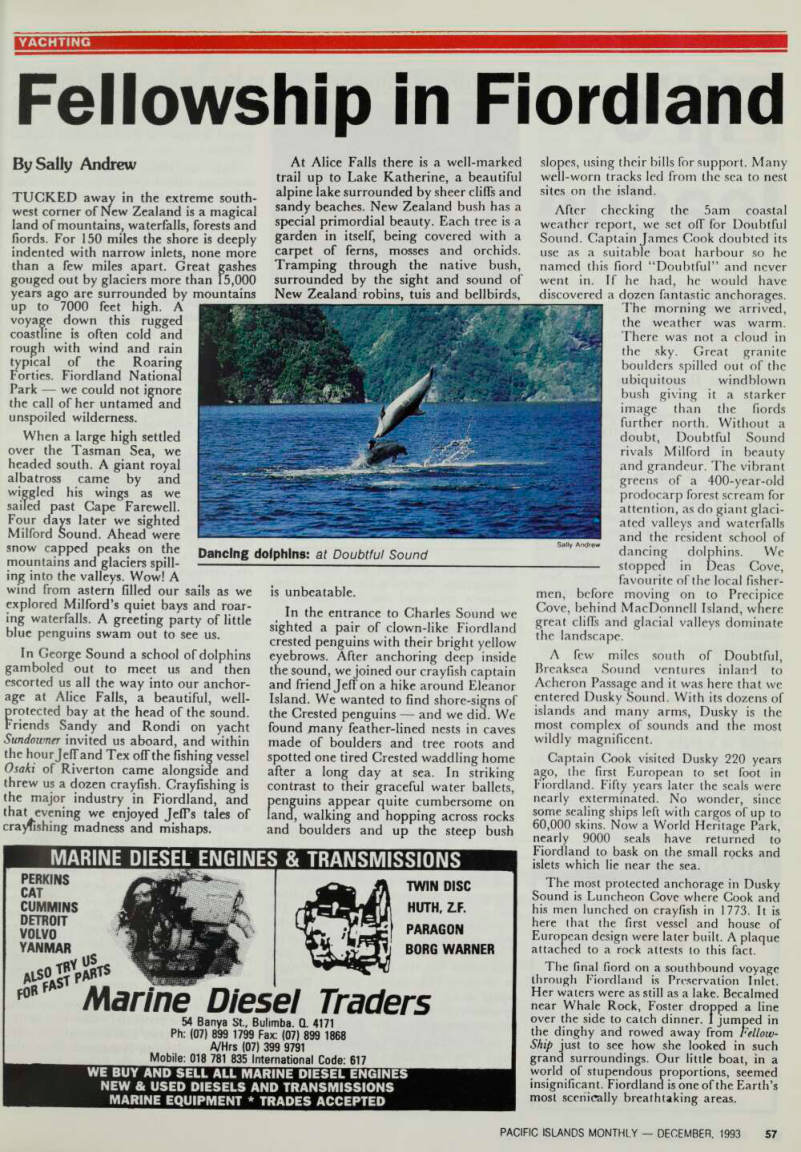
There was not a cloud in the sky. Great granite boulders spilled out of the übiquitous windblown bush giving it a starker image than the fiords further north. Without a doubt, Doubtful Sound rivals Milford in beauty and grandeur. The vibrant greens of a 400-year-old prodocarp forest scream for attention, as do giant glaci ated valleys and waterfalls and the resident school of
dancing dolphins. We
stopped in Deas Cove, favourite of the local fisher
men, before moving on to Precipice Cove, behind MacDonncll Island, where great clifts and glacial valleys dominate
the landscape.
A few miles south of Doubtful, Brcaksea Sound ventures inland to Acheron Passage and it was here that we entered Dusky Sound. With its dozens of islands and many arms, Dusky is the most complex of sounds and the most
wildly magnificent.
Captain Cook visited Dusky 220 years ago, the first European to set foot in Fiordland. Fifty years later the seals were nearly exterminated. No wonder, since some sealing ships left with cargos of up to 60,000 skins. Now a World Heritage Park, nearly 9000 seals have returned to Fiordland to bask on the small rocks and islets which lie near the sea.
The most protected anchorage in Dusky Sound is Luncheon Cove where Cook and his men lunched on crayfish in 1773. It is here that the first vessel and house of European design were later built. A plaque attached to a rock attests to this fact.
The final fiord on a southbound voyage through Fiordland is Preservation Inlet.
Her waters were as still as a lake. Becalmed near Whale Rock, Foster dropped a line over the side to catch dinner, f jumped in the dinghy and rowed away from Fellow- Ship just to see how she looked in such grand surroundings. Our little boat, in a world of stupendous proportions, seemed insignificant. Fiordland is one of the Earth’s most sceriically breathtaking areas.
Dancing dolphins: at Doubtful Sound
Sally Andrew