Unhappy natives
p. 38 · Read in the full issue
Books
By lan Williams
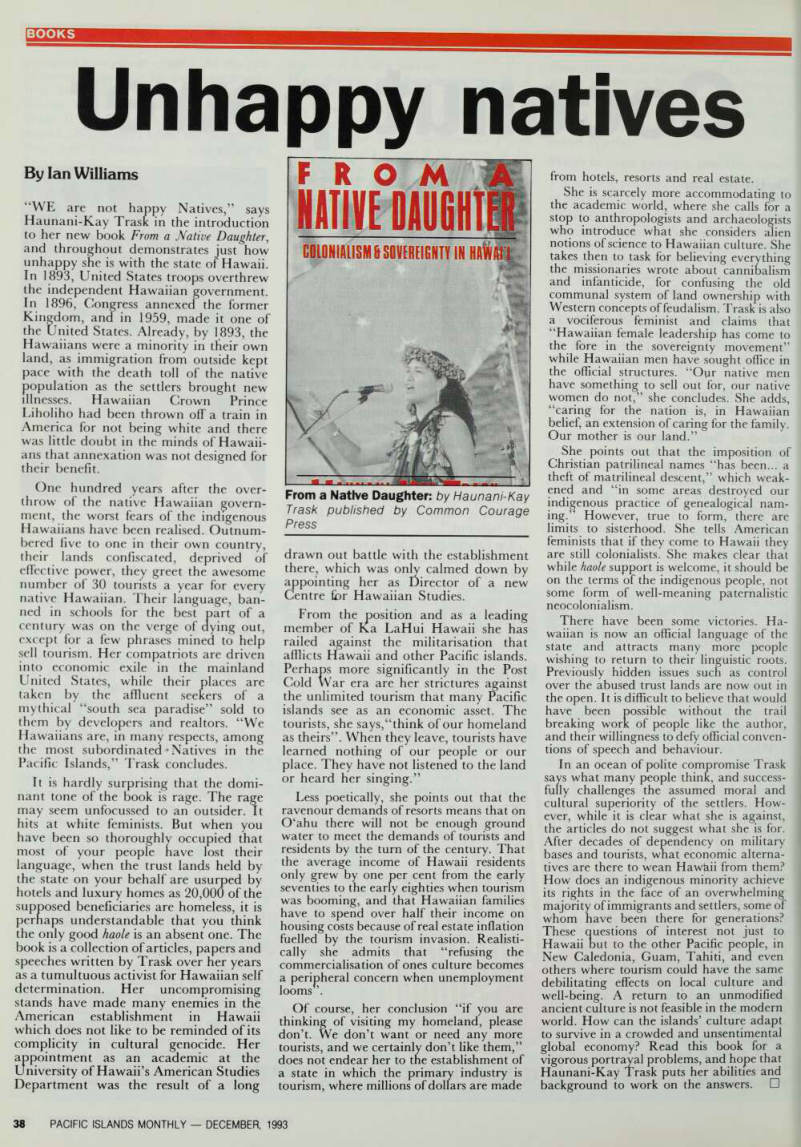
“WE are not happy Natives,” says Haunani-Kay Trask in the introduction to her new book From a Native Daughter , and throughout demonstrates just how unhappy she is with the state of Hawaii.
In 1893, United States troops overthrew the independent Hawaiian government.
In 1896, Congress annexed the former Kingdom, and in 1959, made it one of the United States. Already, by 1893, the Hawaiians were a minority in tlieir own land, as immigration from outside kept pace with the death toll of the native population as the settlers brought new illnesses. Hawaiian Crown Prince Liholiho had been thrown off a train in America for not being white and there was little doubt in the minds of Hawaii ans that annexation was not designed for their benefit.
One hundred years after the over throw of the native Hawaiian govern ment, the worst fears of the indigenous Hawaiians have been realised. Outnum bered five to one in their own country, their lands confiscated, deprived of effective power, they greet the awesome number of 30 tourists a year for every native Hawaiian. Their language, ban ned in schools for the best part of a century was on the verge of dying out, except for a few phrases mined to help sell tourism. Her compatriots are driven into economic exile in the mainland United States, while their places are taken by the affluent seekers of a mythical “south sea paradise” sold to them by developers and realtors. “We Hawaiians are, in many respects, among the most subordinated'Natives in the Pacific Islands,” Trask concludes.
It is hardly surprising that the domi nant tone of the book is rage. The rage may seem unfocussed to an outsider. It hits at white feminists. But when you have been so thoroughly occupied that most of your people have lost their language, when the trust lands held by the state on your behalf are usurped by hotels and luxury homes as 20,000 of the supposed beneficiaries are homeless, it is perhaps understandable that you think the only good haole is an absent one. The book is a collection of articles, papers and speeches written by Trask over her years as a tumultuous activist for Hawaiian self determination. Her uncompromising stands have made many enemies in the American establishment in Hawaii which does not like to be reminded of its complicity in cultural genocide. Her appointment as an academic at the University of Hawaii’s American Studies Department was the result of a long
drawn out battle with the establishment there, which was only calmed down by appointing her as Director of a new Centre for Hawaiian Studies.
From the position and as a leading member of Ka LaHui Hawaii she has railed against the militarisation that afflicts Hawaii and other Pacific islands.
Perhaps more significantly in the Post Cold War era are her strictures against the unlimited tourism that many Pacific islands see as an economic asset. The tourists, she says,“think of our homeland as theirs”. When they leave, tourists have learned nothing of our people or our place. They have not listened to the land or heard her singing.”
Less poetically, she points out that the ravenour demands of resorts means that on o‘ahu there will not be enough ground water to meet the demands of tourists and residents by the turn of the century. That the average income of Hawaii residents only grew by one per cent from the early seventies to the early eighties when tourism was booming, and that Hawaiian families have to spend over half their income on housing costs because of real estate inflation fuelled by the tourism invasion. Realisti cally she admits that “refusing the commercialisation of ones culture becomes a peripheral concern when unemployment looms .
Of course, her conclusion “if you are thinking of visiting my homeland, please don’t. We don’t want or need any more tourists, and we certainly don’t like them,” does not endear her to the establishment of a state in which the primary industry is tourism, where millions of dollars are made
from hotels, resorts and real estate.
She is scarcely more accommodating to the academic world, where she calls for a stop to anthropologists and archaeologists who introduce what she considers alien notions of science to Hawaiian culture. She takes then to task for believing everything the missionaries wrote about cannibalism and infanticide, for confusing the old communal system of land ownership with Western concepts of feudalism. Trask is also a vociferous feminist and claims that “Hawaiian female leadership has come to the fore in the sovereignty movement” while Hawaiian men have sought office in the official structures. “Ovir native men have something to sell out for, our native women do not,” she concludes. She adds, “caring for the nation is, in Hawaiian belief, an extension of caring for the family.
Our mother is our land.”
She points out that the imposition of Christian patrilineal names “has been... a theft of matrilineal descent,” which weak ened and “in some areas destroyed our
indigenous practice of genealogical nam
ing.” However, true to form, there are limits to sisterhood. She tells American feminists that if they come to Hawaii they are still colonialists. She makes clear that while haole support is welcome, it should be on the terms of the indigenous people, not some form of well-meaning paternalistic neocolonialism.
There have been some victories. Ha waiian is now an official language of the state and attracts many more people wishing to return to their linguistic roots.
Previously hidden issues such as control over the abused trust lands are now out in the open. It is difficult to believe that would have been possible without the trail breaking work of people like the author, and their willingness to defy official conven tions of speech and behaviour.
In an ocean of polite compromise Trask says what many people think, and success fully challenges the assumed moral and cultural superiority of the settlers. How ever, while it is dear what she is against, the articles do not suggest what she is for.
After decades of dependency on military bases and tourists, what economic alterna tives are there to wean Hawkii from them?
How does an indigenous minority achieve its rights in the face of an overwhelming majority of immigrants and settlers, some of whom have been there for generations?
These questions of interest not just to Hawaii but to the other Pacific people, in New Caledonia, Guam, Tahiti, and even others where tourism could have the same debilitating effects on local culture and well-being. A return to an unmodified ancient culture is not feasible in the modern world. How can the islands’ culture adapt to survive in a crowded and unsentimental global economy? Read this book for a
vigorous portrayal problems, and hope that
Haunani-Kay Trask puts her abilities and background to work on the answers. □
From a Native Daughter: by Haunani-Kay Trask published by Common Courage Press