Coconut power
p. 37 · Read in the full issue
Technology
By Bill Morton
THERE are few more omnipresent symbols of the Pacific Islands than the humble coconut. From Melanesia to Micronesia to Polynesia it is always there an existing, renewable resource with an important role in everyday life.
Coconut cream is an essential ingredient in household cooking and in special ceremonial dishes. Coconut flesh is used as feed for pigs. Dried coconut in the form of copra has provided an important cash crop.
Now the coconut may have a new significance. Dr Dan Etherington, agri cultural economist with the Research School of Pacific Studies at Australian National University, has found coconut oil may be a viable replacement for diesel oil. His latest research indicates villagers may be able to extract the valuable oil themselves.
Vanuatu is the biggest per capita producer of coconuts in the world with about 3000 nuts per person per year.
Western Samoa produces about half that and the Solomon Islands produce half that amount again. The discovery that locally produced coconut oil can fuel power generators, trucks and outboard motors is exciting news for all the Pacific, and especially for small communities struggling to generate cash income. The cost of diesel bites hard for Pacific communities because it must first be imported into the country and often then transported to remote locations.
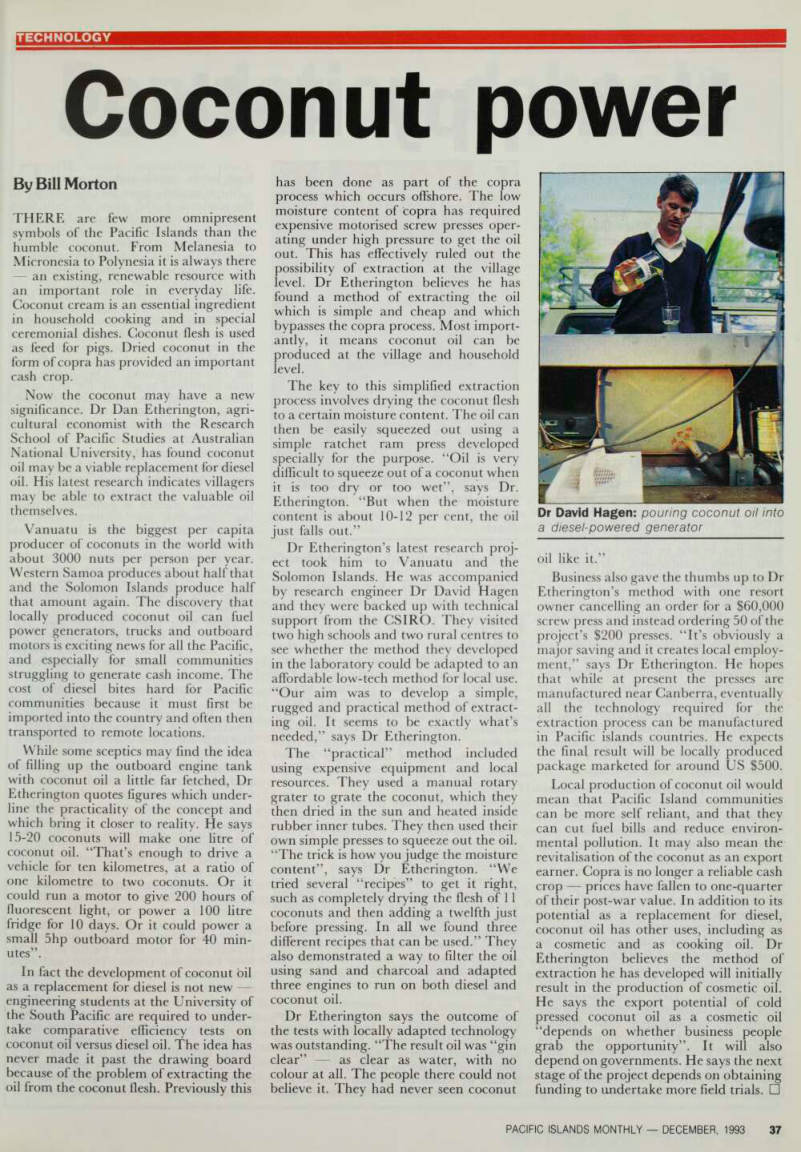
While some sceptics may find the idea of filling up the outboard engine tank with coconut oil a little far fetched, Dr Etherington quotes figures which under line the practicality of the concept and which bring it closer to reality. He says 15-20 coconuts will make one litre of coconut oil. “That’s enough to drive a vehicle for ten kilometres, at a ratio of one kilometre to two coconuts. Or it could run a motor to give 200 hours of fluorescent light, or power a 100 litre fridge for 10 days. Or it could power a small shp outboard motor for 40 min utes”.
In fact the development of coconut oil as a replacement for diesel is not new engineering students at the University of the South Pacific are required to under take comparative efficiency tests on coconut oil versus diesel oil. The idea has never made it past the drawing board because of the problem of extracting the oil from the coconut flesh. Previously this
has been done as part of the copra process which occurs offshore. The low moisture content of copra has required expensive motorised screw presses oper ating under high pressure to get the oil out. This has effectively ruled out the possibility of extraction at the village level. Dr Etherington believes he has found a method of extracting the oil which is simple and cheap and which bypasses the copra process. Most import antly, it means coconut oil can be produced at the village and household level.
The key to this simplified extraction process involves drying the coconut flesh to a certain moisture content. The oil can then be easily squeezed out using a simple ratchet ram press developed specially for the purpose. “Oil is very difficult to squeeze out of a coconut when it is too dry or too wet”, says Dr.
Etherington. “But when the moisture content is about 10-12 per cent, the oil just falls out.”
Dr Etherington’s latest research proj ect took him to Vanuatu and the Solomon Islands. He was accompanied
by research engineer Dr David Hagen
and they were backed up with technical support from the CSIRO. They visited two high schools and two rural centres to see whether the method they developed in the laboratory could be adapted to an affordable low-tech method for local use.
“Our aim was to develop a simple, rugged and practical method of extract ing oil. It seems to be exactly what’s needed,” says Dr Etherington.
The “practical” method included using expensive equipment and local resources. They used a manual rotary grater to grate the coconut, which they then dried in the sun and heated inside rubber inner tubes. They then used their own simple presses to squeeze out the oil.
“The trick is how you judge the moisture content”, says Dr Etherington. “We tried several “recipes” to get it right, such as completely drying the flesh of 11 coconuts and then adding a twelfth just before pressing. In all we found three different recipes that can be used.” They also demonstrated a way to filter the oil using sand and charcoal and adapted three engines to run on both diesel and coconut oil.
Dr Etherington says the outcome of the tests with locally adapted technology was outstanding. “The result oil was “gin clear” as clear as water, with no colour at all. The people there could not believe it. They had never seen coconut
oil like it.”
Business also gave the thumbs up to Dr Etherington’s method with one resort owner cancelling an order for a 560,000 screw press and instead ordering 50 of the project’s $2OO presses. “It’s obviously a major saving and it creates local employ ment,” says Dr Etherington. He hopes that while at present the presses are manufactured near Canberra, eventually all the technology required for the extraction process can be manufactured in Pacific islands countries. He expects the final result will be locally produced package marketed for around US $5OO.
Local production of coconut oil would mean that Pacific Island communities can be more self reliant, and that they can cut fuel bills and reduce environ mental pollution. It may also mean the revitalisation of the coconut as an export earner. Copra is no longer a reliable cash crop prices have fallen to one-quarter of their post-war value. In addition to its potential as a replacement for diesel, coconut oil has other uses, including as a cosmetic and as cooking oil. Dr Etherington believes the method of extraction he has developed will initially result in the production of cosmetic oil.
He says the export potential of cold pressed coconut oil as a cosmetic oil “depends on whether business people grab the opportunity”. It will also depend on governments. He says the next stage of the project depends on obtaining funding to undertake more field trials. □
Dr David Hagen: pouring coconut oil into a diesel-powered generator