Nationals make it
p. 35 · Read in the full issue
Politics
A QUIETER, altogether less dynamic New Zealand is what Pacific nations will need to get used to in the near future. The one-seat majority in parliament by the ruling National Party government following the November 6 election means New Zealand will be more preoccupied with domestic rather than foreign affairs. Initially, most attention has gone on reassuring investors that a
shaken political mixture doess not mean a dangerous economic cocktail. In the first day of trading, the New Zealand share market lost millions of dollars, the Kiwi dollar fell and wholesale interest rates rose sharply.
Prime minister Jim Bolger had already signalled before the election an end to the sweeping economic and social reforms of the past decade, and publicly told treasury not to darken his door with any radical proposals. The massive swing against National at the polls, wiping out the biggest parliamentary majority in New Zealand’s history, is a clear indication the country has had enough of slash-and-burn economics.
The 54 per cent referendum support for voting under Mixed Member Pro portional (MMP) in future elections, signals the end of the days of a majority partly riding roughshod over parlia ment and the public. Alliance leader Jim Anderton says New Zealand
already has MMP-style politics, and
politicians need to adjust now, not after the next election. It’s a message Bolger
has been quick to acknowledge, saying
New Zealand politics had reached the “end of an era” with no room for “egos and preconceived agendas”. Bolger be-
lieves he can work with the Alliance and New Zealand First, saying he’s shown himself capable of
working with people
“whose ideas are not naturally my own”. But it will be an unnatural union.
Jim Anderton and New Zealand First’s Winston Peters both ad
vocate public spending to
create jobs, either through large-scale pub
lie works or by offering incentives to small businesses. Both want a return to free public health and tertiary educa tion, changes to the Accident Compen sation (ACC) scheme and the scrapping of the Employment Contracts Act (EGA). As this would mean National reneging on the past three years, Jim Bolger may face a rebellion within his own caucus. For the moment, Anderton says the party with the most seats should govern and the Alliance MPs will not support no-confidence motions against the government. Winston Peters says only that NZ First will exercise its “balance of responsibility” and wants parliament, not the executive, framing
legislation.
The Labour Party wants a new election under MMP by the end of 1994, and seems to be targeting Anderton as the patsy to try to make it happen. Moor says Labour will test Anderton as the patsy to try to make it happen. Moore says Labour will test Anderton by proposing a series of opposition bills which reflect the Alliance manifesto.
Moore is likely to get his first chance in February when parliament sits for the Address-in-Reply debate. In the mean time, all the parties are quietly prepar ing for an early election. □
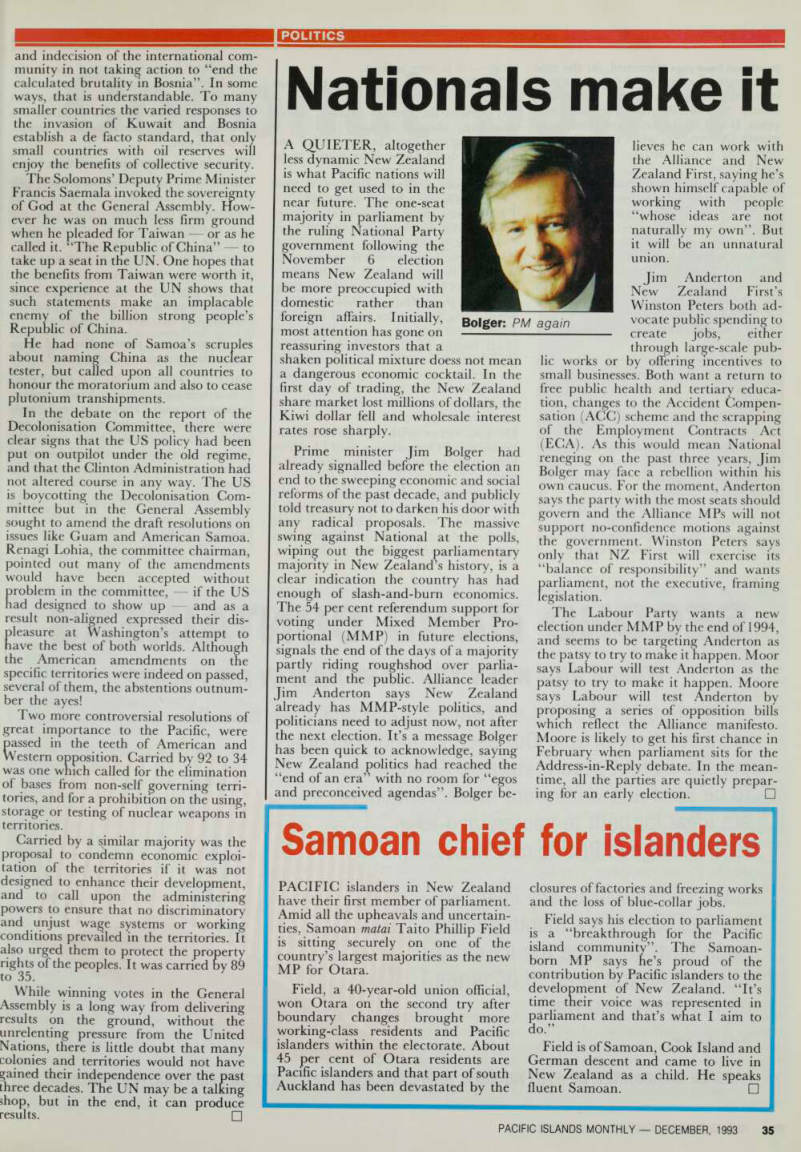
Bolger: PM again