A voice in New York
pp. 34-35 · Read in the full issue
The United Nations
A UN-Pacific round up
with UN correspondent
fan Williams in New York
MORE and more the Pacific island nations are using the United Nations to give their views a leverage that small countries would not otherwise have.
Summing up the change, in his speech to the General Assembly, Moses Resio, external affairs secretary of Micronesia called attention to the change in FSM’s short life. When it became independent, it was reliant on bilateral mostly American-aid. Now, he said, through the work of the UN “with our partici pation,” the special development and environmental needs of small island states like his were being addressed in a variety of settings.
From Agenda 21, the Commission on Sustainable Development and the Glo bal Conference on Small Island states, the islands had made their mark on the international decision-making process.
And Pacific initiatives in New York have had their ripples abroad. The Common wealth Heads of Government Meeting in Cyprus enthusiastically endorsed the Barbados Small Island Summit next April and called upon heads of govern ment to attend.
Among those supporting the initiative was British Prime Minister John Major whose desire for a week in the sun in the Caribbean doubtless shocked the British Mission to the UN in New York which had not hitherto been distinguished by its enthusiasm for the conference.
However, the agenda of the Assembly demonstrates that the SOPAC nations have not restricted themselves to domestic issues. They are all supporting the resolution submitted by Papua New Guinea’s Renagi Renagi Lohia, calling for the establishment of a Commission on “Opportunity and Par
ticipation”.
Across the globe, companies, govern ments and people have been sacrificed on the altar of the “market,” which has been given quasi-religious significance, especi ally when applied to developing econom ies. The commission, drawn from dis tinguished world figures, would look at the failings of the “market” in not allowing for participation by the people of developing countries, and their ex clusion from sources of capital, control over their own resources, and over the terms of trade.
At every level, developing countries are suffering from being increasingly intertwined in a world financial and trading system in which they suffered the consequences while receiving few benefits “As a result,” PNG submission says, “many of the most important, powerful and widespread difficulties experienced in securing opportunities for economic participation by individuals, groups and firms in developing countries, remain largely unattended.”
PNG foreign minister John Kaputin has made a personal crusade of trying to reconcile the best parts of traditional social systems with the opportunities of modern economies. He has pointed out the problems in the importation of Western legal and governmental systems that do not take into account traditional customary law. He has, for example, suggested that this is at the core of the
problems in Bougainville.
In his speech to the UN he pointed out that while PNG was enjoying 9 per cent annual growth rates, that was not true of the living standards of most of the people, who were not participating in the economic boom.
However, the present balance of power disrupts the old protections without replacing them with new ones that the people of the industrialised world enjoy.
Western banking systems, for example do not recognise as collateral land held under traditional title, which may be collectively owned. A way to capitalise that asset without depriving the title of the owners could unlock valuable capital for development.
The proposal has the backing of the Forum, Melanesian Spearhead and many non-aligned governments. In the past, when such things have been said, they have been to the accompaniment of harsh rhetoric about imperialism and Western domination. What distinguishes PNG’s proposal is its non-antagonistic good sense and that the results of such a study could be useful in the industrialised world, where most governments are now committed, albeit in the terms of the market, to getting citizens involved in entrepreneurial activities, whether as shareholders or business people.
All the South Pacific speakers sup ported the PNG initiative (although there were whispers of disgruntlement from some that New Zealand’s endorse ment was not as resoundingly unequi vocal as its Forum membership should make it). For example, Tofilau Eti Alesana, the Samoan prime minister told the General Assembly that “human misery brought about by poverty and the denial of democratic human rights are the real and fundamental problems,” and that dealing with them should be “major preoccupation of the United Nations”.
Speaking a week after the Chinese nuclear test, he tactfully avoided naming the perpetrator when he condemned the breaching of the test moratorium but tied a demand for the end of nuclear testing to an insistence that the South Pacific should not be used as dumping ground for the world’s toxic wastes.
He also, in unusually forthright tones for the Pacific, condemned the slowness
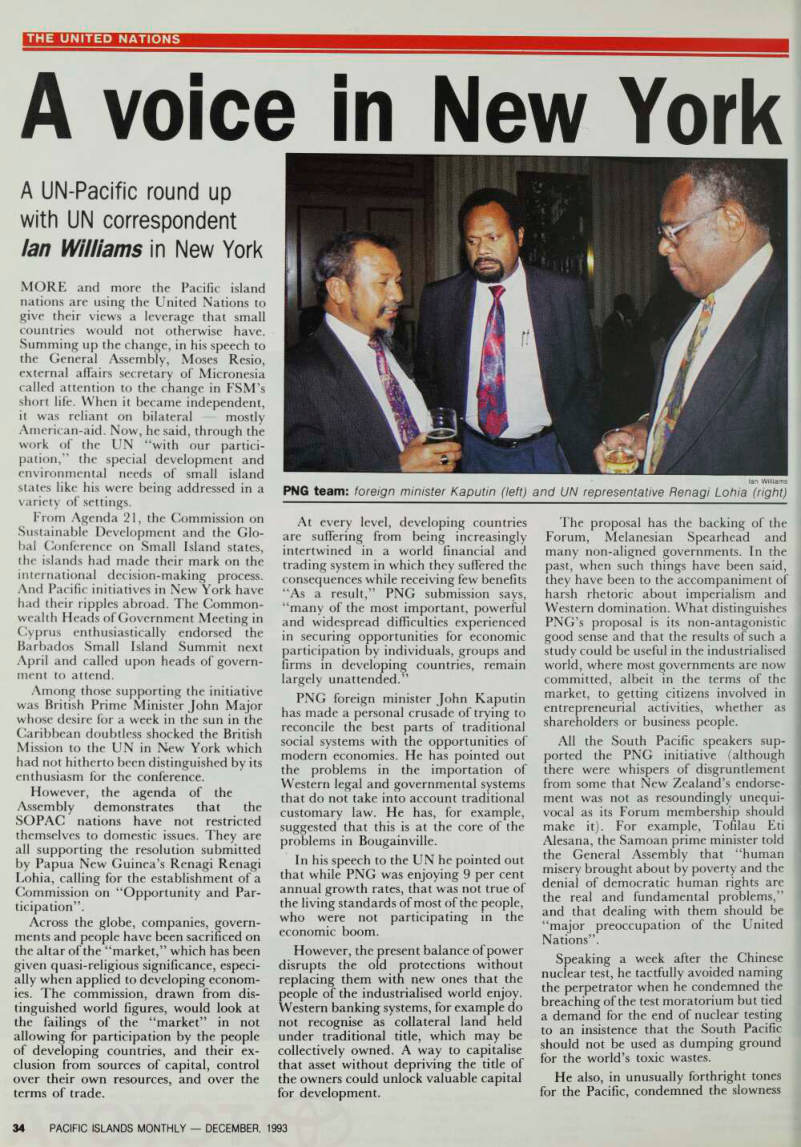
lan Williams PNG team: foreign minister Kaputin (left) and UN representative Renagi Lohia (right)
and indecision of the international com munity in not taking action to “end the calculated brutality in Bosnia”. In some ways, that is understandable. To many smaller countries the varied responses to the invasion of Kuwait and Bosnia establish a de facto standard, that only small countries with oil reserves will enjoy the benefits of collective security.
The Solomons’ Deputy Prime Minister Francis Saemala invoked the sovereignty of God at the General Assembly. How ever he was on much less firm ground when he pleaded for Taiwan or as he called it. “The Republic of China” to take up a seat in the UN. One hopes that the benefits from Taiwan were worth it, since experience at the UN shows that such statements make an implacable enemy of the billion strong people’s Republic of China.
He had none of Samoa’s scruples about naming China as the nuclear tester, but called upon all countries to honour the moratorium and also to cease
plutonium transhipments.
In the debate on the report of the Decolonisation Committee, there were clear signs that the US policy had been put on outpilot under the old regime, and that the Clinton Administration had not altered course in any way. The US is boycotting the Decolonisation Com mittee but in the General Assembly sought to amend the draft resolutions on issues like Guam and American Samoa.
Renagi Lohia, the committee chairman, pointed out many of the amendments would have been accepted without problem in the committee, if the US had designed to show up and as a result non-aligned expressed their dis pleasure at Washington’s attempt to have the best of both worlds. Although the American amendments on the specific territories were indeed on passed, several of them, the abstentions outnum ber the ayes!
Two more controversial resolutions of great importance to the Pacific, were passed in the teeth of American and Western opposition. Carried by 92 to 34 was one which called for the elimination of bases from non-self governing terri tories, and for a prohibition on the using, storage or testing of nuclear weapons in territories.
Carried by a similar majority was the proposal to condemn economic exploi tation of the territories if it was not designed to enhance their development, and to call upon the administering powers to ensure that no discriminatory and unjust wage systems or working conditions prevailed in the territories. It also urged them to protect the property rights of the peoples. It was carried by 89 to 35.
While winning votes in the General Assembly is a long way from delivering results on the ground, without the unrelenting pressure from the United Nations, there is little doubt that many colonies and territories would not have gained their independence over the past three decades. The UN may be a talking >hop, but in the end, it can produce results. □