Terrible taro blight
pp. 14-15 · Read in the full issue
IN a region renown for root crop diseases the return of yet another unpronounce able bacterial infestation (Phytophthora colocasiae) would generally not be worthy of comment but most regrettably the one presently destroying the Western Samoan taro crop has a long and terrifying pedigree. A close cousin of this disease is the infamous potato blight which resulted in a famine that killed 30 per cent of Ireland’s population in the 1840 s and forced millions to emigrate.
Closer to home the taro leaf blight devastated the taro crop in large parts of the Solomon Islands after World War 11.
The disease was so devastating that those areas of the country that were previously taro producing areas shifted to other root crops such as sweet potato and cassava.
The Western Samoan Department of Agriculture reports the disease has spread to every district on the island of Upolu and is reported on 60 per cent of the island of Savai’i. The spread of the disease is remarkably rapid as it was only discovered in Western Samoa in July of this year. It is expected that the blight
will wipe out 40 per cent of Samoa’s crop this year and there is every likelihood the effects in the longer term will be to wipe out, at least for one year, virtually the entire crop. In 1991 total exports of taro from Western Samoa was close to WSS6.9 million most of which went to Auckland. However according to World Bank estimates the official export figure
greatly underestimates the amount of taro actually leaving the country because a substantial proportion of exports is leaving the country carried by emigrants and returning residents of New Zealand.
Exporters also have tendency to under report the volume and value of exports.
Total value of exports of taro from Western Samoa may actually be twice
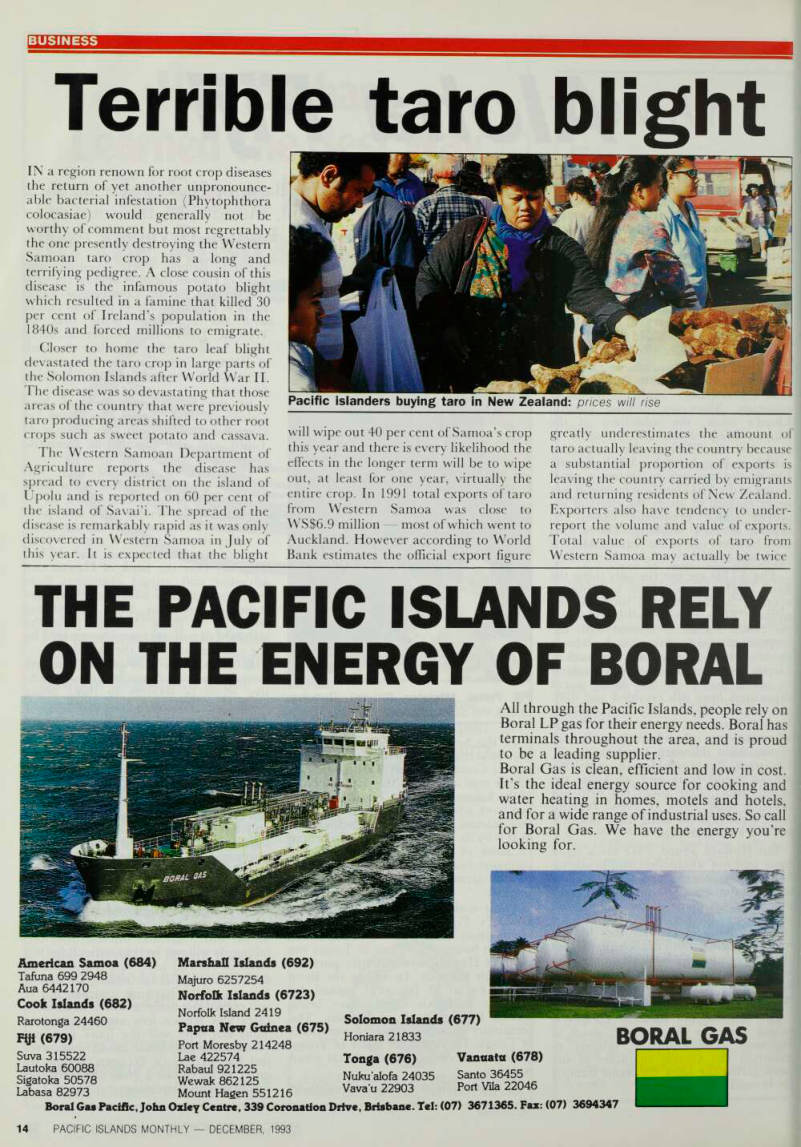
Pacific islanders buying taro in New Zealand: prices will rise
what is officially recorded in government statistics.
The only known way of halting the outbreak of the disease is to undertake a complete field sanitation which basically means halting the production of taro in Western Samoa for one year.
Needless to say this would devastate the Western Samoan economy which is a major exporter of taro the US and New Zealand markets. Moreover, it would mean that the country would have to move temporarily to other food crops as well as bringing in more imported food.
Another alternative would be for Western Samoa to abandon ‘Taro Niue’ the most common and preferred variety and move over to other more disease resistant varieties.
The giant taro is far more resistant to this type of leaf blight than Taro Niue but is for generally good reasons of taste disliked by Samoans. Perhaps just as importantly giant taro does not have a very long shelf life making it a poor export product.
While there had been no major effects af the outbreak on exports to New Zealand exporters are expecting to feel a rapid decline in Western Samoan exports n November and December as demand or taro in New Zealand increases.
Shipments to New Zealand were dready declining in late October. In >rder to meet the short fall in demand mporters will be looking to Fiji to supply he market of Pacific Islanders in New Zealand.
According to Alf Hazelman, a Suva >ased exporter, prices have already been ising and there is already a natural endency for prices of taro to rise towards Christmas time in Fiji. He said “It is very loubtful that Fiji would be able to meet big rise in demand for taro from New Zealand as we produce very little ‘Taro fiue’. It will take us quite some time to e able to expand production.”
Market prices in Suva have already isen sharply in the last few months ecause of drought conditions in the ountry. Prices have risen from Fs6oo er tonne in the middle of the year to $lOOO in November. December prices re expected to rise even further accord ig to Hazelman.
Just like Cyclone Ofa in 1990 in /estern Samoa this disaster will cause icreases in taro prices in Fiji, Western amoa and New Zealand and the ripple feet will be felt throughout the entire acific. As in all commodity trade, one
roducer’s blight is another’s blessing but
essing or blight the consumer will pay. □