Aloha Fill
p. 13 · Read in the full issue
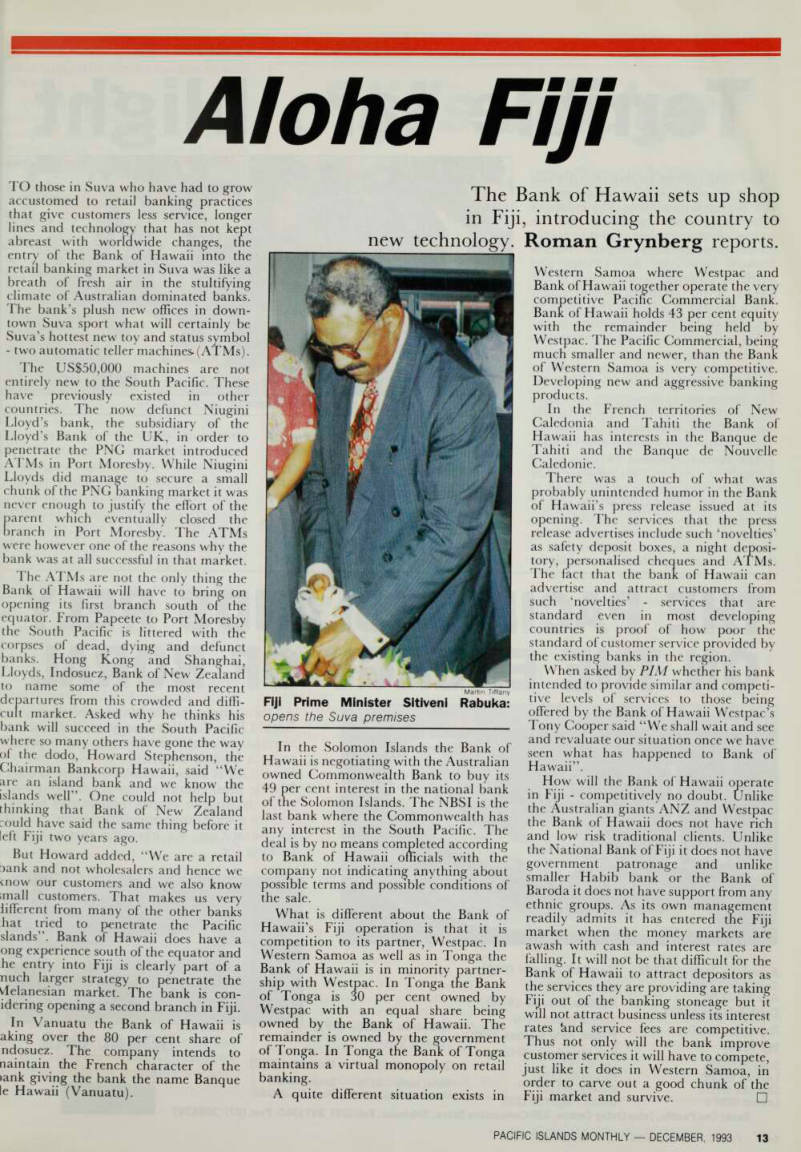
TO those in Suva who have had to grow accustomed to retail banking practices that give customers less service, longer lines and technology that has not kept abreast with worldwide changes, the entry of the Bank of Hawaii into the retail banking market in Suva was like a breath of fresh air in the stultifying climate of Australian dominated banks.
The bank’s plush new offices in down town Suva sport what will certainly be Suva’s hottest new toy and status symbol - two automatic teller machines (ATMs).
The US$5O,OOO machines are not entirely new to the South Pacific. These have previously existed in other countries. The now defunct Niugini Lloyd’s bank, the subsidiary of the Lloyd’s Bank of the UK, in order to penetrate the PNG market introduced ATMs in Port Moresby. While Niugini Lloyds did manage to secure a small chunk of the PNG banking market it was never enough to justify the effort of the parent which eventually closed the branch in Port Moresby. The ATMs were however one of the reasons why the bank was at all successful in that market.
The ATMs are not the only thing the Bank of Hawaii will have to bring on opening its first branch south of the equator. From Papeete to Port Moresby the South Pacific is littered with the corpses of dead, dying and defunct
banks. Hong Kong and Shanghai,
Lloyds, Indosuez, Bank of New Zealand to name some of the most recent departures from this crowded and diffi cult market. Asked why he thinks his bank will succeed in the South Pacific where so many others have gone the way of the dodo, Howard Stephenson, the Chairman Bankcorp Hawaii, said “We are an island bank and we know the islands well”. One could not help but thinking that Bank of New Zealand :ould have said the same thing before it left Fiji two years ago.
But Howard added, “We are a retail aank and not wholesalers and hence we enow our customers and we also know •mall customers. That makes us very different from many of the other banks hat tried to penetrate the Pacific slands”. Bank of Hawaii does have a ong experience south of the equator and he entry into Fiji is clearly part of a nuch larger strategy to penetrate the Helanesian market. The bank is con idering opening a second branch in Fiji.
In Vanuatu the Bank of Hawaii is aking over the 80 per cent share of ndosuez. The company intends to naintain the French character of the >ank giving the bank the name Banque
le Hawaii (Vanuatu).
The Bank of Hawaii sets up shop in Fiji, introducing the country to new technology. Roman Grynberg reports.
In the Solomon Islands the Bank of Hawaii is negotiating with the Australian owned Commonwealth Bank to buy its 49 per cent interest in the national bank of the Solomon Islands. The NBSI is the last bank where the Commonwealth has any interest in the South Pacific. The deal is by no means completed according to Bank of Hawaii officials with the company not indicating anything about possible terms and possible conditions of the sale.
What is different about the Bank of Hawaii’s Fiji operation is that it is competition to its partner, Westpac. In Western Samoa as well as in Tonga the Bank of Hawaii is in minority partner ship with Westpac. In Tonga trie Bank of Tonga is 30 per cent owned by Westpac with an equal share being owned by the Bank of Hawaii. The remainder is owned by the government of Tonga. In Tonga the Bank of Tonga maintains a virtual monopoly on retail
banking.
A quite different situation exists in
Western Samoa where Westpac and Bank of Hawaii together operate the very competitive Pacific Commercial Bank.
Bank of Hawaii holds 43 per cent equity with the remainder being held by Westpac. The Pacific Commercial, being much smaller and newer, than the Bank of Western Samoa is very competitive.
Developing new and aggressive banking products.
In the French territories of New Caledonia and Tahiti the Bank of Hawaii has interests in the Banque de Tahiti and the Banque de Nouvelle Caledonie.
There was a touch of what was probably unintended humor in the Bank of Hawaii’s press release issued at its opening. The services that the press release advertises include such ‘novelties’ as safety deposit boxes, a night deposi tory, personalised cheoues and ATMs.
The fact that the bank of Hawaii can advertise and attract customers from such ‘novelties’ - services that are standard even in most developing countries is proof of how poor the standard of customer service provided by the existing banks in the region.
When asked by PIM whether his bank intended to provide similar and competi tive levels of services to those being offered by the Bank of Hawaii Westpac’s Tony Cooper said “We shall wait and see and revaluate our situation once we have seen what has happened to Bank of Hawaii”, How will the Bank of Hawaii operate in Fiji - competitively no doubt. Unlike the Australian giants ANZ and Westpac the Bank of Hawaii does not have rich and low risk traditional clients. Unlike the National Bank of Fiji it does not have government patronage and unlike smaller Habib bank or the Bank of Baroda it does not have support from any ethnic groups. As its own management readily admits it has entered the Fiji market when the money markets are awash with cash and interest rates are falling. It will not be that difficult for the Bank of Hawaii to attract depositors as the services they are providing are taking Fiji out of the banking stoneage but it will not attract business unless its interest rates hnd service fees are competitive.
Thus not only will the bank improve customer services it will have to compete, just like it does in Western Samoa, in order to carve out a good chunk of the Fiji market and survive. □
Martin Tiffany FIJI Prime Minister Sitiveni Rabuka: opens the Suva premises