Terrible Tarawa
p. 29 · Read in the full issue
History
By Peter McQuarrie
FIFTY years ago US marines began their first counter-offensive against Japanese forces in the Central Pacific War, in November 1943. The Battle of Tarawa or “Operation Galvanic” as it was code named, was the first amphibi ous landing on a coral atoll and it proved to be a disaster for the Americans who suffered high casualties. They had under estimated the strength of the Japanese fortifications on the island and had greatly over-estimated the effectiveness of their own “softening-up” bombing.
Worst of all, they completely miscalcu lated the tides so that their landing craft became stranded on the surrounding reef, hundreds of metres from the beaches and marines were cut down by machine gun fire as they attempted to wade ashore.
The assault on Tarawa in the Gilbert Islands (now the Republic of Kiribati) was the first of a series of amphibious landings and the beginning of an island hopping campaign across the Central Pacific. The Gilbert, Marshall, Caroline and Mariana Islands would be captured, the stepping stones along the path to Tokyo. The US military had scant information of the reefs, coasts and other geographical features of Tarawa so they enlisted the help of British expatriates who had lived in the British colony before it was captured by the Japanese. They also called on the knowledge of ships’ captains familiar with the port of Betio.
The Americans were warned that the surrounding reef would be completely dry at the low spring tides and would be covered by less than two-metres of water at high springs. The best bet was obviously high water spring tides.
At the time the Americans were still developing and testing amphibious as sault vehicles. They had made practice landings and had assessed two types of amphibious vehicles, the DUKW (Duck) and the Landing Vehicle Tracked (LVT) or ‘amtrac’. It was decided that the amtrac was the solution for the Tarawa operation but only 75 vehicles were shipped with the marine division when it headed out of Tarawa. A further 100 were promised for the invasion but only 50 of these arrived in time.
Amatracs would form the first waves of the attack but reserves would have to make it to shore in landing craft and wooden ‘Higgins Boats’.
D-Day for Galvanic was set for November 20. One of the British ad visers, Major F G L Holland, travelling with the American task force, was appalled by the date. But at that late stage the Americans would not be persuaded to alter the date. In Novem ber 1943 the moon was in the last quarter
at two hours before midnight on the 19th, this produced a period of neap tides and vvas the worst possible time for an amphibious landing. The American attack began with the bombing of Betio islet, the fortified Japanese base on Tarawa. First there were the land-based B-24 Liberator bombers from bases on Nanumea and Funafuti in the Ellice Islands and from Canton Island in the Phoenix Group. Then a day before the landing, carrier based planes of the task force undertook further bombings raids.
On the morning of the invasion there were further bombing attacks by the carrier planes and Americans battleships shelled the island. The bombardment of the four kilometres by 500 metres was impressive, nearly every stick of vegelation was destroyed and the Americans believed it was impossible that any human could be left alive on Betio. They had however grossly underestimated the strength of this Japanese fortress. The Japanese had built concrete blockhouses with walls two-metres thick and then covered these with layers of coconut palm logs, sandbags, and finally sand.
Their commanding officer, Rear Admiral Keiji Shibasaki, had informed his men that a million men could not take Tarawa in a hundred years.
The American plan was to land 18,600 marines against what remained of the 2619 Japanese garrison troops and the 2217 construction workers (mostly Koreans) and to capture the island within 24 hours. So American marines headed for shore in their amtracs, believing that they would meet little resistance, but the Japanese defences had hardly been touched. When the amtracs came over the reef the marines soon learnt that the Japanese defences were alive. Many amtracs were knocked out by mortar fire before they made it to the
beaches. Those who safely arrived at the beach found that there was a barricade of coconut palm logs one to 1.5 metres high, along the edge of the beach, over which the amtracs could not climb. The marines, pinned-down on the beaches, urgently needed assistance and it was when attempts were made to provide this that the real disaster occurred. The landing craft bringing reserves could not get over the reef. Tfiey grounded hun dreds of metres out from the beach. The men had little protection from machine gun fire in the open landing craft, and none at all as they attempted to wade ashore. They were shot down in the hundreds. The situation was improved when Hell Cat fighter planes and dive bombers and US destroyers attacked the
Japanese positions and shelled the island.
Eventually the surviving amtracs were able to ferry reinforcements to shore and by the afternoon of the second day several Sherman tanks had landed.
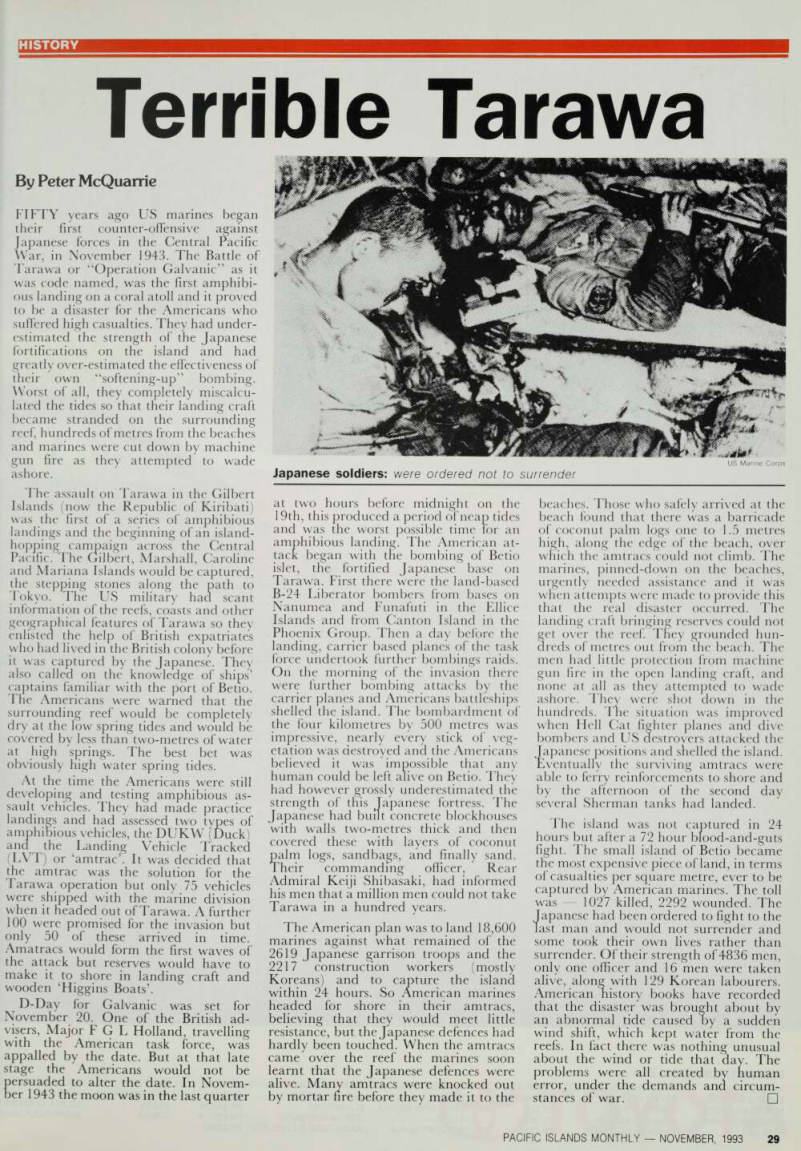
The island was not captured in 24 hours but after a 72 hour blood-and-guts fight. The small island of Betio became the most expensive piece of land, in terms of casualties per square metre, ever to be captured by American marines. The toll was - 1027 killed, 2292 wounded. The Japanese had been ordered to fight to the last man and would not surrender and some took their own lives rather than surrender. Of their strength of 4836 men, only one officer and 16 men were taken alive, along with 129 Korean labourers.
American history books have recorded that the disaster was brought about by an abnormal tide caused By a sudden wind shift, which kept water from the reefs. In fact there was nothing unusual about the wind or tide that day. The problems were all created by human error, under the demands and circum stances of war. □
Japanese soldiers: were ordered not to surrender
US Marine Corps