Reforming trade laws
p. 28 · Read in the full issue
LET’S face it proposals
for the reform of trade laws in this region tend not to excite as much interest as the more “juicy”, politically-pregnant issues of corruption in PNG, logging in Vanuatu, the Bougainville situation and dare I say, the
Hilly government’s declar
ation of yours truly as persona non grata in Solomon Islands.
Yet the question of overhauling the arcane laws regulating commerce in the Pacific can not be shunned for too long in a region which is vigorously courting international trade and investment to propel its economic advancement.
Exactly a year ago, the Pacific Economic Cooperation Council (PECC) convened an exploratory meeting in Canberra on “Harmonisation of International Trade Law to Benefit Trade, Business and Investment in the Pacific Basin”.
The PECC initiative stemmed from a genuine concern about the high transaction costs and uncertainty associ ated with trading in a region where national commercial laws are so divergent from internationally-accepted norms and practice. Add to this the problem of intransparency of existing laws in some countries and what you have is a situation militating against any prospect for Asia-Pacific
regional integration.
Now, whatever be one’s stance in the debate on regional integration, few will quarrel with the observation that disparate national mercantile laws constitute yet another non-tariff barrier to international trade.
Speaking on this subject in Canberra, I pointed out that the Pacific islands have had more or less uniform commercial laws for over a century. Following our colonisation, we “inherited” the legal systems and traditions of our colonisers including, of course, the laws and customs regulating commercial life in the metropolis.
Thus, for example, the English Sale of Goods Act and Bills of Exchange Act applied in the British colonies. Similarly, French mercantile law applied uniformly throughout the French colonies. And so on.
With one or two exceptions, the colonial legal framework has remained largely intact in the post independence era. And this is not because of any conscious decision to preserve the system. Without any pressure for reform from the business and legal communities, most Pacific governments have preferred to ‘let sleeping dogs lie’. And why not? Isn’t the system working perfectly? I doubt that very much.
What is even more disconcerting is the realisation that colonial commercial laws have remained on the statute books in the Pacific despite their modification (and in some cases, complete repeal) in the mother country. Our much-
prized colonial legal ‘legacies’ the legislation on sale of goods, maritime transport and arbi tration, to take some British ex amples derive more respect as relics in a British museum than they do in a London legal book
shop.
The commercial arbitration scene illustrates these points rather well. The former English arbi tration legislation contained a
provision empowering an arbi
trator to state a special case to the court at any time on any question of law arising out of the arbi tration. Now, the case-stated pro cedure had provoked trenchant criticism in England leading to its abolition in the revised Arbi tration Act of 1979.
The procedure represented a powerful tactical weapon in the armoury of the recalcitrant party for creating delays and otherwise impeding the efficient conduct of the arbitration.
Despite reforms in England and elsewhere, the case stated procedure continues to exist on the statute books of several Pacific nations. The situation was not remedied by the Solomon Islands parliament when it enacted a new Arbitration Act in 1987. What is remarkable about that legislation is that Section 21 (which retains the case-stated procedure) is followed immediately by Section 22 which provides a very restricted facility for leave to appeal. The latter provision, borrowed “lock, stock and barrel from Section 1 of the 1979 English Act, sits rather uncomfort ably in the scheme of the Solomon Islands Act. The juxtaposition of the two provisions also ignores the
philosophy underlying reforms in England.
So how does the Pacific compare with other regions and countries of the world? “Not so badly, except that we are a hundred or so years behind” might be an instinctive response. Seriously though, within the Pacific Basin a number of countries are modernising their trade laws by
adopting more progressive, trade-responsive statutory
instruments.
Both the Canberra meeting and that held in Singapore in September (where I was joined by Isikeli Mataitoga, Fiji’s dynamic Solicitor-General and Rima Ravusiro, the Forum Secretariat’s Trade & Investment Officer) noted that the traditionally sensitive issue of sovereignty is also becoming less significant in the borderless world of international trade.
Whether our developing international outlook on trade matters is reflected in our trading laws is another matter one clearly befitting urgent consideration by one of our regional bodies. Now, there’s a thought for another aid
funded project proposal!
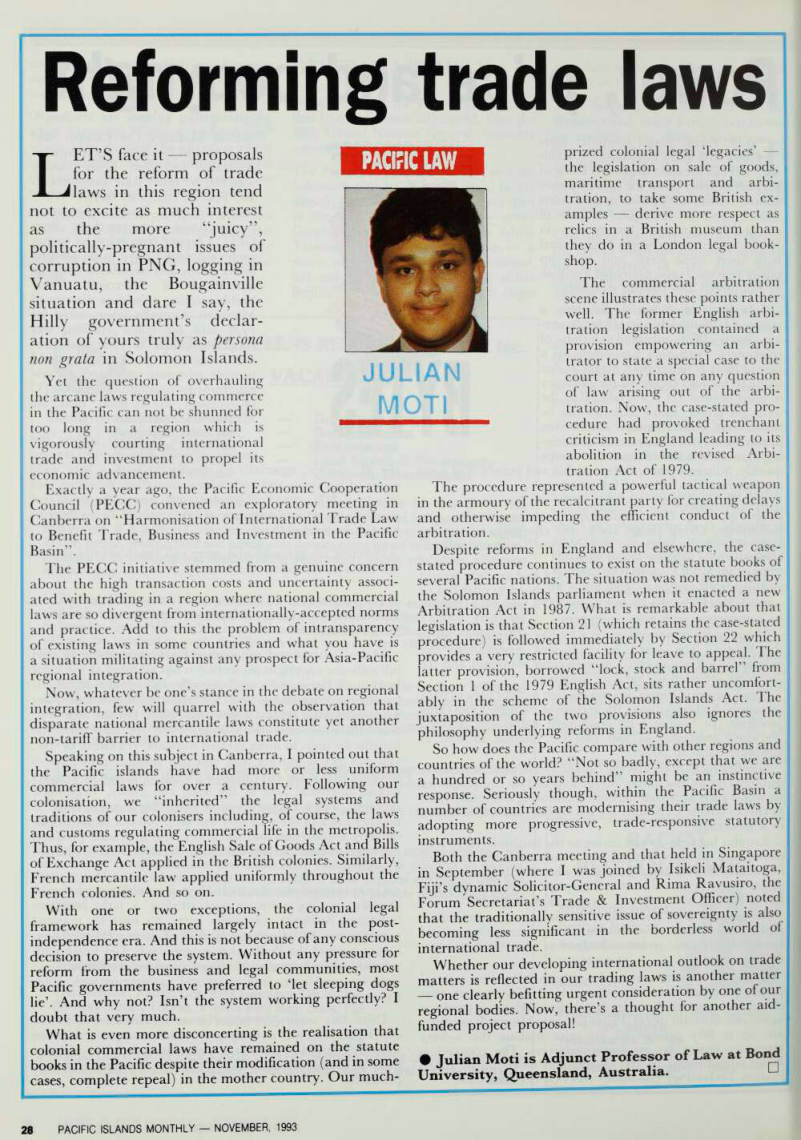
• Julian Moti is Adjunct Professor of Law at Bond University, Queensland, Australia.