Blessing
p. 13 · Read in the full issue
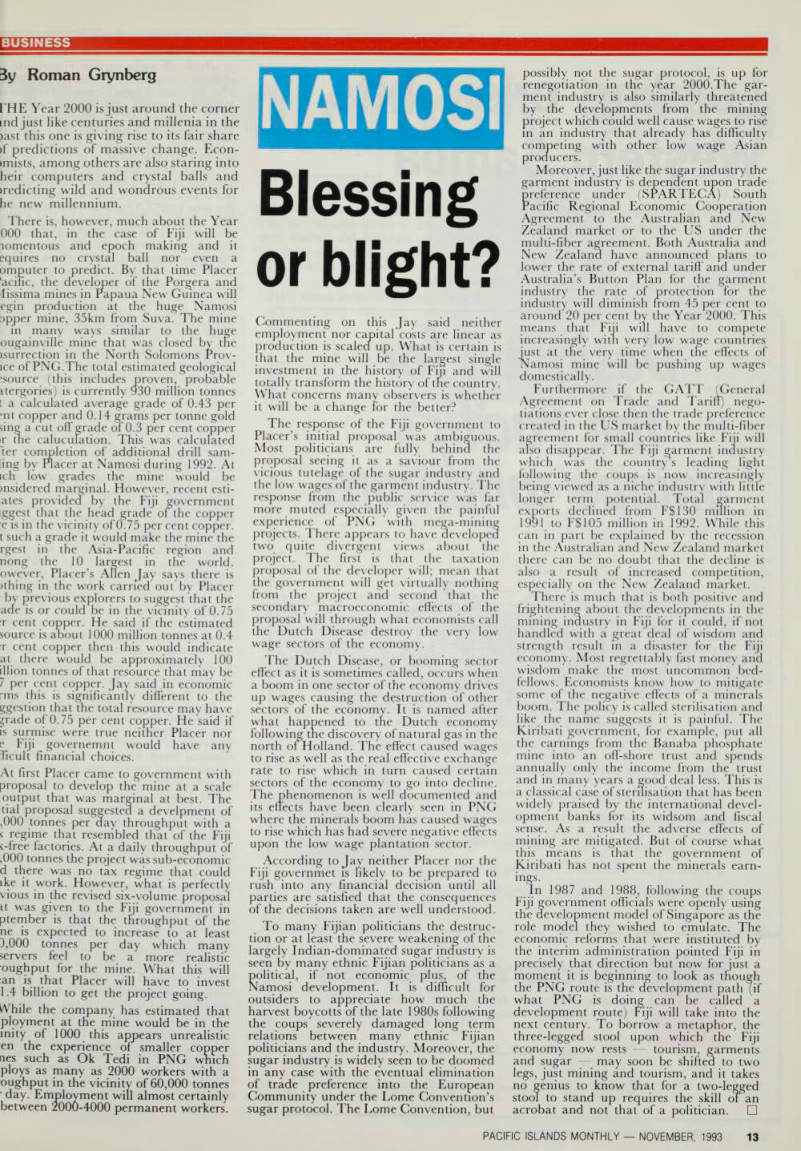
Namosi
Blessing or blight?
Commenting on this Jay said neither employment nor capital costs are linear as production is scaled up. What is certain is that the mine will be the largest single investment in the history of Fin and will totally transform the history of tne country.
What concerns many observers is whether it will be a change for the better?
The response of the Fiji government to Placer’s initial proposal was ambiguous.
Most politicians are fully behind the proposal seeing it as a saviour from the vicious tutelage of the sugar industry and the low wages of the garment industry. The response from the public service was far more muted especially given the painful experience of PNG with mega-mining projects. There appears to have developed two quite divergent views about the project. The first is that the taxation proposal of the developer will; mean that the government will get virtually nothing from the project and second that the secondary macroeconomic effects of the proposal will through what economists call the Dutch Disease destroy the very low wage sectors of the economy.
The Dutch Disease, or booming sector effect as it is sometimes called, occurs when a boom in one sector of the economy drives up wages causing the destruction of other sectors of the economy. It is named after what happened to tne Dutch economy following tne discovery of natural gas in the north ofHolland. The effect caused wages to rise as well as the real effective exchange rate to rise which in turn caused certain sectors of the economy to go into decline.
The phenomenon is well documented and its effects have been clearly seen in PNG where the minerals boom has caused wages to rise which has had severe negative effects upon the low wage plantation sector.
According to Jay neither Placer nor the Fiji governmet is likely to be prepared to rush into any financial decision until all parties are satisfied that the consequences of the decisions taken are well understood.
To many Fijian politicians the destruc tion or at least the severe weakening of the largely Indian-dominated sugar industry is seen by many ethnic Fijian politicians as a political, if not economic plusL of the Namosi development. It is difficult for outsiders to appreciate how much the harvest boycotts of the late 1980 s following the coups severely damaged long term relations between many ethnic Fijian politicians and the industry. Moreover, the sugar industry is widely seen to be doomed in any case with the eventual elimination of trade preference into the European Community under the Lome Convention’s sugar protocol. The Lome Convention, but
possibly not the sugar protocol, is up for renegotiation in the year 2000. The gar ment industry is also similarly threatened
by the developments from the mining
project which could well cause wages to rise m an industry that already has difficulty competing with other low wage Asian
producers.
Moreover, just like the sugar industry the garment industry is dependent upon trade preference under (SPARTECA) South
Pacific Regional Economic Cooperation
Agreement to the Australian and New Zealand market or to the US under the multi-fiber agreement. Both Australia and New Zealand have announced plans to lower the rate of external tariff and under Australia’s Button Plan for the garment industry the rate of protection for the industry will diminish from 45 per cent to around 20 per cent by the Year 2000. This means that Fiji will have to compete increasingly witn very low wage countries just at the very time when the effects of Namosi mine will be pushing up wages
domestically.
Furthermore if the GATT (General Agreement on Trade and Tariff) nego tiations ever close then the trade preference created in the US market by the multi-fiber agreement for small countries like Fiji will
also disappear. The Fiji garment industry
which was the leading light following the coups is now increasingly being viewed as a niche industry with little longer term potential. Total garment exports declined from FSI3O million in 1991 to FSIOS million in 1992. While this can in part be explained by the recession in the Australian and New Zealand market there can be no doubt that the decline is also a result of increased competition, especially on the New Zealand market.
There is much that is both positive and frightening about the developments in the mining industry in Fiji for it could, if not handled with a great deal of wisdom and strength result m a disaster for the Fiji economy. Most regrettably fast money and wisdom make the most uncommon bed fellows. Economists know how to mitigate some of the negative effects of a minerals boom. The policy is called sterilisation and like the name suggests it is painful. The Kiribati government, for example, put all the earnings from the Banaba phosphate mine into an off-shore trust and spends annually only the income from the trust and in many years a good deal less. This is a classical case of sterilisation that has been
widely praised by the international devel
opment banks for its widsom and fiscal sense. As a result the adverse effects of mining are mitigated. But of course what this means is that the government of Kiribati has not spent the minerals earn
ings.
In 1987 and 1988, following the coups
Fiji government officials were openly using
the development model of Singapore as the role model they wished to emulate. The economic reforms that were instituted by the interim administration pointed Fiji in precisely that direction but now for just a moment it is beginning to look as though the PNG route is the development path (if what PNG is doing can be called a development route) Fiji will take into the next century. To borrow a metaphor, the three-legged stool upon which the Fiji economy now rests tourism garments and sugar may soon be shifted to two legs, just mining and tourism, and it takes no genius to know that for a two-legged stool to stand up requires the skill of an acrobat and not that of a politician. □