Squash success
pp. 12-13 · Read in the full issue

Business
By Roman Grynberg
Why Tonga has been able to get top prices in Japan
FOR the past six years, a visit to Tonga’s main island of Tongatapu in the month of October was a lesson that the myth of the unentrepreneurial Pacific islander was completely misplaced. The island is literally transformed, at least for a month or two into the hub of export driven commerce the sort of thing that would gladden the heart of any World Bank official.
Everywhere you look there are farmers busily harvesting their crop of squash ready for the lucrative Japanese market.
However, if the expansion that is cur rently beginning in Vanuatu and similar attempts to expand in Western Samoa and New Caledonia, then the lucrative Japanese niche market that exists in November and December of each year may well turn into a grave for squash growers.
Squash, despite its shape and appear ance, has become an attractive vegetable in western countries. High in fibre, it is a frequently recommended vegetable in diet conscious western countries. How ever, it is in the ‘far west’ ie. Japan, that the vegetable constitutes a standard staple for low income individuals. The Butternut or Delicia squash (cubrita maxima) is hybrid member of the pump kin family. Japanese consumption of squash stands at about 200,000 tonnes per annum with about 60 per cent being grown domestically and tne remainder being mainly imported from New Zea land, Mexico and the United States.
The New Zealand and Mexican sup pliers come on stream in January-May and the US and Pacific islands supply in the November-December period. The beauty of Tonga’s position is that it is able to supply squash just at the very time when there are virtually no other supplies on the market and as a result it gets peak prices for its product. Squash requires cool climates at night ana as a result there are few places mat are able to supply the Japanese market in the
peak period.
Fiji Situation
For years the agricultural experts have been telling the Pacific islanders what they painfully know for decades there is no future in copra and they had better find niche markets that are more appro griate. Fiji was the first country in the acific to discover that it had the potential to export squash to Japan. In 1984, Fiji’s National Marketing Author ity (NMA) contracted farmers to start growing squash in western Viti Levu.
The crop was a disaster. In 1987, the NMA tned again but this time with the assistance of some seasoned New Zealand squash growers. Unfortunately, divine rather human intervention caused the 1988 failure which resulted from one of
the worst droughts in Fiji’s history.
In 1988, the Fiji farmers were told that the maturity period of squash would be from 90-95 days. In reality the maturity period was only 65-70 days and as result the Fiji crop in that year hit the market too early and got the lowest possible prices, less than half the Tongan price.
Production in 1988 peaked in Fiji that year at 500 tonnes but by 1992 exports to Japan had fallen to 185 tonnes. While there are growers in the Sigatoka Valley
the export industry has gone nowhere in large measure because the Fiji Ministry of Primary Industries has not been successful in getting the industry organ ised.
Tonga gets it Right While Tiji could hardly be called a success in squash market, Tonga has in large measure been a text book case.
What made Tonga work and Fiji fail?
The first difference between Fiji and Tonga was that squash production got the whole-hearted support of the govern ment and in Tonga has royal patronage which has meant that the country has in large measure been mobilised behind it.
The other key factor was that govern ment has provided the industry with important financial credits whicn have helped facilitate the development of an industry which remains an intensive user of working capital (seed of the Delicia, for example, costs around Ts4oo/kg).
While officials may now not be happy to admit it, much of the reason for the industry’s early success stems also from involvement by New Zealanders experi enced in the industry who did muen to transfer the technology to Tonga.
While they provided the information that helped Tonga move quickly down its learning curve it has largely been Tongans who moved the industry into high gear. A good Tongan farmer will earn some T 52200 per acre from squash as compared to TSI9OO from vanilla and TS7OO from copra. With an average size
farm of four acres Tongan growers are
earning exceptionally high incomes by
regional standards from a crop that only occupied land 3-4 months per year.
Vanuatu Jumps In For a while tne Tongan squash industry puttered along nicely just as one would nave expected out as it was the best game in town the inevitable happened. In 1991, just as the law of supply and demand predicts everyone wanted tc grow squash and in a region where saying no” is considered impolite the Tongan government allowed it to hap pen.
The number of growers expanded rapidly form 39(3 in 1990 tc approximately 1500 in 1991. Productior for the Japanese market expanded frorr 5700 tonnes in 1990 to 21,900 tonnes ir 1991. This figure was well beyond the 18,000 tonnes that the Japanese markei could absorb. The price in Japar collapsed from Y275/kg in 1990 tc Y167/kg and a large number of Japanese
importers got their fingers badly burned
The near catastrophe of 1991 resultec in losses of at least T 52.7 million tc importers who set their prices for toe high. Fortunately for Tonga, the govern ment immediately took the right re medial measures to defend the industry In 1992 production was limited to 10,00( tonnes, legislation was introduced tc control standards and quality, and the number of exporters limited. The experi ence of 1991, however, was far longei reaching because Tonga’s reputation suffered. The Japanese mod market is 2 » profitable place if you can get ir e standards are high and exacting The losses of 1991 have meant that some Japanese importers have started looking to other suppliers.
In no small measure the mistakes of 1991 have given greater impetus to new supplier: like Vanuatu where large producers like Robert Bohn, an American plantation owner, are looking to expand productior substantially. Mr Bohn and his suppliers are intending to increase their productior from the current level of 500 tonnes tc eventually 5000 tonnes. Again whethei Vanuatu can supply will depend upon whether they will be able control quality and maintain regularity of supply.
Free Markets of Free For All?
The real question is whether Tonga can continue to control the small Japanese niche markets in November and December.
Squash is a very particular vegetable il likes cold nights which means that some countries that are busily eyeing the squash market, such as Western Samoa, are unlikely to ever succeed. However, New Caledonia does have the right market and can also hit the Japanese market at the same time as Tonga. So while the govern ment of Tonga has taken all the right measures to stop the development of over supply it cannot stop other countries entering the market. In theory, the right approach would be to have some form of regional co-operation to make sure that there is no repetition of 1991. However, that would seem inevitable as the new entrants such as Vanuatu and the potential entrants such as New Caledonia have nc interest in carving up a market which Tonga now dominates.
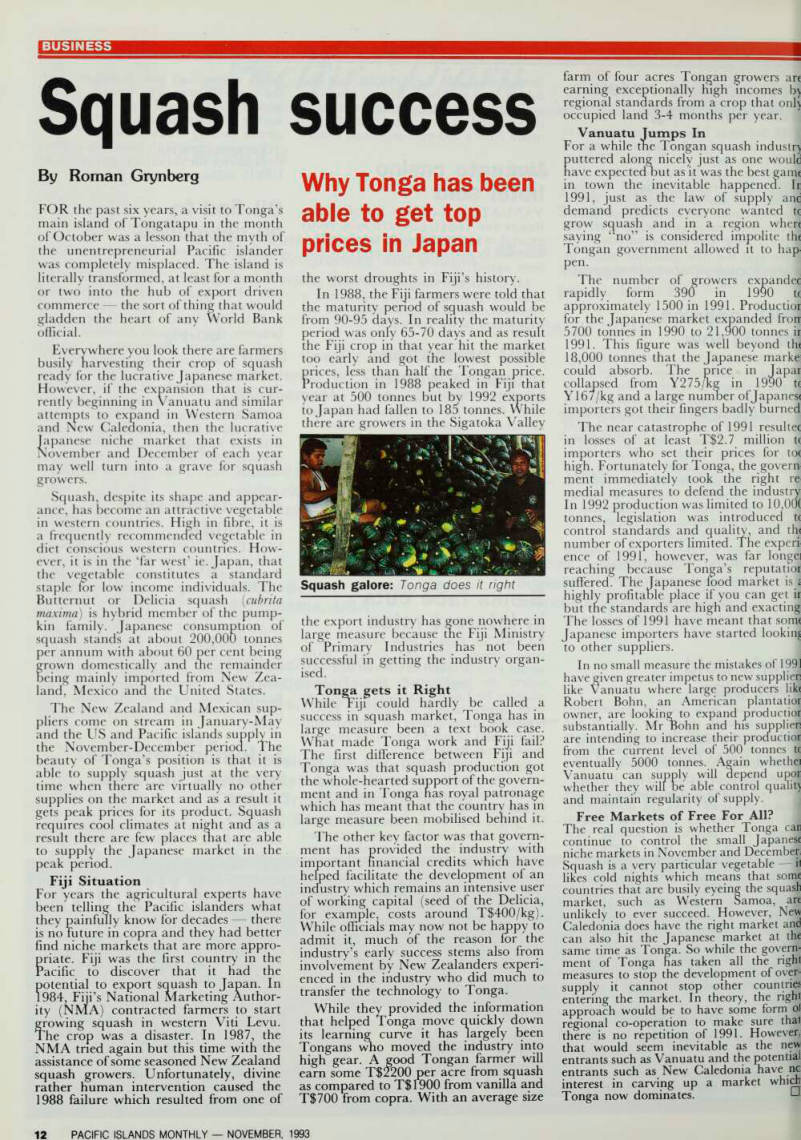
Squash galore: Tonga does it right
By Roman Grynberg
fHE Year 2000 is just around the corner md just like centuries and millenia in the >ast this one is giving rise to its fair share
>f predictions of massive change. Econ
unists, among others are also staring into heir computers and crystal balls and iredicting wild and wondrous events for he new millennium.
There is, however, much about the Year 000 that, in the case of Fiji will be
lomentous and epoch making and it
equires no crystal ball nor even a omputer to predict. By that time Placer 'acinc, the developer of the Porgera and lissima mines in Papaua New Guinea will
egin production at the huge Namosi
apper mine, 35km from Suva. The mine m many ways similar to the huge ougainville mine that was closed by the isurrection in the North Solomons Prov ice of PNG.The total estimated geological
•source (this includes proven, probable
itergories) is currently 930 million tonnes t a calculated average grade of 0.43 per mt copper and 0.14 grams per tonne gold >ing a cut off grade of 0.3 per cent copper r tne calculation. This was calculated ter completion of additional drill sam ing by Placer at Namosi during 1992. At ich low grades the mine would be msidered marginal. However, recent est
ates provided by the Fiji government
iggest that the head grade of the copper e is in the vicinity of 0.75 per cent copper, t such a grade it would make the mine the rgest in the Asia-Pacific region and nong the 10 largest in the world, owever, Placer’s Allen Jay says there is )thing in the work carried out by Placer by previous explorers to suggest that the ade is or could be in the vicinity of 0.75 t cent copper. He said if the estimated source is about 1000 million tonnes at 0.4 r cent copper then this would indicate at there would be approximately 100 illion tonnes of that resource that may be 7 per cent copper. Jay said in economic rms this is significantly different to the ggestion that the total resource may have of 0.75 per cent copper. He said if is surmise were true neither Placer nor e Fiji governemnt would have any Ficult financial choices.
At first Placer came to government with proposal to develop the mine at a scale output that was marginal at best. The tial proposal suggested a develpment of ,000 tonnes per day throughput with a c regime that resembled that of the Fiji c-free factories. At a daily throughput of ,000 tonnes the project was sub-economic d there was no tax regime that could ike it work. However, what is perfectly vious in the revised six-volume proposal it was given to the Fiji government in ptember is that the throughput of the ne is expected to increase to at least 3,000 tonnes per day which many servers feel to be a more realistic oughput for the mine. What this will an is that Placer will have to invest 1.4 billion to get the project going.
While the company has estimated that ployment at the mine would be in the mity of 1000 this appears unrealistic en the experience of smaller copper nes such as Ok Tedi in PNG wnich ploys as many as 2000 workers with a oughput in the vicinity of 60,000 tonnes
• day. Employment will almost certainly
between 2000-4000 permanent workers.