Schoolboys show
pp. 51-53 · Read in the full issue
Sport
how
NZ side walks away with top honours in Pacific rugby tourney
By Shailendra Singh
FROM the onset, it became clear that the others would have to make way for a New Zealand-Western Samoa grand finale in last month’s Shell Pacific Rim
Secondary Schools Rugby tournament
in Suva. With two of the world’s mightiest national teams as role models, the Kiwis and the Samoans were more than a match for the other our aspirants in the two-week event
rom August 24 to September 4.
Represented by a Northern Region Secondary Schools selection, New Zea and displayed a coolness and clinical ‘fficiency synonymous of the mighty All Slacks; and the Samoans with the ormidable reputation of the Manu >amoa bearing down on them did not ack in aggression or determination.
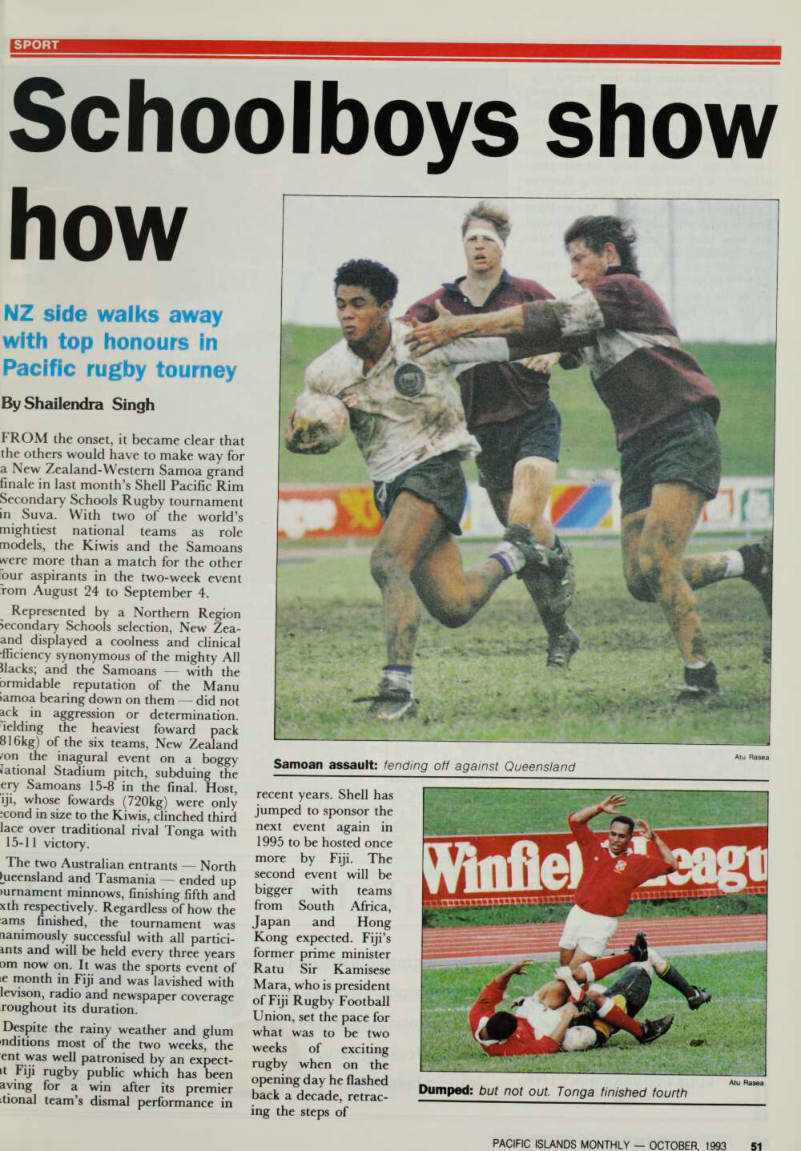
Welding the heaviest foward pack 816 kg) of the six teams, New Zealand the inagural event on a boggy Jational Stadium pitch, subduing the ery Samoans 15-8 in the final. Host, iji, whose fowards (720 kg) were only xond in size to the Kiwis, clinched third lace over traditional rival Tonga with
15-11 victory.
The two Australian entrants North Queensland and Tasmania ended up mmament minnows, finishing fifth and xth respectively. Regardless of how the ams finished, the tournament was nanimously successful with all partici mts and will be held every three years □m now on. It was the sports event of ie month in Fiji and was lavished with levison, radio and newspaper coverage roughout its duration.
Despite the rainy weather and glum nditions most of the two weeks, the ent was well patronised by an expect it Fiji rugby public which has been aying for a win after its premier itional team’s dismal performance in
recent years. Shell has jumped to sponsor the next event again in 1995 to be hosted once
more by Fiji. The
second event will be bigger with teams from South Africa,
Japan and Hong
Kong expected. Fiji’s former prime minister Ratu Sir Kamisese Mara, who is president of Fiji Rugby Football Union, set the pace for what was to be two weeks of exciting rugby when on the
opening day he flashed
back a decade, retrac ing the steps of
Alu Rasea
Alu Rasea
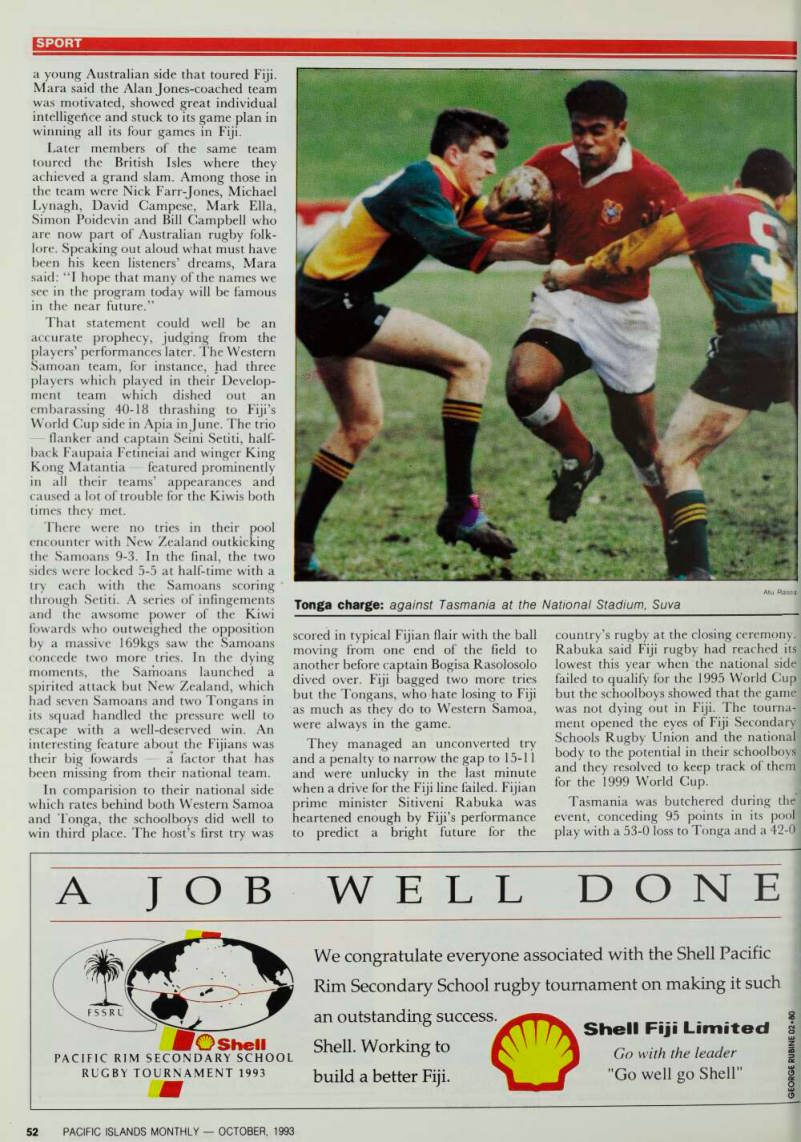
Dumped: but not out. Tonga finished fourth
Samoan assault: fending off against Queensland
a young Australian side that toured Fiji.
Mara said the Alan Jones-coached team was motivated, showed great individual intelligence and stuck to its game plan in winning all its four games in Fiji.
Later members of the same team toured the British Isles where they achieved a grand slam. Among those in the team were Nick Farr-Jones, Michael Lynagh, David Campese, Mark Ella, Simon Poidevin and Bill Campbell who are now part of Australian rugby folk lore. Speaking out aloud what must have been his keen listeners’ dreams, Mara said: “I hope that many of the names we see in the program today will be famous in the near future.”
That statement could well be an accurate prophecy, judging from the players’ performances later. The Western Samoan team, for instance, had three players which played in their Develop ment team which dished out an embarassing 40-18 thrashing to Fiji’s World Cup side in Apia in June. The trio flanker and captain Seini Setiti, half back Faupaia Fetineiai and winger King Kong Matantia featured prominently in all their teams’ appearances and caused a lot of trouble for the Kiwis both times they met.
There were no tries in their pool encounter with New Zealand outkicking the Samoans 9-3. In the final, the two sides were locked 5-5 at half-time with a try each with the Samoans scoring through Setiti. A series of infmgements and the awsome power of the Kiwi fowards who outweighed the opposition by a massive 169kgs saw the Samoans concede two more tries. In the dying moments, the Samoans launched a spirited attack but New Zealand, which had seven Samoans and two Tongans in its squad handled the pressure well to escape with a well-deserved win. An interesting feature about the Fijians was their big fowards a factor that has been missing from their national team.
In comparision to their national side which rates behind both Western Samoa and Tonga, the schoolboys did well to win third place. The host’s first try was
scored in typical Fijian flair with the ball moving from one end of the field to another before captain Bogisa Rasolosolo dived over. Fiji bagged two more tries but the Tongans, who hate losing to Fiji as much as they do to Western Samoa, were always in the game.
They managed an unconverted try and a penalty to narrow the gap to 15-11 and were unlucky in the last minute when a drive for the Fiji line failed. Fijian prime minister Sitiveni Rabuka was
heartened enough by Fiji’s performance
to predict a bright future for the
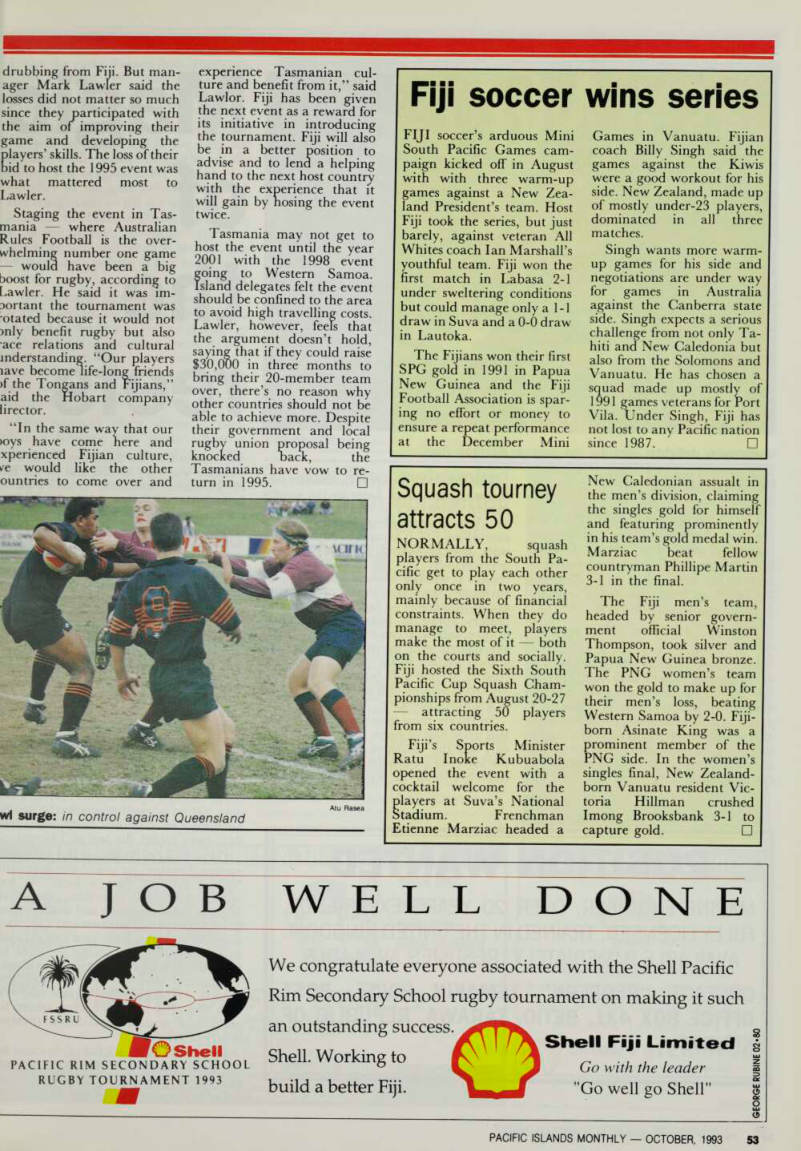
country’s rugby at the closing ceremony, Rabuka said Fiji rugby had reached its lowest this year when the national side failed to qualify for the 1995 World Cup but the schoolboys showed that the game was not dying out in Fiji. The tourna ment opened the eyes of Fiji Secondary Schools Rugby Union and the national bo< L «° the potential m their schoolboys and they reso ved to keep track of them for the 1999 World Cu P Tasmania was butchered during the event, conceding 95 points in its pool play with a 53-0 loss to Tonga and a 42-0
Atu Rasea
Tonga charge: against Tasmania at the National Stadium, Suva
drubbing from Fiji. But man ager Mark Lawler said the losses did not matter so much since they participated with the aim of improving their game and developing the players’ skills. The loss of their bid to host the 1995 event was what mattered most to Lawler.
Staging the event in Tas mania where Australian Rules Football is the over whelming number one game - would have been a big boost for rugby, according to Lawler. He said it was im portant the tournament was 'otated because it would not pnly benefit rugby but also ace relations and cultural
mderstanding. “Our players
lave become life-long friends )f the Tongans and Fijians,” aid the Hobart company lirector.
“In the same way that our >oys have come here and xperienced Fijian culture, ve would like the other ountries to come over and
experience Tasmanian cul ture and benefit from it,” said Lawlor. Fiji has been given the next event as a reward for its initiative in introducing the tournament. Fiji will also be in a better position to advise and to lend a helping hand to the next host country with the experience that it will gain by nosing the event twice.
Tasmania may not get to host the event until the year 2001 with the 1998 event going to Western Samoa.
Island delegates felt the event should be confined to the area to avoid high travelling costs.
Lawler, however, feels that the argument doesn’t hold, saying that if they could raise $30,000 in three months to bring their 20-member team over, there’s no reason why other countries should not be able to achieve more. Despite their government and local
rugby union proposal being
knocked back, the Tasmanians have vow to re turn in 1995. □
wl surge: in control against Queensland
Alu Rasea