Celebration Time
pp. 46-47 · Read in the full issue

Advertising Feature
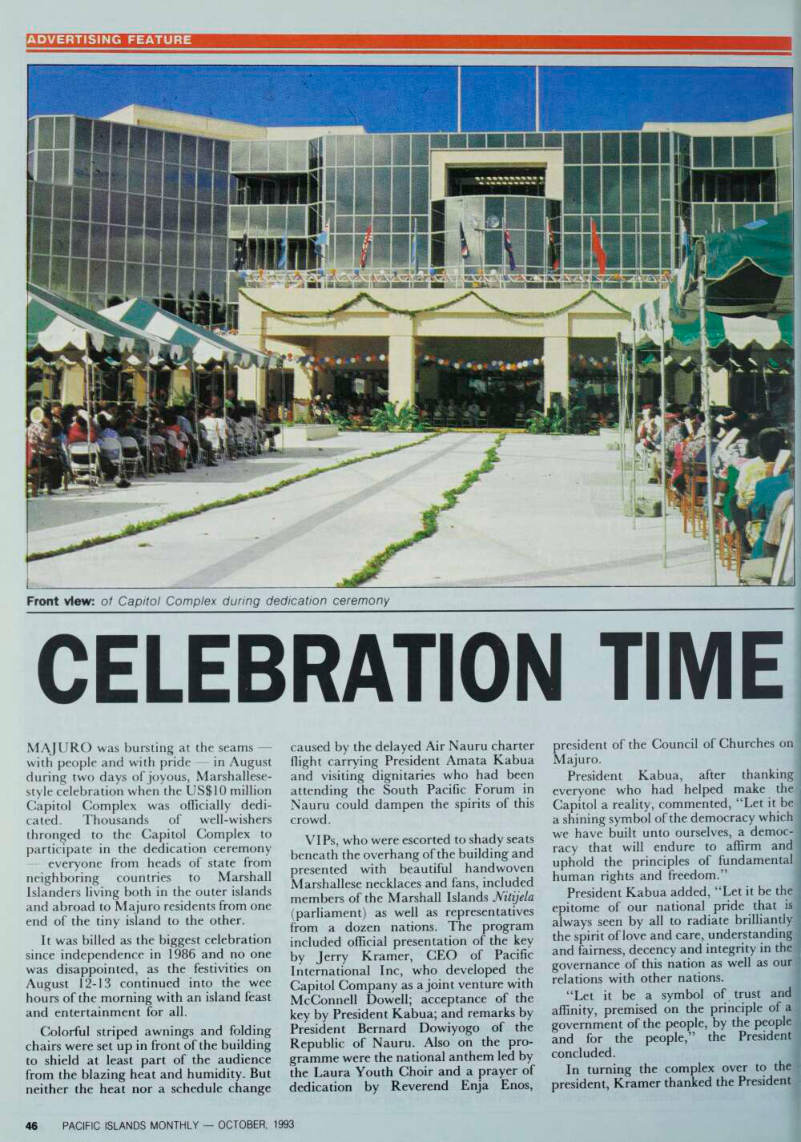
MAJURO was bursting at the seams with people and with pride in August during two days of joyous, Marshallesestyle celebration when the US$lO million Capitol Complex was officially dedicated. Thousands of well-wishers thronged to the Capitol Complex to parttctpate in the dedication ceremony everyone from heads of state from neighboring countries to Marshall Islanders living both in the outer islands and abroad to Majuro residents from one end of the tiny island to the other.
It was billed as the biggest celebration since independence in 1986 and no one was disappointed, as the festivities on August 12-13 continued into the wee hours of the morning with an island feast and entertainment for all.
Colorful striped awnings and folding chairs were set up in front of the building to shield at least part of the audience from the blazing heat and humidity. But neither the heat nor a schedule change
caused by the delayed Air Nauru charter flight carrying President Amata Kabua and visiting dignitaries who had been attending the South Pacific Forum in Nauru could dampen the spirits of this crowd.
VIPs, who were escorted to shady seats , . over h a ne of the building and med with be lutiful handwoven £f arshallese necklaces and fans, included members of the Marsha n Islands Nitijek , iament) as weU as representatives £, m a doMn nations . The program included official presentation of the key by Terry Kramer, CEO of Pacific International Inc, who developed the Capitol Company as a joint venture with McConnell Dowell; acceptance of the key by President Kabua; and remarks by President Bernard Dowiyogo of the Republic of Nauru. Also on the pro gramme were the national anthem led by the Laura Youth Choir and a prayer of dedication by Reverend Enja Enos,
president of the Council of Churches on Majuro.
President Kabua, after thanking everyone who had helped make the Capitol a reality, commented, “Let it be a shining symbol of the democracy which we have bui!t unto ourselves a democ rac V that wlll e ™ ure toalhrm and uphold the prmctples of fundamental human rights and freedom President Kabua added, Let it be the epitome of our national pride that is always seen by all to radiate brilliantly the spirit of love and care, un man mg and fairness, decency and mtegn y in governance of this nation as we as our relations with other nations “Let it be a symbol ot trust and affinity, premised on the principle ol a governmcntof the peop e > Y 1 an or p p ,
concluded. ,
In turning the complex over to the president, Kramer thanked the Presiden
Front view: of Capitol Complex during dedication ceremony
md his cabinet for their faith and trust n PII and McConnell Dowell, thanked he many subcontractors who worked on he project and also extended his ap ireciation to “the over 200 Marshallese raftsmen and workers who comprised >ver 70 percent of our work force.”
First Lady Emlain Kabua was at the Drefront of the ribbon cutting, with ssistance from the leiroj (queens), from he various atolls in the Marshalls. With he speeches spoken and the ribbon cut, was time to tour the building to view he modem space for the Nitijela and ovemment officials and to enjoy a ;w minutes of cool air conditioning!
Foreign dignitaries participating in ic celebration included FSM president ailey Olter; Nauru president Bernard |owiyogo, Kiribati president Teatao eaunaki; Tuvalu prime minister ikenibeu Paeniu; Maori queen Te rikinu Dame Te Arirangikaahu; Ratu u‘uakitau Cokanauto, president of the iji Senate; Dr. Andrew Theophanous, mister for health, Australia; Jim erard, deputy speaker of New Zealand ouse of Representatives; John Kaputin MG minister of foreign affairs; Zhou nming, Chinese ambassador; Masao M ede, Belau minister of health, and avid Fields, US ambassador.
The visiting dignitaries, together with e Marshallese senators and other local IPs, enjoyed a buffet dinner inside the w building, with food dishes provided local restaurants. They dined on licacies such as roast pork, lobster, ib, sashimi and breadfruit. Outside, e festivities continued with island-style xl plates filled to the brim for all who shed to participate. And as dusk settled
er the new Capitol Complex, the
thusiastic audience settled in for an “ning of performances that dazzled the “ and soothed the ear. Clearly, the jgest crowd-pleaser was the Jobwa , netimes referred to as “the war dance”
or “the stick dance,” performed by a large group from Ujae Atoll. With sticks thrust together in an eloborate chor eography and grass skirts flying as the dancing became more frenzied, the boys and young men impressed all. The Jobwa is a very special dance in Marshallese custom that can be performed only with permission from the high chief, in this case President Amata Kabua, who is also the high chief of the Ralik Chain.
President Kabua enjoyed the perform ance from his front row seat in the audience.
Entertainers journeyed to Majuro
from as far north as the Marshallese community living in California to as far
South as Fiji. Many of the outer atolls in the Marshalls sent performing groups; others had representatives perform from among those currently living in the capital Majuro. Altogether, more than 30 groups performed.
And whether you were physically at the Capitol Complex to witness the performances or were at home anywhere in Majuro, you were bound to hear the melodies as the local radio stations broadcast the performances lives.
Whether the visitors to Majuro were VIPs or “just plain folk” the consensus seemed to be that the Marshallese “throw quite a party!” □
Dance: part of the performing group from Southern California entertaining at the opening