opportunities
p. 43 · Read in the full issue
Investment opportunities
SINCE its inception in 1987, the Tax Free Factory/Tax Free Zone Scheme, has contributed significantly to Fiji’s economy by stimulating investment and encouraging export oriented enterprises.
The scheme has also contributed sub stantially to the growth of the manufac turing sector. Tiie scheme was intro duced by the interim government in late 1987 to stimulate investment and foster foreign exchange earnings through the diversification and expansion of exports.
The scheme is administered by the Fiji Trade and Investment Board (FTIB) and is in line with government’s policy to shift production from import substitution to export oriented industries. A Tax Free Zone (TFZ) is a collection of factories, within a specific location, enjoying pref erential conditions, while individual fac tories, enjoying the same conditions, are known as Tax Free Factories (TFFs).
The scheme combines an elaborate package of incentives with financial concessions and subsidies to attract companies to establish operations in Fiji, An enterprise qualifies for TFF status if it exports 95 per cent of its annual production or is engaged in re-exports of at least 95 per cent of its output.
As in all such schemes, TFFs in Fiji enjoy a number of advantages designed to enable their products to successfully compete and gain a foothold in overseas markets. The import of capital goods and other production materials are exempt from licensing and import duties.
Exemption from customs duty is given for the importation of raw materials and items required for establishing a TFF enterprise. Products manufactured un der tne scheme are also exempt from
excise duty. Operations, moreover are
exempt from paying tax on corporate profits for a period of 13 years with no tax on interest, dividends and royalties.
Foreign owned firms are allowed to repatriate capital and profits and all firms including non-TFF enterprises are opportunities to recruit specialist Dersonnei from overseas. Other ad ditional advantages include an acceler
ited depreciation allowance on capital
md equipment, carrying forward losses
e losses incurred in any year may be iffset against profits earned during the icxt succeeding six years, double tax ition agreements and in certain circum tances the Minister of Finance may vaive or reduce dividend, interest or
oyalty withholding taxes.
As a Forum island country, Fiji enjoys inferential treatment when exporting to he Australian and New Zealand mar kets, under the South Pacific Regional rade and Economic Cooperation
Agreement (SPARTECA). Exports from
yi, complying with SPARTECA rules f origin, enter duty free giving exporters Dme advantage over competitors. Fiji Iso benefits from exports to European ountries under the Lome Agreement nd to a number of other countries under le General System of Trade Preferences. l special derogation clause in the Lome
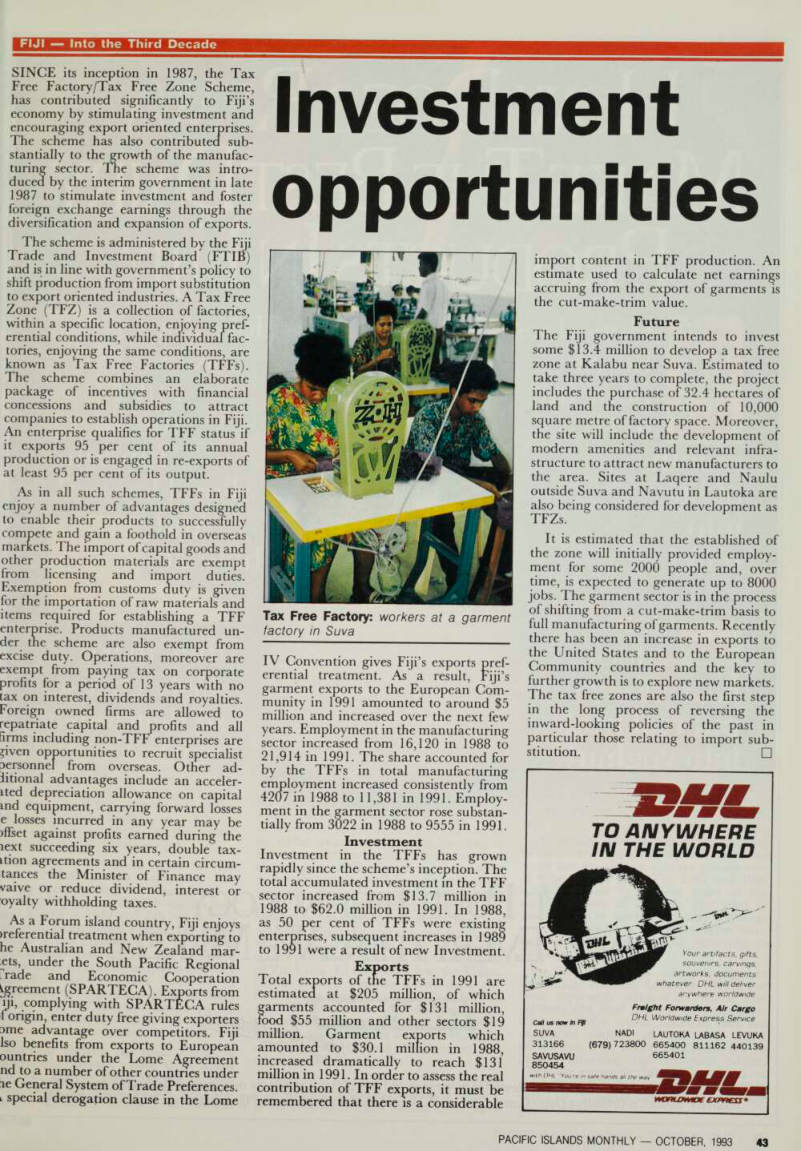
IV Convention gives Fiji’s exports pref erential treatment. As a result, Fiji’s garment exports to the European Com munity in 1991 amounted to around $5 million and increased over the next few years. Employment in the manufacturing sector increased from 16,120 in 1988 to 21,914 in 1991. The share accounted for by the TFFs in total manufacturing employment increased consistently from 4207 in 1988 to 11,381 in 1991. Employ ment in the garment sector rose substan tially from 3022 in 1988 to 9555 in 1991.
Investment Investment in the TFFs has grown rapidly since the scheme’s inception. The total accumulated investment m the TFF sector increased from 513.7 million in 1988 to 562.0 million in 1991. In 1988, as 50 per cent of TFFs were existing enterprises, subsequent increases in 1989 to 1991 were a result of new Investment.
Exports Total exports of the TFFs in 1991 are estimated at 5205 million, of which garments accounted for Sl3l million, food 555 million and other sectors Sl9 million. Garment exports which amounted to 530.1 million in 1988, increased dramatically to reach $l3l million in 1991. In order to assess the real contribution of TFF exports, it must be remembered that there is a considerable
import content in TFF production. An estimate used to calculate net earnings accruing from the export of garments is the cut-make-trim value.
Future The Fiji government intends to invest some $13.4 million to develop a tax free zone at Kalabu near Suva. Estimated to take three years to complete, the project includes the purchase of 32.4 hectares of land and the construction of 10,000 square metre of factory space. Moreover, the site will include the development of modern amenities and relevant infra structure to attract new manufacturers to the area. Sites at Laqere and Naulu outside Suva and Navutu in Lautoka are also being considered for development as
Tfzs.
It is estimated that the established of the zone will initially provided employ ment for some 2000 people and, over time, is expected to generate up to 8000 jobs. The garment sector is in the process of shifting from a cut-make-trim basis to full manufacturing of garments. Recently there has been an increase in exports to the United States and to the European Community countries and the key to further growth is to explore new markets.
The tax free zones are also the first step in the long process of reversing the inward-looking policies of the past in particular those relating to import sub stitution. □
Tax Free Factory: workers at a garment factory in Suva