Sweet success
pp. 39-41 · Read in the full issue

The lifeblood of the economy is sugar
THE story of the sugar industry in Fiji over the years is one of sweet success.
Thought to be indigenous to the South Pacific, sugar cane was found growing in Fiji by the early European discoverers and settlers. Fijians grew sugar cane for chewing and they are known to have used the juice for sweetening food. The first sugar in the country was produced on Wakaya Island, in Western Fiji, by David Whippy in 1862. The following year, Brewer and Joske erected a small experimental sugar mill in Suva, fol lowed by a larger mill a year later. About 640 acres of cane were planted on the site now largely occupied by the city of Suva.
Now, revenue from sugar and molasses accounts for between 60 per cent and 70 per cent of Fiji’s export earnings. Weath ering some turbulent times over the years, the sugar industry had alone shouldered the responsibility as the backbone of the economy. Because of sugar’s importance today, many people are often surprised to learn that it was the second choice to cotton when early Fiji planters decided which crop would bring them the most money. Cotton pro duction in the United States had slumped during the civil war of the early 1860 s and world markets opened to new producers. Prospects for cotton growing in Fiji looked bright; and when the civil war ended and American plantations began to recover, cotton enterprises in Fiji began to fail.
The Start Fiji turned to sugar about 1870 and by 1883 the crop had displaced copra as the country’s main export a position it has held to this day. In 1879, the British government brought indentured labourers from India to work on cotton, coffee, sugar and other plantations. Most of them stayed on when sugar became the main crop; and more Indians came to Fiji until the indenture system stopped in 1916. The Indian migrants had a right of free journey back to India but the majority chose to stay. Today, most of the country’s cane growers are descend ents of those early indentured labourers.
Labour on plantations became scarce after 1916 with no further migrants
entering Fiji. To solve /the problem,
several schemes were tried before the small-farm system was developed. Indian farmers were settled on farms averaging
4.05 hectares, with the farmer and his family doing most of the work. In 1880, a well-established Australian firm the
Colonial Sugar Refining Company
started in Fiji and it brought more resources and experience than any previous entrepreneur, CSR’s first mill started at Nausori in 1882 and closed in 1959. In the following years two more
mills were established by CSR Rarawai Mill on the bank ofßa River in 1886, Labasa Mill, on Vanua Levu, in 1894.
The company’s largest mill (one of the biggest in the Southern Hemisphere at the time) commenced crushing at Lauto ka in 1903. Penang Mill, founded by the two Chalmers brothers in 1881 at
Rakiraki, was acquired by CSR from the Melbourne Trust Company in 1926.
Today, the four mills represent the manufacturing side of the industry. In 1961, CSR formed a subsidiary, South Pacific Mills Ltd. SPSM shares were offered to people and only two per cent of shares were purchased by the public.
Following an award by Lord Denning on the sharing of proceeds with growers, which was deemed unacceptable, CSR Ltd withdrew from the Fiji Sugar industry on March 31, 19/3. The government bought CSR’s interest in the company for $lO million. The Fiji Sugar Corporation was incorporated in Fiji by an Act of Parliament in 1972 to take over the milling activities with effect from April 1, 1973. At present, of the 44,399,998 fully paid shares, the govern ment owns 30,239,160 shares and the rest are owned by statutory bodies, local public companies and individuals.
The four sugar mills have the capacity to crush over four million tonnes of cane per season. Being the country’s largest employer, the FSC provides direct em ployment to over 40,000 people.
The four mills crushed a total of 3,380,324 tonnes of cane during the 1991 season, a decrease of 635,2/9 tonnes compared with the 1990 season. A total of 3«8,962 tonnes of sugar was produced in 1991 considerably below expec tation attributed to mainly the decline in cane production and the lower sugar content of cane. The consolidated profit before-tax for the year ended March 31,
1992, is 510.2 m compared with 512.1 m for the previous year. The total revenue generated from sugar and molasses amounted to 5250.8 m, an increase of S4.lm over the previous year. The increased revenue is inclusive of the 20 million European Currency Units
(Ecu).
A total of 355,600 tonnes of 1991 season sugar was exported to the follow ing countries; United Kingdom 183,200 tonnes; Malaysia 88,000; United States
14,600; Japan 44,700; and China 25,200.
FSC managing director Jonetani Galuinadi, in the 1992 annual report, stresses the efficiency of the company and the need for increased production: “the Fiji Industry is at present relatively efficient. It makes good sugar. But we cannot become complacent. vVe have to become a better producer. We must thoroughly appraise every part of the industry, from farming methods to har vesting, transport and milling. What we need is more sugar at the lowest cost.”[H
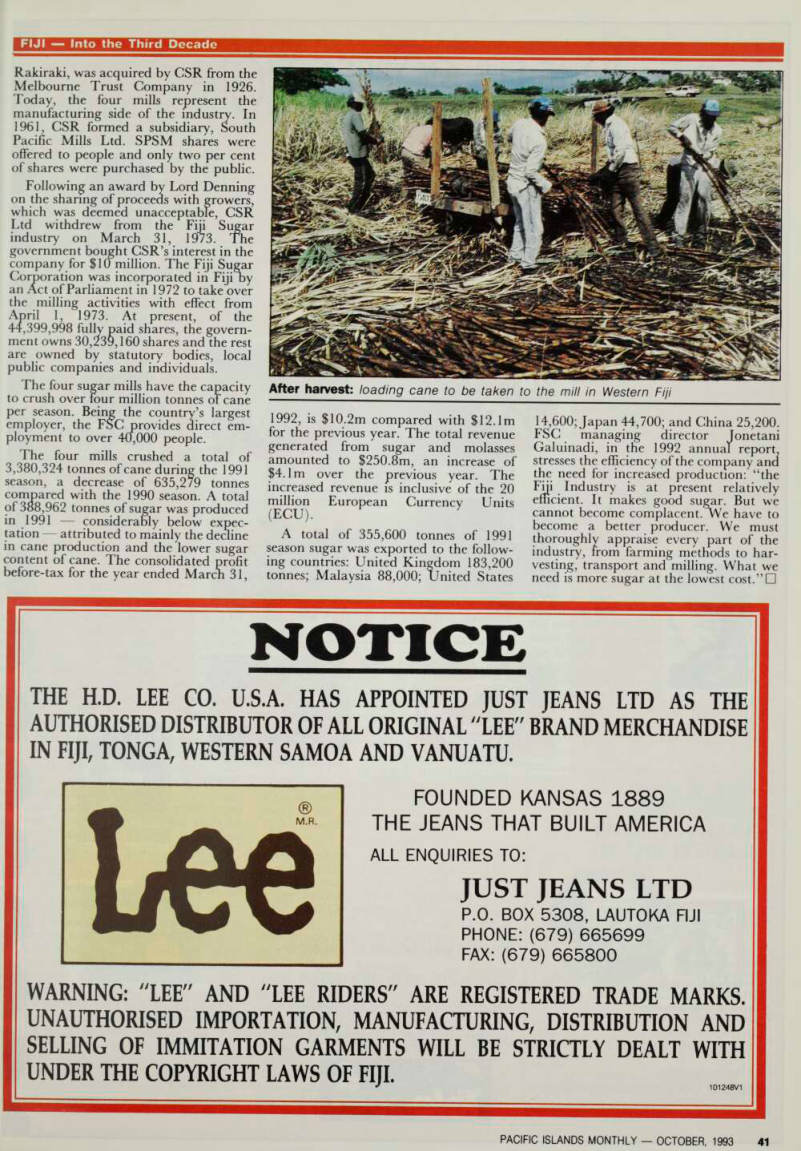
After harvest: loading cane to be taken to the mill in Western Fiji