Pacific nations
p. 21 · Read in the full issue
The United Nations
Pacific nations begin UN moves
By Ian Williams
THE Pacific island states have now entered the world of geopolitical manoeuvring at the United Nations.
During the summer, the Asia group of states made a bid for more chairmanships of UN committees, because, they claimed, the coming accession of Nauru, Tuvalu, Kiribati and Tonga to the UN would mean the Asia group would outnumber the Africa group.
However, it all seems to have been based on a misapprehension. A Pacific ambassador had said that if they were to join they would join the Asia group, which would then become the biggest regional grouping. In fact, only Tuvalu is currently considering joining, and membership will be a big domestic electoral issue. Nauru, in some way, should now feel less embarrassed by its size and should consider applying. Hav ing successfully done a David and Goliath imitation by securing a settle ment of $73 million from Australia at the International Court of Justice it would also no longer be quite so much smaller than other member states. This year the tiny European states of Andora, and Monaco each with about 8,000 citizens, *ere admitted to the United Nations.
The Asian Group however, may yet jet their enhancement soon. Australia md New Zealand are in the increasingly
momalous “West European and
Others” regional grouping, and are xpected to make a determined bit to nove to the Asian group. In the neantime, Forum member New Zealand las been on the Security Council, where >ower in the United Nations is increas ingly concentrated, since January. It nhanced its reputation by being one of he few members of the council, along dth Britain and France, to be up to date n its dues payments. However there are
3me ripples on the waters. Despite
ersistent attempts in Vila to replace Robert Van Lierop, Vanuatu’s Am assador to the UN, the rumors of his eparture so far seem exaggerated. He is ill in office, and active in the corridors f the organization. None the less, the rospect of his removal is causing Dncern among island members who oint out that Vanuatu’s international
standing, and the Pacific’s, has been greatly heightened by Van Lierop’s efforts on behalf of the Alliance of Small Island States.
AOSIS now has a formidable block of around 40 members, and their pressure at the Earth Summit in Rio last year led to recognition of their special problems.
That in turn has led to the most significant event for the Pacific in the coming year, the Global Conference on Sustainable Development for Small Island Developing States, to be held in Barbados next year. The conference is expected to seek financial and techno logical aid from the developed world, as well as building regional cooperation, to deal with their particular needs like transportation, communication, fishery protection and preparedness for natural disaster. Of course, global warming and its consequences such as sea level rise and coral bleaching will loom large on the agenda.
According to the UN the islands have in common “a small land area, and are constrained by a paucity of natural resources. Their populations are small and their age composition is strongly affected by the tendency of islanders to emigrate to seek work.” But that does not stop the populations densities being very high with consequent environmental stress. Their economies are “small, lack ing in diversification.” All that smacks of truism. The real question is what can be done about countries which would, if the World Bank types had their way, be wound up as inherently unprofitable. At the beginning of September, the Pre paratory Committee meeting in New York revealed some fission lines between the two biggest groups, the Caribbean and the Pacific, but they were on matters of presentation rather than substance and the conference itself is unlikely to see any stormy debates between the two.
Indeed the gathering itself will be the largest ever held in the Caribbean and certainly, say the organisers, the largest ever to take place in a country the size of Barbados, which is rushing to com plete its conference centre in time for the occasion. Since one of the problems of the island states in the small size of their economies, it may seem that the last thing they need is to spend large proportions of their budgets sending
politicians and officials to the other side of the world. Luckily the need should be averted by a $950,000 voluntary fund by which the richer nations of the world will finance their small island brethren. Even tiny Liechtenstein has contributed a 1000 Swiss francs to the fund. Australia, for its part has put up $200,000 through SPREP to help Pacific delegations, and in conjunction with New Zealand has made a contribution to the cost of staffing the conference secretariat in New York.
However, as with all UN Conferences, the “Island Summit” has to persuade the rest of the world of its relevance. The UN bureaucracy is already coining stultify ing terms like SIDS (Small Island Developing States) which could rapidly kill interest. Many Pacific states are anxious to ensure that it should not be seen as a “begging” conference, trying to tap the donor countries’ treasuries.
Indeed some developing countries resent the attempts of the islands to present themselves as a special case, while some donor countries are equally concerned that there should not be a proliferation of categories of aid recipients.
The various preparatory conferences so far have produced some 250 separate recommendations, but there is concern that the conference shouldn’t just pro duce a long shopping list. “We want a brief plan of action that sets out the methods an overall strategy, from which those 250 recommendations would flow” one Pacific diplomat told PIM.
The Caribbean and Pacific states are already developing regional approaches to their problems, so the Conference has to interest the rest of the world if it is not just going to add further gusts of hot air to the problem of global warming. The question then is how to interest the
developing countries. By concentrating
on the role of the islands as reservoirs of biodiversity, and custodians of their surrounding maritime resources, it is hoped that the islands will persuade the rest of the world not to leave them all at sea. At least this part should be in good hands. One of the officers for the conference is Lelei Lelaulu, Samoan president of the Pacific Islands Associ ation in the US who, despite having been a UN civil servant for many years has a grasp on reality because of his many years as a journalist. □
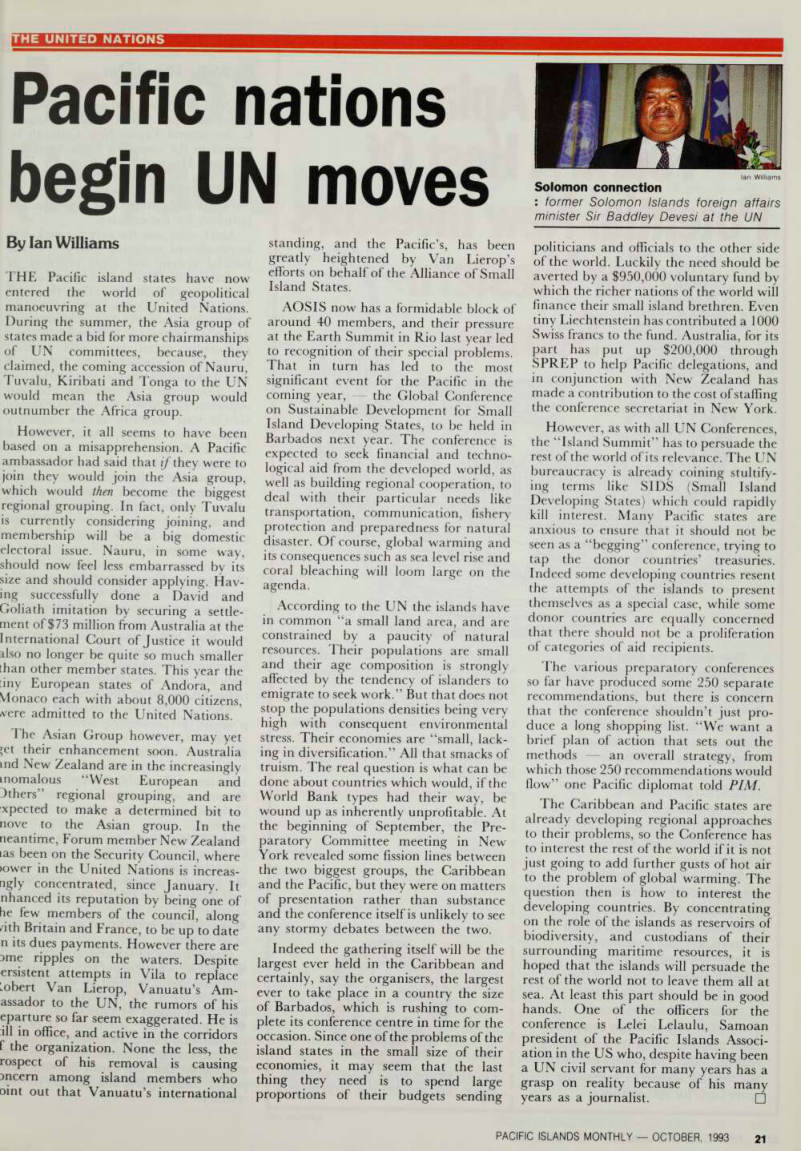
lan Williams Solomon connection former Solomon Islands foreign affairs minister Sir Baddley Devesi at the UN