Spearhead surprise
pp. 18-19 · Read in the full issue
FOR years Fiji has had a standing invitation to join the Melanesian Spearhead Group (MSG) and for years the invitation was met with gracious silence from the Department of Foreign Affairs in Suva. For this reason the announcement by the Fiji prime minister, Sitiveni Rabuka that Fiji are likely to accept the invitation was surprising to most commentators. The reason why Fiji has in the past been so reluctant to join the MSG has been because the country is so clearly both Melanesian and Polynesian.
While anthropologists often dispute the existence of a clear difference be tween Melanesians and Polynesians none who have sat drinking with Polynesian officials after a regional conference would ever doubt its existence. There exists a great divide between Polynesia and Melanesia and it runs right through the Pacific and right through Fiji. The divide in Fiji is more than just geographical it is more than just Rotuma and the Lau group of islands. It is also very political
with the Lau group of islands to this day the traditional power centre in Fiji.
Throughout much of the pre-colonial era the Lau group of islands, located half way between Tonga and Fiji, were enormously influential in determining the direction which Fiji took through their contact and close relationship with the powerful, well armed and well organised Kingdom of Tonga. Many of the traditional chiefs of Fiji trace their lineage and connection to Lau and further to Tonga where the ties between the King of Tonga and Fiji’s chiefs remain very strong even today. Perhaps more importantly the way power is wielded by the chiefs within traditional
Fijian society is distinctly Polynesian
rather than the looser ‘big man’ system that exists in Melanesia. So while most Fijians may appear very much like Melanesians, especially to outsiders, the society’s structure and much of the culture remain distinctly Polynesian.
Forum meetings are, for many Pacific island leaders, a difficult and perplexing
event because they are under the eye of the media and there is an enormous amount of pressure to actually do something. For a rare moment the region’s media is focused upon the leaders and they are desperately looking for news and for some sort of evidence of a regional initiative that might make it possible to justify to their editors the cost of such a long journey. Increasingly the news worthiness of the Forum is making editors think more than twice about sending their staff. However, Sitiveni Rabuka announcement at the Nauru Forum of the inevitability of Fiji seeking membership in the Melanesian Spear head Group could result in the most profound political and economic realign ment of the South Pacific since the creation of the Forum over 20 years ago.
The fact is obvious that economically the future of the South Pacifc lies very much in Melanesia. PNG with its enormous resource wealth, Fiji with its industrial sector and New Caledonia with its apparently limitless access to the French treasury make for an impressive political constellation. Add to this Vanu atu with its tourism potential and Solomon Islands with its low labour cost there can be little doubt that if there is any economic potential in the South Pacific it lies in Melanesia.
Almost immediately following prime minister Rabuka’s announcement at the Forum the sounds of flip-flop and back track could be heard in the corridors of power in Suva with senior government officials talking of the undesirability of the proposal. Even Rabuka was quoted as saying within two days of the announcement that this would not mean a down-grading of the links with Poly nesia. The problem for the Fiji prime minister is that having now made the announcement at the Forum if he backtracks under pressure from the traditional elite he faces the possibility of irreparably damaging diplomatic and trade relations with Melanesia.
Just one year ago the MSG appeared to be almost defunct with the heads of government unable to even to decide to meet and while officials were still discuss ing a trade treaty the only trade that appeared to be of any significance was the trade in lead between the PNG Defence force and the Solomon Islands.
However, with the full of Solomon Islands Prime Minister Solomon Mamaloni and the rise to power of Francis Billy Hilly a new era in relations
Fiji ’s interest in joining the MSG has
surprised many
between PNG and the Solomons appears to have begun. This was signalled at the recent MSG summit held in June in Rabaul where the heads of government signed the much awaited MSG trade agreement. The trade agreement be tween the three countries eliminates the import duties on three commodities - beef from Vanuatu, canned fish from Sol omon Islands and tea from PNG. It is the duty free entry of the latter into the Solomon Islands that has already created difficulties on the Fiji side where tea exporter Hari Punja is facing increased competition from PNG tea in the Solomon Islands market as a direct result of the preferential access under the trade agreement.
The MSG trade agreement is a development that Fiji officials have eyed with both some trepidation as well as increasing interest. Fiji exporters and re exporters have carved out small but important export markets in many of the small South Pacific island states. These markets are important to Fiji well beyond their market value because they
permit Fiji to purchase in larger
quantities than is otherwise the case and as a result this lowers the cost of imports to both Fiji and the island states. The preferential access arrangement that is evolving between PNG and Solomon Islands and Vanuatu threatens to under mine the Fiji trade advantage in the Solomon Islands and Vanuatu. Fiji traders have never been able to establish a serious foothold in the huge PNG market. This trade advantage is crucial to Fiji and its economy and it is for this reason that Prime Minister Rabuka may be willing to take the flack he will get from Fiji’s Polynesian elite.
While the politicians of the MSG may be officially and publicly applauding Fiji’s entry into the MSG, their trade officials are a good deal less predisposed to the idea. There is a long standing and well justified fear that the advanced Fiji manufacturing sector, would, in the absence of tariffs, wipe out the fledgling manufacturing sectors in the other MSG counties. As a result, there is a great deal less enthusiasm at the official level for
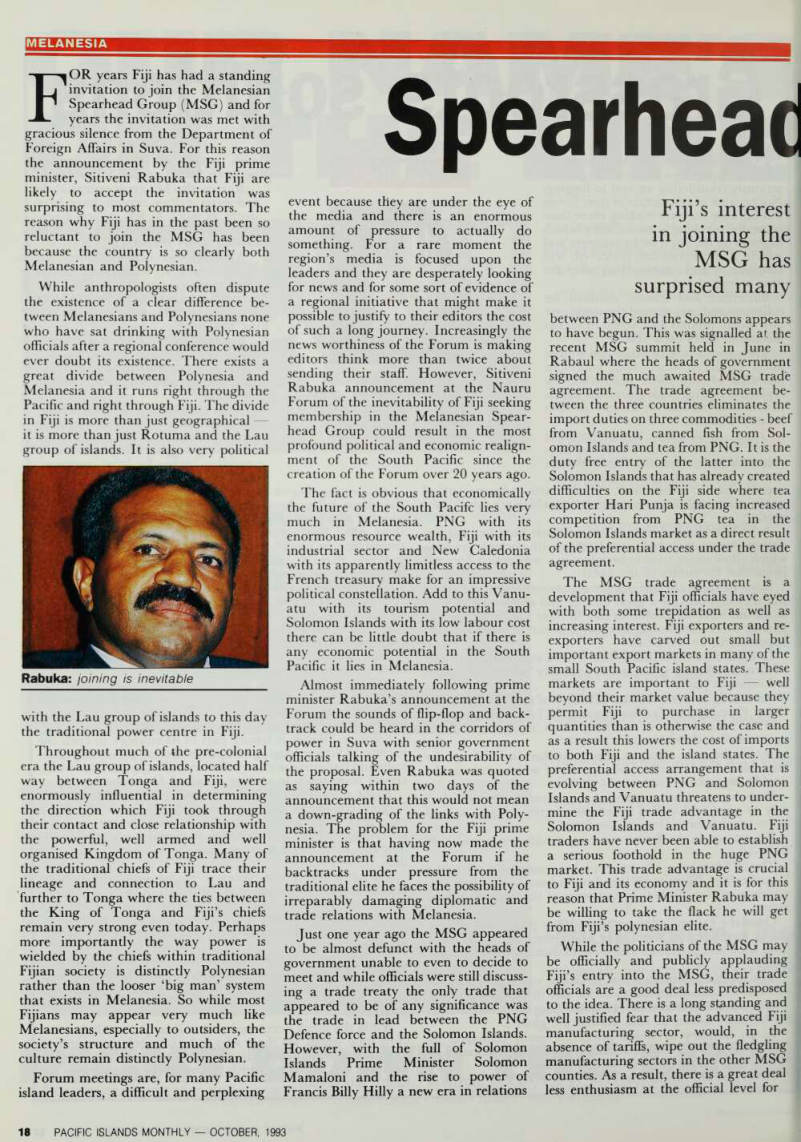
Rabuka: joining is inevitable
iji’s entry into the MSG than there ppears to be at the political level, lowever, entry of Fiji into the MSG does ot necessarily mean that the MSG Duntries will immediately extend the
ISG trading privileges to Fiji.
The MSG agreement at the moment very limited covering only three goods ut, as officials point out, so were most ther trade agreements when they were rst signed. Fiji knows that if it is to get i on the ground floor of the only real ade game in the South Pacific it must in the MSG.
However, what has really been missed f the political commentators is just how
ternationally significant Fiji’s entry
ill be to the political calculus of the estem Pacific. One of the reasons why e Pacific Islands Development Pro am annual meeting of islands leaders is been so popular is that it has rmitted island leaders to meet without iy metropolitan powers attending. The mual Forum and the meeting of the •uth Pacific Commission are meetings
where the metropolitans are present
physically, financially and politically.
However, an MSG that includes the only five countries that really matter among the island states of the South Pacific, despite what the Forum officially says, may be the beginnings of a new very important political alignment that may change the nature of political power in the region and potentially undermine the Forum.
Both within Fiji and regionally the possible entry of Fiji as a full member of the Melanesian Spearhead Group is a major event. It is a case where the economics of the South Pacific dictate that Fiji should enter the MSG despite what may be some short term difficulties at home.
Outside Fiji an expanded MSG may
finally signal the development of truly
regional organisation that is, despite protestations to the contrary, not domi nated by one or other of the former metropolitan powers, □
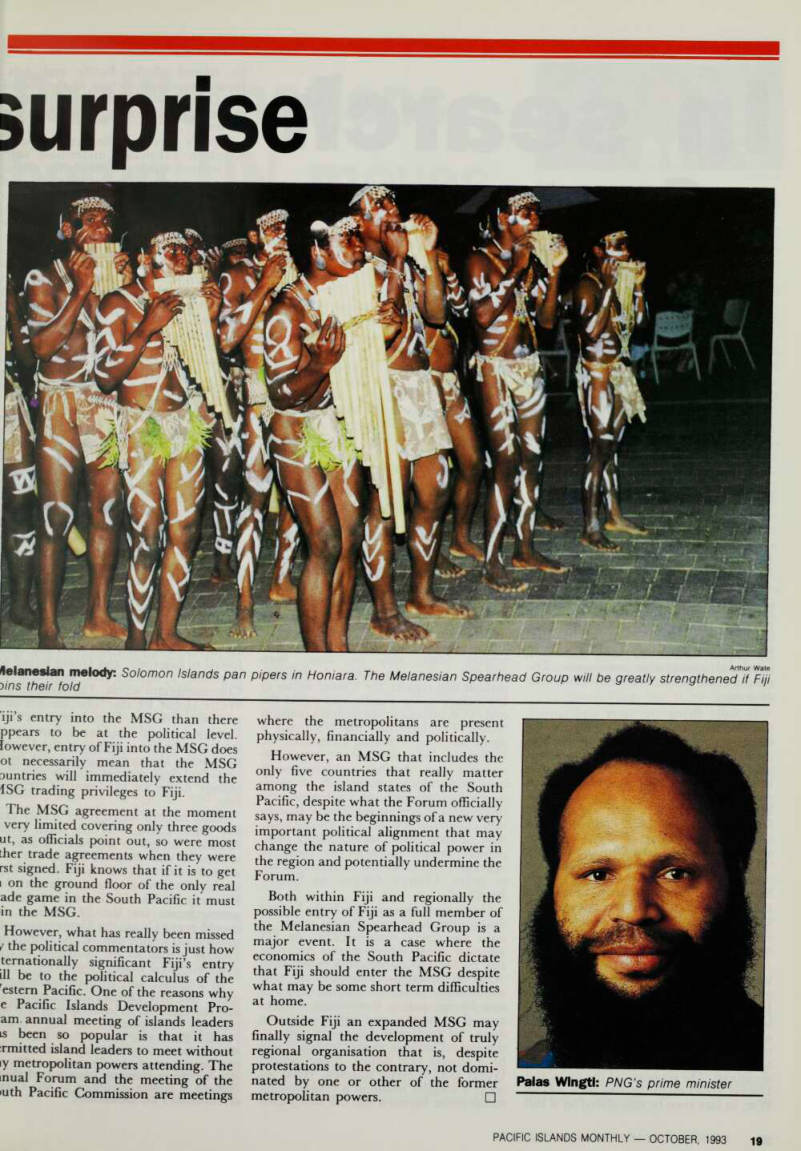
lelanesian melody: Solomon Islands pan pipers in Honiara. The Melanesian Spearhead Group will be greatly strengthened if Fill oins their fold
Palas Wlngtl: PNG's prime minister