Economic
pp. 16-17 · Read in the full issue
By David North
IN a move critic dubbed “economic Japan has the Mariana loses a challenging the lease on which the airline has built a $6O million hotel. If JAL’s threat carried out, it would cripple the islands’major industry tourism — which relies on Japan for 80 per cent of
its visitors. The public threat has already further clouded the Northern Mariana’s image in Japanese investment circles, which have grown cool to the islands
because of a series of land-alienation suits. The nearby island of Guam, which has three times the amount of Japanese tourism investment as Saipan and almost one million visitors annuallly, is feeling reverberations from JAL’s ultimatum since some Japanese investors find it difficult to distinguish among the islands.
The Japanese move comes on top of the Northern Marianas’ problems with US congressional leaders who have threatened to block millions in capital grants because of alien labour abuses and garment industry excesses on Saipan, the capital island. (See report on Pages 14, 15) .
“If we lose this lawsuit and the hotel is taken away from us, Hotel Nikko and JAL will leave the island,” wrote Nikko president Mitsuo Kitajima and Japan
Airline Development Company, Ltd
senior vice-president Tsunehisa Hayami in a letter to the Northern Marianas Senate. “And if this happens, every bank, developer and investor in Japan will know why,” the Japanese business men warned island leaders.
The letter was written as comment on a pending senate Bill which would compensate JAL and Nikko if they lost the suit and the hotel. Saying their hotel once was a symbol of the island’s bright future, the JAL spokesmen said “unfor tunately, today the hotel stands as a symbol of Article XII lawsuits that threaten the island’s economic and tourism industry”. JAL views the lease lawsuits as a way local people can get their property back after selling it, including the improvements like hotels, resorts, and shopping malls, without having to pay any restitution for the hotel or land, the letter said.
The 313-room Hotel Nikko was built in 1986 for US$6O million. The original owners of the land were paid U 55720,000 in 1983 for the 32,000 square metres on which the resort stands.
The La Fiesta San Roque shopping mall cost US$4O million to build aand has 60 retail units.
JAL, the major carrier of tourists to the islands, has 10 flights a week to
Saipan, including daily 747 Jumbo Jet
service from Tokyo and Osaka. The airline carries about 200,000 Japanese visitors a year to Saipan. The Japanese have invested about US$l billion in the Saipan resorts (with more than 1600 hotel rooms) and that investment and the construction industry it spawned have been key facors in the islands double digit private sector growth throughout the 1980 s. Saipan receives about 425,000 tourists a year.
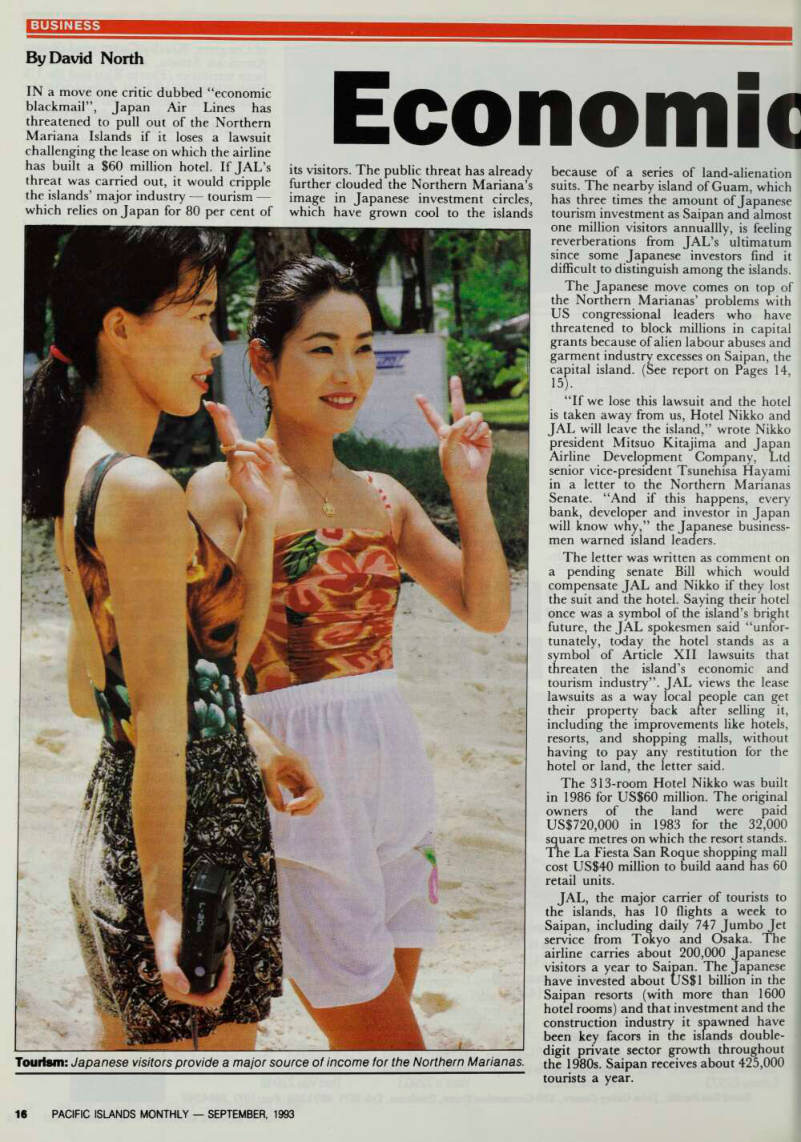
Tourism: Japanese visitors provide a major source of income for the Northern Marianas.
iM.ki.wjuima
jißiM
Only about 20 per cent of them are non- Japanese. Article XII of the Northern Mari anas constitution limits land ownership and leases beyond 55 years to persons of Northern Marianas descent. The constitutional prohib ition against land alienation essen tially a ban on the sale of lands to outsiders was designed to pro tect the islanders from losing their land.
Article Xll’s limits on land ownership re quires that non indigenous persons, in cluding US citizens as well as all foreigners, cannot own or hold
long term controlling
interests in land. They may lease land with terms ranging up to 55 years.
However, some leases which were used for major hotel development have been found unconstitutional by the local courts because the lease was obtained by outside investors using local residents as agents, and having companies with 51 per cent local control, buy the properties and hold the title. The Northern Mari anas superior court has held that these transactions are void because they al owed persons not of Northern Marianas descent “to acquire an equitable interest }f indeterminate duration in real prop erty in the Commonwealth”.
Companies that have acquired and auilt hotels, resorts, and shopping malls
m such lands face losing everything
and and buildings if the courts ledare the leases invalid. The ruling has he additional effect of clouding other as r et uncontested, titles, investors have aid. Some Japanese businessmen have earned that these lease problems would iurt capital inflow to tne islands even fter Japan has recovered from its ecession.
One alternative is to settle out-of ourt, paying additional compensation 3 the original owners in a sense enegotiating leases with the original mdowners for property that is now lany times more valuable. That was the
choice recently of a US title insurance company First American Title which paid S 3 million to settle an Article XII suit by former land owners against the Pacific Islands Club.
Ted Mitchell, the American attorney who had spearheaded the Article XII lawsuits and who represents the original landowners in the Hotel Nikko case, called the Japanese actions “outright economic blackmail”. Mitchell expressed surprise at the bluntness of the threat, saying it was so uncharacteristic of the Japanese. He speculated it was a ploy by the US legal firm representing JAL in the land suit. But Kitajima said Mitchell was twisting the situation out of recognition.
It is the Japanese who paid in good faith for the property and entered agreemennts for its development, who are being victimised, Kitajima main tained. “It is the former landowners who are blackmailing the Japanese inves tors,” he said.
Other Saipan leaders are taking the threat seriously, Saipan Chamber of Commerce president Koy Morioka said, “Japannese businessmen are not known to make frivolous threats. I’ve got to believe they are serious about this”.
Northern Marianas Governor Larry Guerrero admits the issue has created problems. “I understand the frustration of foreign investors,” he said in an April
6, 1993 speech, promising that the “current confusion to investors should be cleared up by the courts and our local
legislature”.
Lt-Gov. Benjamin Manglona empha
sised that the local government would work something out for the Japanese. “I don’t consider it a threat but it is a serious concern,” he said of the JAL ultimatum. “My message to businessmen and prospective investors is not to worry.
We will come around, identify problem areas and try to rectify them. We cannot leave this unresolved.” The local govern ment is not only drafting legislation that would allow the government to compen sate companies who would lose assets if their leases were ruled invalid but also seeking to limit the fees lawyers can collect from the suits. In July, the local government also brought the leading authority on trust law in the United States, University of California Berkeley law professor Edward C Halbach Jr to the island to talk to the legislature about “resulting trusts” (the key to the earlier court decisions on Article XII suits), to help develop a legal strategy to find a compromise in the lease suits and to su gg est how the local courts might reinterpret the land alienation cases to lessen the financial impact on the investors. □