Saipan
pp. 14-15 · Read in the full issue
Trouble in
By David North
AMERICA’S island territories rarely attract serious political or media atten tion on the mainland but the Commonwealth of the Northern Mariana Islands (CNMI) has recently managed to bring all sorts of negative attention upon itself. For example in July, the front page of the prestigious New York Times carried a long, damning report about the continuing garment manufacturing scandal on Saipan. Al though the clothes involved carry fashionable labels (Ralph Lauren, Liz Claiborne and the like) and say Made in the USA they are made under grim conditions which would not be tolerated on the mainland.
As the Times documented, not only is the minimum wage in CNMI about half that of the mainland, where it is U 554.25 an hour, the workers are often not even paid the CNMI minimum, and they are frequently housed in shanties surrounded by barbed wire. Being foreigners, they rarely complain about their treatment on the grounds that they might lose their jobs, and be sent back to China.
The garment workers’ scandal is only one of CNMI’s long list of self-inflicted problems with the mainland problems that threaten the island’s political and financial relations with Washington. As noted in an accompanying report, Sai pan has also managed to foul up its relations with Japan which supplies the islands with needed investment and its
principal source of prosperity —Japan
ese tourists.
Vis-a-vis Washington, CNMI is simul taneously blessed with the best of both words as US flag territories go but is vulnerable to threats of mainland backlash.
The Marianas: • unlike most US island territories, controls its own immigration policies, and has used that power to bring in a huge, ill-paid foreign work force which is valuable to hotel and factory owners; • the Marianas, alone of the US territories, set its own minimum wage,
without any Washington participation;
• and CNMI, like all the other territories, can ship goods to the US without paying tariffs.
But this particular cluster of benefits has all been granted to Saipan, perhaps casually, by the Congress of the United States; and what Congress gives, Con gress can take away. (The relations of the Marshalls and Federated States of Micronesia (FSM) to the US, as associ ated states, are subject to treaties, and are considerably more solid than the
CNMI-mainland arrangements).
Meanwhile, the Marianas has built up three sets of problems with Washington, in policies, personalities, and structural arrangements.
Policies: the Times report reflects a policy problem, the differing attitudes of mainland and island decision makers about how workers should be treated. In the course of this one of the most conservative Democratic members of the House, L F Payne, has introduced legislation designed to prevent the Mari anas from under-cutting mainland cloth ing factories, including several in his rural Virginia district. His Bill, which is pending before his own Ways and Means
Committee, would subject Saipan-made
garments to US tariffs unless the main land minimum wage is paid, and unless at least half the garment workers are permanent island residents less than 10 per cent are currently.
Another policy problem is CNMI’s peculiar tax structure which involves large rebates of income taxes and apparently a regressive rate system which helps the rich. Governor Lorenzo I
DeLeon Guerrero waged a long fight
with the Inspector General of the Department of Interior about revealing the inner workings of the tax system, before finally letting the IG see the documents he wanted.
US island territory
upsets mainland
Similarly, the Marianas seem to have a remarkably hard time collecting utility fees for water, sewage, and electricity which weakens the island’s capacity to furnish these services to residents and tourists alike; CNMI pleas for funding from Washington, to fix up its infrastruc ture are undercut by the territory’s inability to tax its well-to-do and to collect its utility bills.
In recent months CNMI has taken a few small steps towards changing some of these policies; it has passed a Bill calling for a gradual increase in the minimum wage, rising from US$2.l5 now to the current mainland level (U 554.25) in the Year 2000, and there have been some moves to reform its tax structure.
As if these policy differ ences were not enough, Guerrero has managed his relations with the new chair of the House Interior and Insular Affairs Committee very badly. Congressman George Miller, a strong-minded liberal Democrat from California, recently suc ceeded the beloved Congressman Morris Udall (Arizona) as chairman. Even when physically stronger, Udall was a laid-back politician who generally was friendly to the islands.
Miller, however, was worried about the loss of mainland jobs to the exploitive garment factories and he encouraged the committee to hold a hearing on the subject last year. Guerrero appeared but misread the level of mainland unhappi ness with the fate of the garment workers, and tried, in vain, to smooth over the differences. The newspaper headlines back home indicated, appropriately, that it had been a rocky hearing for the islands.
Then the CNMI Governor’s Office did something that still has Washington heads shaking. It announced that the Governor and Miller had a private, 'post hearing meeting, and that things were going to be all right.
At first there were shoodng headlines in the Saipan and Guam press;
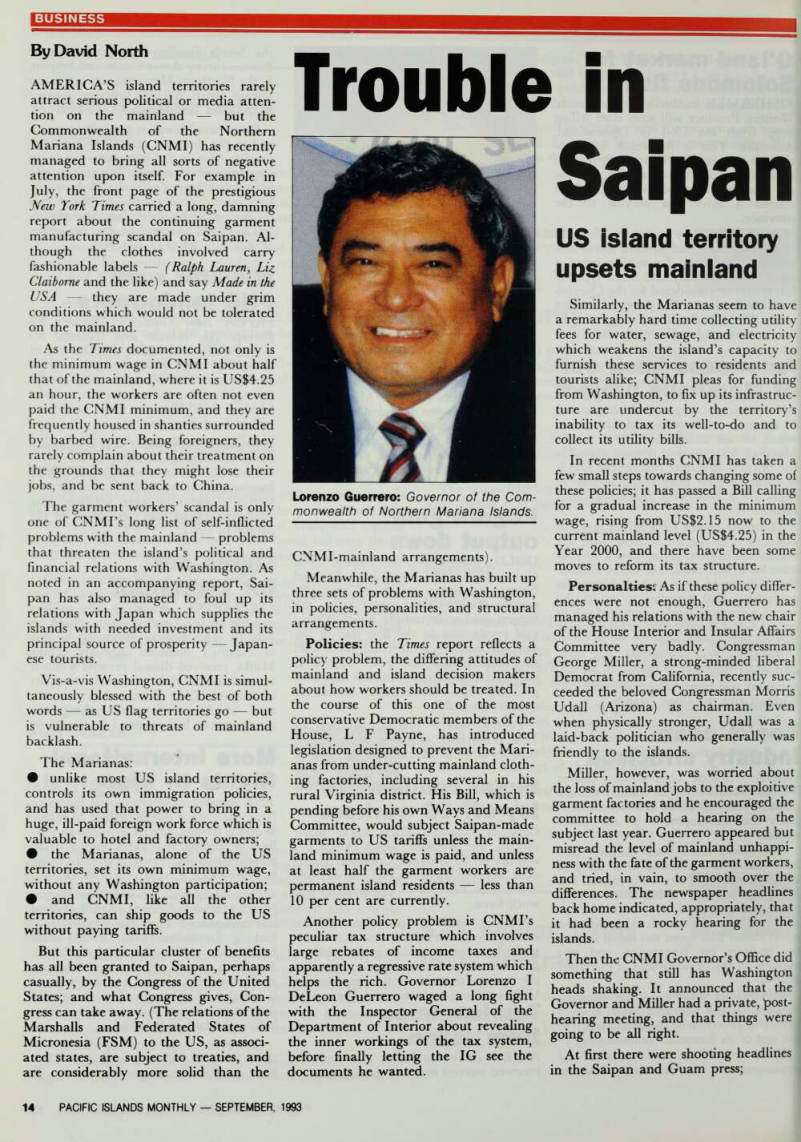
Lorenzo Guerrero: Governor of the Com monwealth of Northern Mariana Islands.
a couple of days later they came to the attention of Miller. He was furious.
There never had been a meeting. No-one in Washington can recall anyone, much less a governor (or his office) simply inventing a meeting with a committee chairman. Guerrero, said his press secre tary was confused.
Miller did not forget the incident. At the moment he is trying to push through the senate a Bill which he steered through the House which would take away millions of dollars of Compact Funds that CNMI had been expecting to flow out of Washington. Miller is also more than sympathetic to Payne’s bill but that will be handled by another House Commit
tee.
Meanwhile, the CNMI politician with the most credibility on tne mainland,
CNMI’s elected Washington Represen
tative, Juan Babauta, will be leaving town at the end of the year when his four year term expires. Instead of seeking to keep a safe seat, he contested with Guerrero for the Republican nomination for governor and lost by a handful of votes. Guerrero faces a November elec tion for another four-year term; his opponent, whom he beat once before, will be Democrat Froilan Tenorio, who
served as Washington Representative
until four years ago.
Structure. CNMI is currently the only US-flag territory without a member
of Congress. Nearby Guam, and distant American Samoa, and the two Carib bean territories (Puerto Rico and the US Virgin Islands) all have delegates in the House of Representatives. While they can not vote on some legislative matters on the Floor of the House, they can speak, and they do vote in the all important committees, and in the party caucus. All have proved useful to their islands.
Up until about a year ago CNMI could have had a similar seat in the House at mainland expense had they simply asked for it, but they did not do so. Now the Governor wants such a seat but given his troubles with Miller, and the garment scandal, and a broader battle about extending the delegates’ voting rights in January, there is no likelihood that what was once easily available will be obtainable in the near future. The Democratic leadership of the House, in January, sought to give the delegates from the islands, and from Washington DC, more voting power on the House Floor, and set off a terrible row with the Republicans.
One of the most remarkable elements of the Saipan story is the way it has broken up the previous islands solidarity in Washington; typically all the islands work togetner. But, as one representative of another territory said, “these guys are screwing things up for all the islands. We try hard to do tne right thing but the Saipan garment scandal makes it tough for all of us”. □
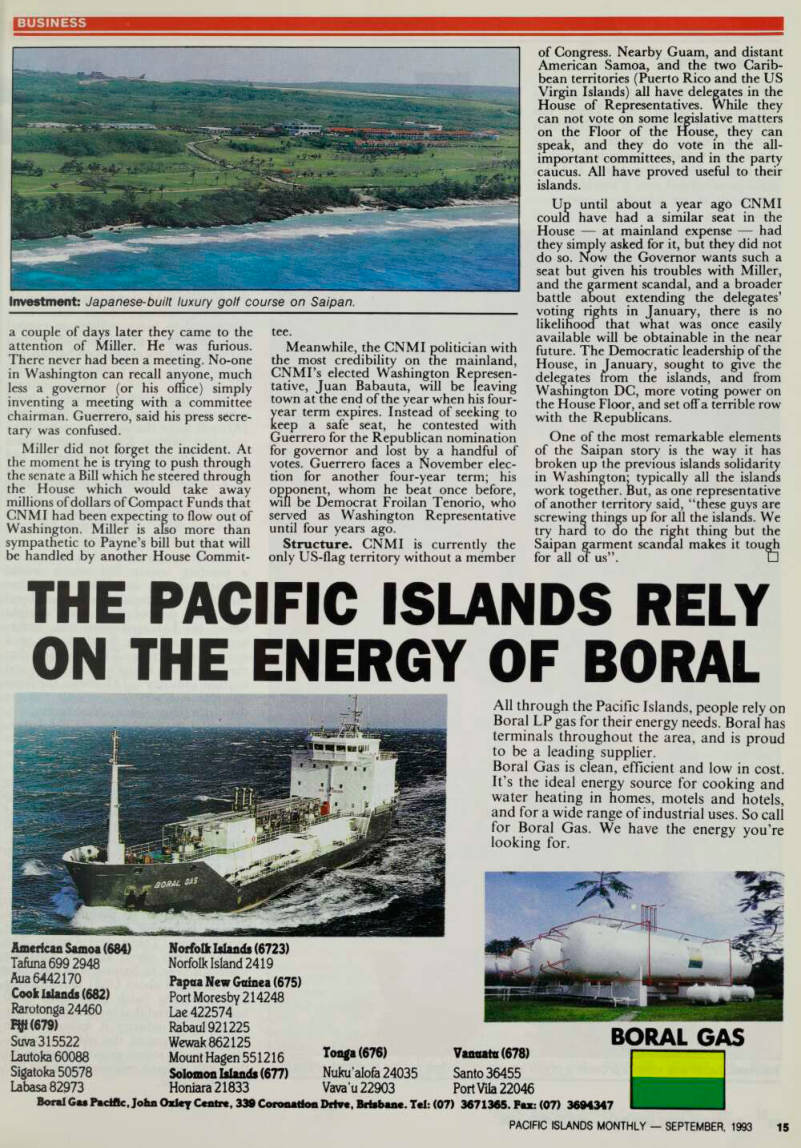
Investment: Japanese-built luxury golf course on Saipan.