Wingti explains
pp. 22-24 · Read in the full issue
Profile
Wingti explains why
PNG prime minister speaks to Liz Thomspon on internal security, Porgera foreign investor confidence and his ‘push north’ policy
In the most recent session of parliament you passed an Internal Security Act. Can you tell me why you decided to introduce it? ell we must have peace and harmony amongst our people and the law and order problem in the country is one of the things which has created a negative image for Papua New Guinea. We decided there were various measures we could take one was to impose a state of emergency; the other one was a curfew in the area where the problem is - but we decided not to take either of those
options as they are short term, but to introduce a comprehensive package of measures to deal with the problem. >y, T , Q * • The Internal Security Act is part of that package and it allows the police force, say, in the instance of another Bougainville saga, to act ... it will empower the police. Where people have dangerous weapons and their behaviour goes against the interest of the state or of other people then we must have laws to deal with this kind of situation. We are also making amendments to the criminal code, amendments to the police force act
and looking at major changes to the constitution. We want to bring in ID cards in the country and we would like to change a section of the constitution so that it would allow for that to take place.
It will provide information on every citizen in the country and will help us to keep records of people who are, and those who are not, criminals, known criminals or people who have escaped out of jails, all this information would be on the ID card.
What do you consider the real threats in relation to the establish ment of this Internal Security Act?
We have very important resources in this country, very important to the nation and the Internal Security Act is designed to assist in the protection of those resources when people take the law into their own hands and engage in military type activities. When people attempt to close down a mine or cause damage to someone else’s property then we have to counteract that and in the past we didn’t have a legal way of handling that situation.
Now the government of the day, through the Internal Security Act, can declare that an area is covered by the act and we can have far more control over people’s movements within that area. We have to learn by our mistakes.
You’re making moves to bring more control back to the national government and limit the control of provincial governments. Why are you
taking this approach?
In this country we have close to four million people. There are 20 provincial governments and we have over 1000 politicians paid by the tax payers. When you compare this with a country like New Zealand which is the same in population and, I understand, they ‘ * . i , , 0/( ; r , , C ? r 1 I< ? ians a e e era level. They also have local government councils but I haven t coun e t em m our case and, if I did then we would have 5000 or 6000 po iticians in our country.
So, the cost factor is very important in this country, and in terms of whether people on the ground are getting the services they should from the provincial governments. In Papua New Guinea the delivery of services has somehow declined compared to the time of the colonial
administration and people can see that.
So we are trying to make the system of government more efficient and in the process looking at a major reform of the provincial government system.
We want to minimise the number of politicians, the number of elections.
Provincial elections cost two or three million kina each, when you multiply that by 20 you’re looking at a substantial amount of money being spent on elec tions.
We’re hoping to produce more inter action between the national and provin cial governments and the national mem bers of parliament do not feel they are involved in the running of the province.
We have a conflict between the national and provincial governments, so we want to see the provincial and national
members working more closely together,
we want less politicians, fewer elections.
The recommendation is that we have one general election. The elections for the whole country are held every five years
which would include national election as well as provincial elections.
So instead of spending over a 100 million Kina running elections we will spend maybe 20 or 30 million Kina running one national election which will cover both national and provincial elections.
The government recently requested more shares in the Porgera mine, given the findings were far above the estimates that were provided by the company at the time of securing the deal. Why did you initiate these demands and were you concerned that changes in a deal at this stage could jeopardise future investor confidence?
Well, I have always maintained that it is important for the investor and the landowners to feel very comfortable with each other. If the government feels that the income from the resource is being fairly distributed and it’s a good deal then there isn’t any problem.
In the case of Porgera, from the very
Liz Thomspn
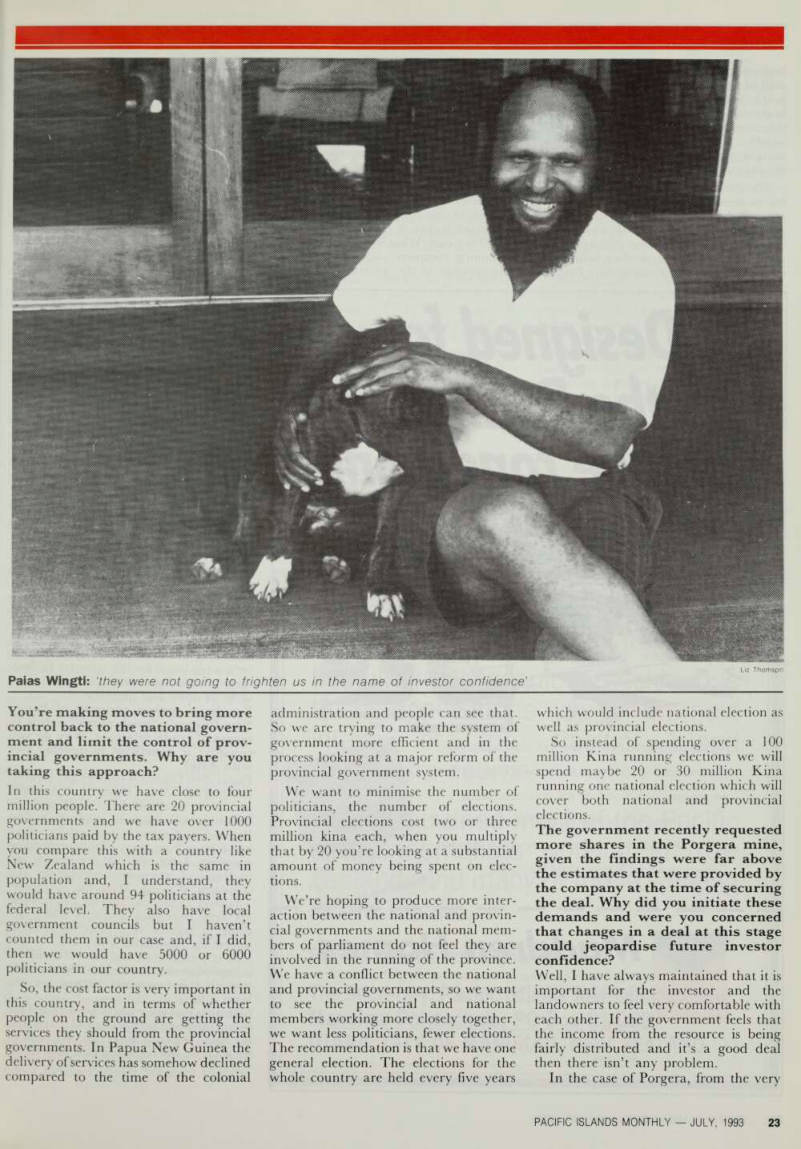
Paias Wingti: ‘they were not going to frighten us in the name of investor confidence'
beginning the profit was not fairly distrib uted in terms of share-holding and benefits to the country. We got a raw deal from the beginning. Some of the multinationals in the country have got a very good track record, but the thing is the mining companies are the ones with the capital and
the expertise.
The government hasn’t got that exper tise in terms of assessing the reserves. We rely on the information they provide us with, and I knew when I was in the opposition that the resource of Porgera was undervalued. I made it clear before the election that we would renegotiate Porgera
if we got into government. As soon as we got into power I called the chairman of the company, based in Canada, and asked him to come to Port Moresby for a one-to-one discussion. I made it clear to him that my government would not protect the mine unless I felt happy, and the government felt happy, that we were getting a fair share.
I informed the chairman that we wanted to increase our share-holding by another 20 per cent, to take it up to 30 per cent, and we wanted to pay a reasonable price for that 20 per cent. What happened was that the mining company underestimated the determination of the government, that I
meant business. So they went ahead, in a three-page statement released to the Syd ney stock exchange, arguing their case against the government publicly. As soon as they did that all the share prices came down and the mining industry was writing about how Papua New Guinea was trying to grab shares in Porgera without paying ... but I allowed them to do that because we were firm and they were not going to frighten us in the name of investor
confidence. They thought they would
create an anti-government feeling and the publicity would be so great that the government, because it was fearful of losing investor confidence would back down.
But I made it very clear that we were very determined, regardless of what the outside press seemed to think of Papua New Guinea. We were successful and now we are happy. But if they didn’t do it I was prepared to take other options and I had them already lined up. I would have introduced a law in parliament and taken over the company. But we are fair people and that was a last resort. I would have taken over Porgera. I was determined.
With the gold prices going up we have made a fortune for our country.
But how do you think it will effect foreign investor confidence?
Well, I think it’s important for investors to appreciate we have never taken any business over. Investors must not look at Chile, Africa, places where the government just took over and paid what they wanted to. We have never done this in our country.
There has always been discussion amongst shareholders.
That is something investors need to be aware of. We are reasonable people. Only when you take us for a ride and we have no other choice would we have to do something like that. The Porgera deal has been a big lesson for this country. In deals there must be some provision available for us to sit down and negotiate.
You have spoken recently of Papua
New Guinea’s “push north” policy in terms of trade relations. Why do you consider it beneficial to develop ties with Asia?
Papua New Guinea is strategically located, bridging the Asian region and Australia and New Zealand. Our traditional re lationship with Australia is important, but Papua New Guinea is in a position where it can learn from many of the surrounding countries. Asian countries are moving fast in terms of economic development and
standards of living. Malaysia, Singapore,
Thailand, Indonesia, Taiwan, China, these are very important countries which are going to become very powerful. That is something Australians can’t beat the level of productivity and the work ethic. It is important that Papua New Guinea looks towards these countries because we can learn a lot.
Countries that are going to be successful are competitive and productive and that is why the Asian region is important. We need to see what we can learn and gain from them.