Police On Trial
pp. 18-21 · Read in the full issue

Cover Story
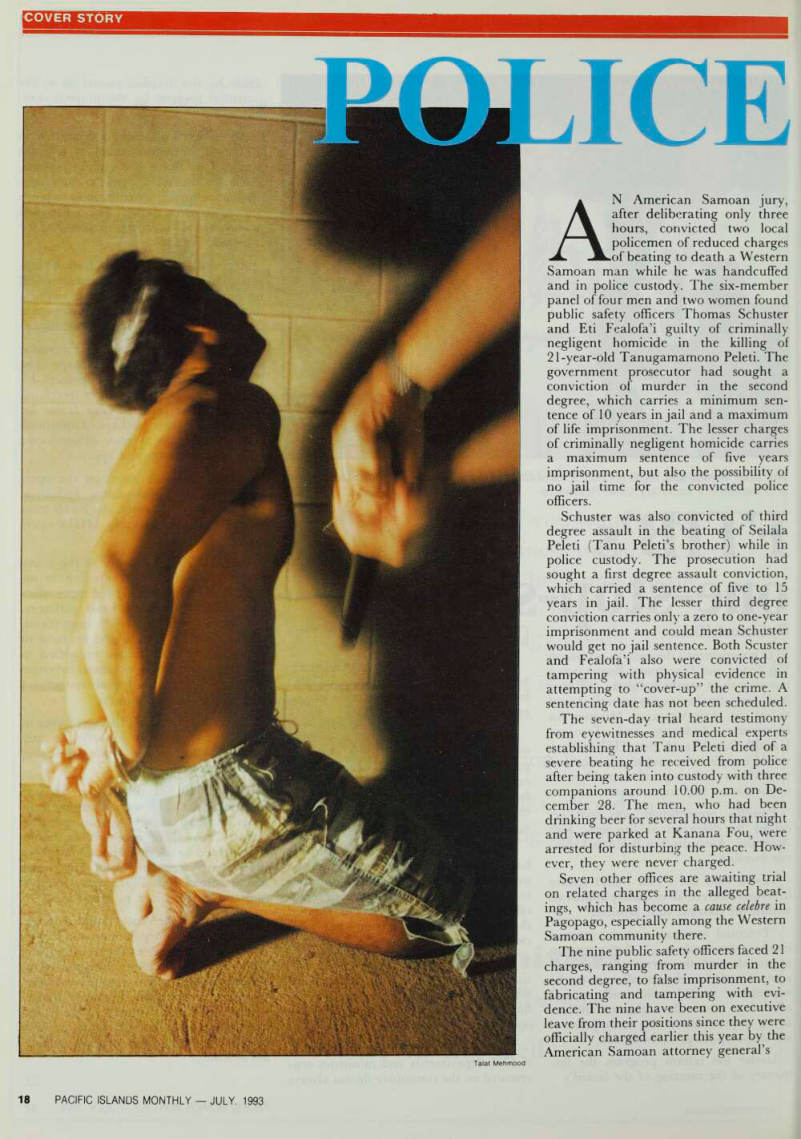
AN American Samoan jury, after deliberating only three hours, convicted two local policemen of reduced charges of beating to death a Western Samoan man while he was handcuffed and in police custody. The six-member panel of four men and two women found public safety officers Thomas Schuster and Eti Fealofa’i guilty of criminally negligent homicide in the killing of 21-year-old Tanugamamono Peleti. The government prosecutor had sought a conviction of murder in the second degree, which carries a minimum sen tence of 10 years in jail and a maximum of life imprisonment. The lesser charges of criminally negligent homicide carries a maximum sentence of five years imprisonment, but also the possibility of no jail time for the convicted police officers.
Schuster was also convicted of third degree assault in the beating of Seilala Peleti (Tanu Peleti’s brother) while in police custody. The prosecution had sought a first degree assault conviction, which carried a sentence of five to 15 years in jail. The lesser third degree conviction carries only a zero to one-year imprisonment and could mean Schuster would get no jail sentence. Both Scuster and Fealofa’i also were convicted of tampering with physical evidence in attempting to “cover-up” the crime. A sentencing date has not been scheduled.
The seven-day trial heard testimony from eyewitnesses and medical experts establishing that Tanu Peleti died of a severe beating he received from police after being taken into custody with three companions around 10.00 p.m. on De cember 28. The men, who had been drinking beer for several hours that night and were parked at Kanana Fou, were arrested for disturbing the peace. How ever, they were never charged.
Seven other offices are awaiting trial on related charges in the alleged beat ings, which has become a cause celebre in Pagopago, especially among the Western Samoan community there.
The nine public safety officers faced 21 charges, ranging from murder in the second degree, to false imprisonment, to fabricating and tampering with evi dence. The nine have been on executive leave from their positions since they were officially charged earlier this year by the American Samoan attorney general’s
Talat Mehmood
office. They have remained free after posting bail, which for those facing the most serious charges amounted to as much as SIOO,OOO.
The remaining seven officers will be prosecuted in two trials. The first trial of three of the seven is scheduled to begin in early July. The charges will be criminally negligent homicide, assault and fabricating evidence. The seven other police officers under indictment are Ronald Tui, Tamasamoa Taua’i and Fuatua Maiava, who will be tried in July, and Swain Meleisea, Tupulua Tagalao, Mascfua Suiaunoa, Peniamina Wilson, who will be tried last.
Key testimony in the Schuster- Fealoa'i trial included the testimony of Dr Mary Flynn, a licensed forensic pathologist and former Hawaii state medical examiner. Flynn, who per formed the autopsy on Tanu Peleti, testified his death was caused by a combination of blunt trauma injuries, positional restraint and asphyxia. The bruises, contusions and lacerations to his head, chest, sides, back, stomach, arms and legs were consistent with his having been kicked and choked while in a handcuffed and restrained position in police custody, Flynn testified on May 28. He had a fractured sternum, two broken ribs on his left side, several internal injuries and his lungs were full of blood, Flynn said. Police spokesmen had said Tanu Peleti received his head injuries when he fell during an escape attempt at Kanana Fou. Tanu Peleti was six foot two inches in height and weighed about 180 pounds.
The position restraint handcuffed and lying face down made it difficult for Tanu Peleti to breathe because his chest could not expand, Flynn said.
Later, when the victim was turned on his back and left in a slouched position, his neck was so bent that oxygen could not 50 to the rest of his body, Flynn testified.
The first three days of the trial heard ?ye-witness testimony from the three )ther men who were allegedly beaten
Uiga Uiga, Fa’alaga Milo, and Seilala
Peleti. Government prosecutor, assistant attorney-general Donald Sheehan, led he three in recounting their recollections afwhat happened the night of December 28 last year when they got together around 8.00 or 9.00 pm when they got ogether for some beer drinking. Later
they went out for a ride to Tafuna and continued drinking after they parked the car in an area known as Kanana Fou, not far from Petesa, where they lived. Late that night several police cars arrived at the scene, flashed lights into the men’s car, and ordered them out of the vehicle.
The men were immediately handcuffed and taken away in police vehicles. Tanu Peleti was taken in one vehicle while the three other men were taken in two other
police cars.
Uiga and Milo said they were not informed of why they were arrested, nor were they read their Miranda Rights. In US jurisdictions, police are required, under the Miranda Law, to advise those they arrest that they have a right to remain silent as well as a right to an attorney. Milo, Uiga and Seilala Peleti, still handcuffed, arrived at a police station in the Office of Motor Vehicles.
The beatings began as soon as they got there. Uiga said. “We were pushed to the ground and beaten. In an emotional testimony on the opening of the trial, Uiga said he cried out during the beatings “Please we’re not animals, we’re human beings.” He told the court, “Police shouldn't do this to us. I am an American Samoan. Police shouldn't do this to their own citizens.” Uiga said he was in great pain during the beating and was having great trouble breathing.
Uiga said as he continued to cry out, one police officer told him he talked too much
and “pushed a flashlight against my
jaw.” Uiga testified that at one point in the beatings he heard Eti Fealofa’i saying
“That’s enough”.
Fa’alaga Milo, another relative of Tanu Peleti, testified, “I was pushed to the floor and beaten.” He demonstrated for the court his position during the beatings by getting down on his knees, with his hands behind him as if cuffed, and with his face flat on the floor. He said during the beatings he continued to yell out, “Oh, I want to live, please.” Milo identified defendants Eti Fealofa’i as one of the officers present at the beatings and one who took part in beating him.
Seilala Peleti testified that when Tanu was brought into the police station that night, “ by two police officers (and) he looked tired, with blood coming from his nose. I then saw him being thrown on the other side of the room next to where Fa’alaga was.” Seilala said officer
Schuster was one of the two police men who brought Tanu into the station. “I saw Schuster stepping on my brother, using his legs to kick Tanu." Seilala also identified defendant Fealofa'i as one of the officers who was wielding a large
black object, possibly a flashlight.
Uiga testified he could see Tanu Peleti after the beat ings and l hat Tanu was in a slouched position with his head and shoulders against the wall. “Tanu was not moving. He looked different when he was brought in.
He did not look strong. He did not have the same strength he had coming into this world.”
Defence counsels Togiola Tulafono, representing Eti Fealofa’i and Steve Watson, representing Schuster, brought out that the men had been drinking quite a lot that night, more than a case of beer.
They also obtained the admission that Seilala Peleti had recently been con victed for driving with a suspended licence, was on a six-month probation at the time of his arrest, and prohibited from drinking alcoholic beverages or driving his car by the terms of that
probation. In subsequent testimony the
defence established that Seilala and one other man resisted arrest and attempted to flee. When officers tried to handcuff him at Kana Fou, Seilala said, “I pulled my hands because I did not know what was going on. The police officers never said why they locked our hands.” He also said the police were not aware of his probation when they arrested him.
A medical officer, emergency medical technician Punefu Tuaolo, testified on May 27 that when he arrived at the police station early December 29 to provide medical assistance, Tanu Peleti was lying motionless and appeared not to be breathing. He said he saw Schuster and another co-defendant Meleisea walking toward their vehicle. “Upon entering the building, I noticed a young man lying on the floor. I asked what happened twice, but no reply came from Fealofa’i who was in the room. Another young man who was sitting in a chair answered, “He is my brother and he was
beaten by the police.”
Dr Vaiula Tuato’o, the chief surgeon at the LBJ Medical Centre, testified on June 1 that the injuries to Seilala Peleti included abrasions on his face, chest, abdomen, hands and feet, with discolour
ation on the left side of the chest as well as swollen and discoloured wrists.
Tuato’o said Seilala complained of severe chest and stomach pain and was having great difficulty breathing. Seilala also had high level of the enzyme CPK, which is produced by damaged muscle. Seilala required hospitalisation for three days.
A former police reserve officer, Fa’asuamalie Fiame, testified on June 1 that while on duty after midnight on December 29 he saw two officers kicking and beating two of the four men who had earlier been brought to the station. He was told by the arresting officers that the men had been creating a public disturb ance, had been chased from one location where they were drinking in a parked car, and that the men had later been apprehended at a second location - Kanana Fou. He said public safety officer Fautua Maiavai was kicking Uiga on one side of the room while community service officer Ronald Tui was doing the same to Seilala on the other side of the room.
Fiame said he also observed one of the handcuffed men lying motionless on the floor and that the man looked very weak.
Mario Leflti, another emeregency medical technician from LBJ Medical Centre, also testified the same day that when he arrived at the police station (the Tafuna Substation West) a few hours after midnight, on December 29, “I saw bruises on Tanu’s (Peleti) chest, blood coming from his mouth, and he was not breathing”. The medics administered CPR and transported the men to the hospital in an ambulance. But Tanu never responded to the medical assist ance. He was pronounced dead at 2.40 am on December 29.
Sgt Terry Letuli, one of the first public safety officers assigned to investigate the death, testified that at the morgue he observed Tanu’s body had numerous contusions on the chest, abdomen, and on his sides. There were blood stains on Tanu’s face and the back of his head.
Foam was coming out of his right ear, and there was bruises on his mouth and ear, as well as contusions on his back and knees, as well as handcuff marks on his wrists.
As he investigation continues, Letuli said, he received written statements from some of the defendents. One statement by Eti Fealofa’i said one of the apprehen ded men had attempted to run away during the arrests at Kanana Fou and that another man, Tanu, while also trying to flee, had fallen and that Fealofa’i, who had been chasing the men, had fallen on top of him. Tanu was then handcuffed and placed in Schuster’s police vehicle.
‘We were pushed to the ground and beaten Please, we’re not animals, we’re human
beings ...
Police shouldn’t do this to their own citizens.’
In testimony on June 1 and 2, other police officers testified that some pages from the official police log book of the night of December 28 and 29 were missing. The missing pages would have contained the entries and comments of the arresting officers for the hours when Tanu Peleti and the three other men were arrested, interrogated and jailed.
Neither Schuster nor Fealofa’i took the witness stand but six other police officers were called by defence attorneys to testify about the stable emotional state of both officers and the attempts of some of those arrested to flee from the police on the night of December 28 at Kanana Fou.
Closing arguments were presented on the morning of June 4, beginning at 8.30 a.m. and lasted for five hours. The prosecution argued that the officers had acted recklessly and with extreme indif ference to human life, had caused Peleti’s death and then had lied to cover up their crime. Defence attorneys argued there was no clear and reliable evidence that proved that either Schuster or Fealofa’i took part in the beatings, and that while
a death had occurred, there were lesser charges the jury could consider, includ ing manslaughter and criminally negli gent homicide.
During and hour of instructions from Chief Justice Michael Kruse the jury was told the officers must be presumed innocent unless convincing evidence proving otherwise had been presented and that several lesser charges were available to them. Justice Kruse defined those charges and explained the sen tences they carried. The jury then began its deliberations and emerged with its verdict about 6.00 pm. □