Dancing the
pp. 54-55 · Read in the full issue
Yachting
Dancing the night away
By Sally Andrew
A CRY of “Mauri!” echoed across the water as Nakiebu paddled towards us in his outrigger. We had anchored in the same spot nearly a year before and
Nakiebu, returning after a day's fishing
outside Katherine Bay, was welcoming Fellowship back to Rabi.
Sharing the anchorage in Katherine Bay was Californian yacht Annie’s Song with Ann and Stu Yellen aboad. The four of us joined a local family on a trip to their garden in the hills. The inhabi tants of Rabi are transplanted Micro nesians from the raised coral island of Banaba, also known as Ocean Island.
Unlike Banaba, Rabi is a lush high island
and “jungle” farming techniques and
crop selection have been learnt from the Fijians. We were impressed by the flourishing number of kava, cassava and dalo plants. A “bush lunch” was sug gested and soon the fire was burning, cassava was boiling, and freshwater prawns were simmering in coconut milk.
Someone asked if we would like to see some traditional Rabi dancing. “We sure would!” the four of us answered and
dancing was oiganised for the evening.
When we stepped ashore, our hostess’s children took us to a tidy concrete block home where we were presented with fragrant flower headdresses. In Rabi the “need” for furniture is not yet under stood. Pandanus mats had been neatly laid on the floor and we„sat cross-legged as dish after dish of food was set in front of us. After eating, we scooted back against the wall. Children began singing,
one young boy stealing the show with an outstanding solo. As darkness fell, men strummed guitars and picked mandolins, making music, each exchanging his instrument for another displaying tremendous versatility. Dancers fidgeted in an adjoining room until finally the
performance began. Rabian dancing
seemed to intergrate traditional Banaban dancing with some evolved changes influenced by the Fijian meke. At the end of the performance, our hostess surprised us asking if we would dance. “We don’t dance very we 11...” we babbled. I thought; “You’ve gotta be kidding!!” But the music started up and two men asked Ann and I to dance. Stu and Foster had to be coached out of the corner, but soon the two wallflowers were making some what rhythmic movements vaguely re sembling John Travolta. Before long all of us had “Saturday Night Fever”.
Everybody got a chance to “twist” with the four yachties.
There is a bus that joins the villages of Rabi together, and the early bus trip from Buakonikai village at the far southeastern end of the line to Nuku is
quite an experience. Schoolchildren pile
on the bus as it winds around the cove.
Men with machetes and women with arms full of packages and babies crowded onto the bus. Before starting up an exceptionally loftg, steep hill all the children got off the bus and walked the rest of the way to Buakonikai Primary School. Even emptied of its mass of children the bus laboured up the hills.
We descended even slower, in lowest gear, noise and red dust rising. It was a long and bumpy ride to Nuku as we
made random stops to pick up passen gers. We were told there are no “bus” stops on Rabi, only ‘"people” stops!!
In Nuku we checked-in with the police, then paid a visit to the Island Council offices where we met Takia, treasurer lor the focal council. At “Women s Interest”, we talked to the women running the shop and bought a few island treasures. In addition to being the handicraft outlet for the island, “Women’s Interest” provides counselling and support for women.
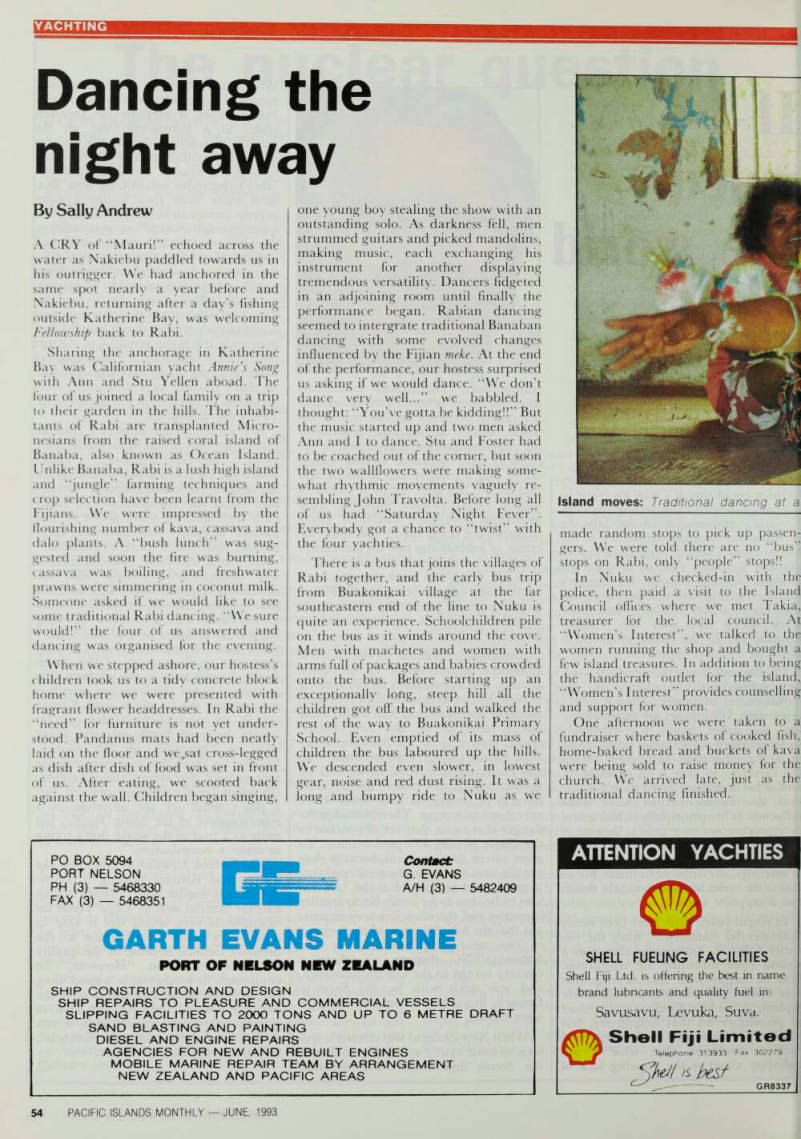
One afternoon we were taken to a fundraiser where baskets of cooked fish, home-baked bread and buckets of kava were being sold to raise money for the church. We arrived late, just as the traditional dancing finished.
Island moves: Traditional dancing at a
Disappointed, our faces told all. After a few whisperings the dance was on again.
We enjoyed the “Dance of the Frigatebird” and were amazed to see a quick-knee’d Tahitian-style dance. Af terwards the group leader presented us with leis and asked if we would mind dancing! “Sure!” we said. Young and handsome Paul soon had me “twisting”, while the woman leader danced with Foster. When the dancing was over, we were honoured in the traditional Bana ban way with a squirt of cologne.
Our last evening at Buakonikai we were invited to a fourth dance perform ance. This time several elders attended and a veritable feast had been prepared.
The merrymaking continued until the wee morning hours. Everybody danced the night away while the rhythmic pounding of kava resounded through the darkness. About one o’clock, Ann made a speech of thanks for the food, dancing, hospitality and friendship. It had all been overwhelming. Speeches were exchanged between us and our hosts. When the words ran out, we made our way back to the boat exhausted but full of grog and good memories.
In Rabi, as in other remote and not so remote parts of Fiji, we had found a special place full of special people. □
[?]ndraiser