ruled
p. 53 · Read in the full issue
Profils
If I
the world
‘What I am unhappy about is the growing lack of transparency'
By Ian Williams
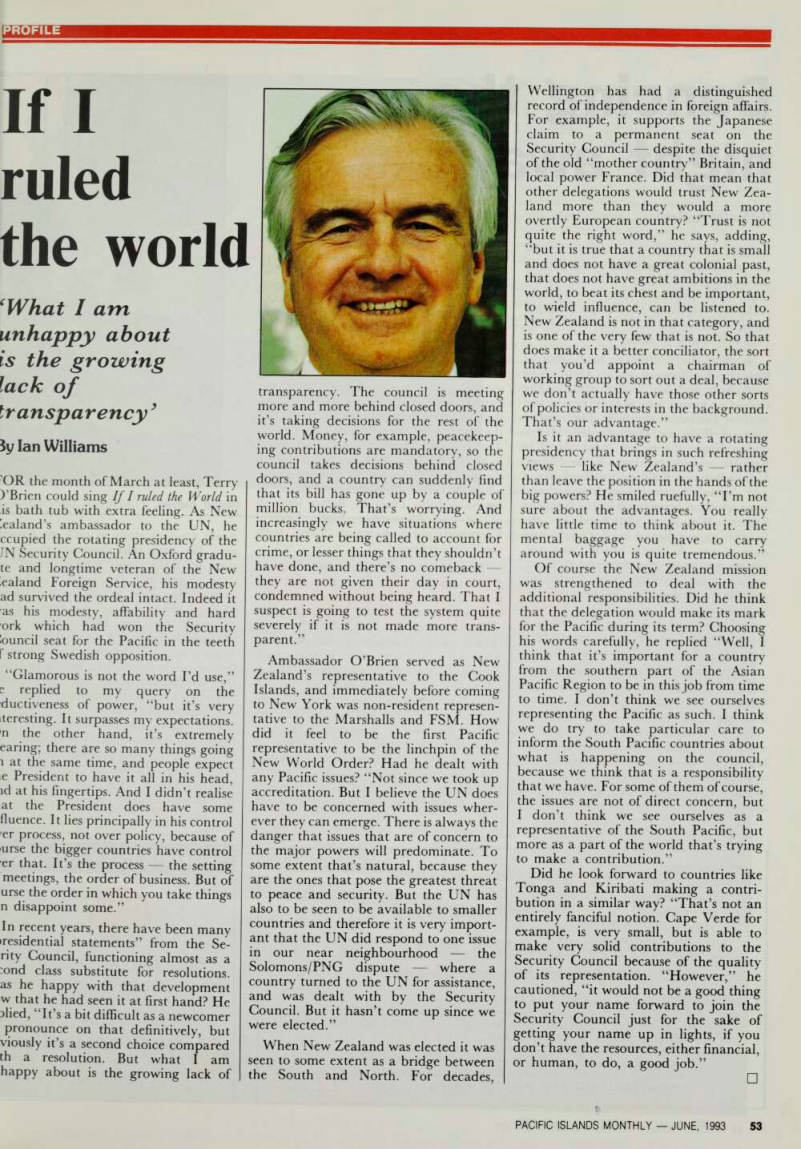
'OR the month of March at least, Terry )’Brien could sing If I ruled the World in is bath tub with extra feeling. As New Zealand’s ambassador to the UN, he ccupied the rotating presidency of the IN Security Council. An Oxford gradu te and longtime veteran of the New ealand Foreign Service, his modesty ad survived the ordeal intact. Indeed it as his modesty, affability and hard ork which had won the Security louncil seat for the Pacific in the teeth f strong Swedish opposition.
“Glamorous is not the word Td use,” s replied to my query on the ductiveness of power, “but it’s very teresting. It surpasses my expectations, n the other hand, it’s extremely earing; there are so many things going i at the same time, and people expect e President to have it all in his head, id at his fingertips. And I didn’t realise at the President does have some fluence. It lies principally in his control r er process, not over policy, because of urse the bigger countries have control er that. It’s the process the setting meetings, the order of business. But of urse the order in which you take things n disappoint some.”
In recent years, there have been many •residential statements” from the Se rity Council, functioning almost as a :ond class substitute for resolutions, as he happy with that development w . t^la ( t t had seen it at first hand? He alied, “It’s a bit difficult as a newcomer pronounce on that definitively, but viously it’s a second choice compared th a resolution. But what I am happy about is the growing lack of
transparency. The council is meeting more and more behind closed doors, and it’s taking decisions for the rest of the
world. Money, for example, peacekeep
ing contributions are mandatory, so the council takes decisions behind closed doors, and a country can suddenly find that its bill has gone up by a couple of million bucks. That’s worrying. And increasingly we have situations where countries are being called to account for crime, or lesser things that they shouldn’t have done, and there’s no comeback they are not given their day in court, condemned without being heard. That I suspect is going to test the system quite severely if it is not made more trans parent.”
Ambassador O’Brien served as New Zealand’s representative to the Cook Islands, and immediately before coming to New York was non-resident represen tative to the Marshalls and FSM. How did it feel to be the first Pacific representative to be the linchpin of the New World Order? Had he dealt with any Pacific issues? “Not since we took up accreditation. But I believe the UN does have to be concerned with issues wher ever they can emerge. There is always the danger that issues that are of concern to the major powers will predominate. To some extent that’s natural, because they are the ones that pose the greatest threat to peace and security. But the UN has also to be seen to be available to smaller countries and therefore it is very import ant that the UN did respond to one issue in our near neighbourhood — the Solomons/PNG dispute — where a country turned to the UN for assistance, and was dealt with by the Security Council. But it hasn’t come up since we were elected.”
When New Zealand was elected it was seen to some extent as a bridge between the South and North. For decades,
Wellington has had a distinguished record of independence in foreign affairs.
For example, it supports the Japanese claim to a permanent seat on the Security Council despite the disquiet of the old “mother country” Britain, and local power France. Did that mean that other delegations would trust New Zea land more than they would a more overtly European country? “Trust is not quite the right word,” he says, adding, “but it is true that a country that is small and does not have a great colonial past, that does not have great ambitions in the world, to beat its chest and be important, to wield influence, can be listened to.
New Zealand is not in that category, and is one of the very few that is not. So that does make it a better conciliator, the sort that you’d appoint a chairman of working group to sort out a deal, because we don’t actually have those other sorts of policies or interests in the background.
That’s our advantage.”
Is it an advantage to have a rotating presidency that brings in such refreshing views - like New Zealand’s rather than leave the position in the hands of the big powers? He smiled ruefully, “I’m not sure about the advantages. You really have little time to think about it. The mental baggage you have to carry around with you is quite tremendous.”
Of course the New Zealand mission was strengthened to deal with the additional responsibilities. Did he think that the delegation would make its mark for the Pacific during its term? Choosing his words carefully, he replied “Well, I think that it’s important for a country from the southern part of the Asian Pacific Region to be in this job from time to time. I don’t think we see ourselves representing the Pacific as such. I think we do try to take particular care to inform the South Pacific countries about what is happening on the council, because we think that is a responsibility that we have. For some of them of course, the issues are not of direct concern, but I don’t think we see ourselves as a representative of the South Pacific, but more as a part of the world that’s trying to make a contribution.”
Did he look forward to countries like Tonga and Kiribati making a contri bution in a similar way? “That’s not an entirely fanciful notion. Cape Verde for example, is very small, but is able to make very solid contributions to the Security Council because of the quality of its representation. “However,” he cautioned, “it would not be a good thing to put your name forward to join the Security Council just for the sake of getting your name up in lights, if you don’t have the resources, either financial, or human, to do, a good job.”