Vanuatu’s Shining Star
pp. 43-45 · Read in the full issue
Tourism is seen as
the one real
hope for the
country’s economy.
THE only truly shining star in the Vanuatu economy is tourism. It is here that despite its very high cost structure the country has something that is quite unique by comparison with other countries in the region. The asset is it is possible to visit traditional villages in safety and then return to a town such as Port Vila where services, while not quite up to five-star level everywhere, are as close as one can find in the Pacific. While Solomon Islands and Papua New Guinea have probably just as much if not more diverse cultures, they both have disad vantages that make them difficult lo :ations for tourism. PNG is simply not perceived to be safe and Solomon Islands las almost no tourism infrastructure.
Airther to the east in Fiji and Polynesia he vast bulk of what was traditional ulture has been destroyed by the mslaught of Western culture.
In the mid-1980s the tourism sector lid not appear so secure. The combin tion of political instability, cyclones and fairly neutral government attitude ombined to make tourism look as hough it was going to go the same way s the tourism sector in PNG. Despite redictions of its imminent demise the )urism sector is grow. ,g from strength ) strength and tourist arrivals have now
cached their pre-independence levels,
ven with six cyclones battering Vanu tu in 1992 the tourist arrivals appear to ave shown no decline. The attitude of
le government has changed perhaps out
necessity or perhaps out of the riderstanding that while tourism-led may not be perfect, it is rtainly preferable to no development at 1. The government has begun to push unsm as a top priority sector and one any officials see as the one real hope the •untry has for sustained economic owth in the future.
In the last few years the rate of cupancy of hotels has increased dras ally and the government is doing erything in its power to try to push new
•tel developments. Within the industry
is widely accepted that at high season e hotels are generally operating at etty close to full capacity and Air muatu has made it perfectly clear the
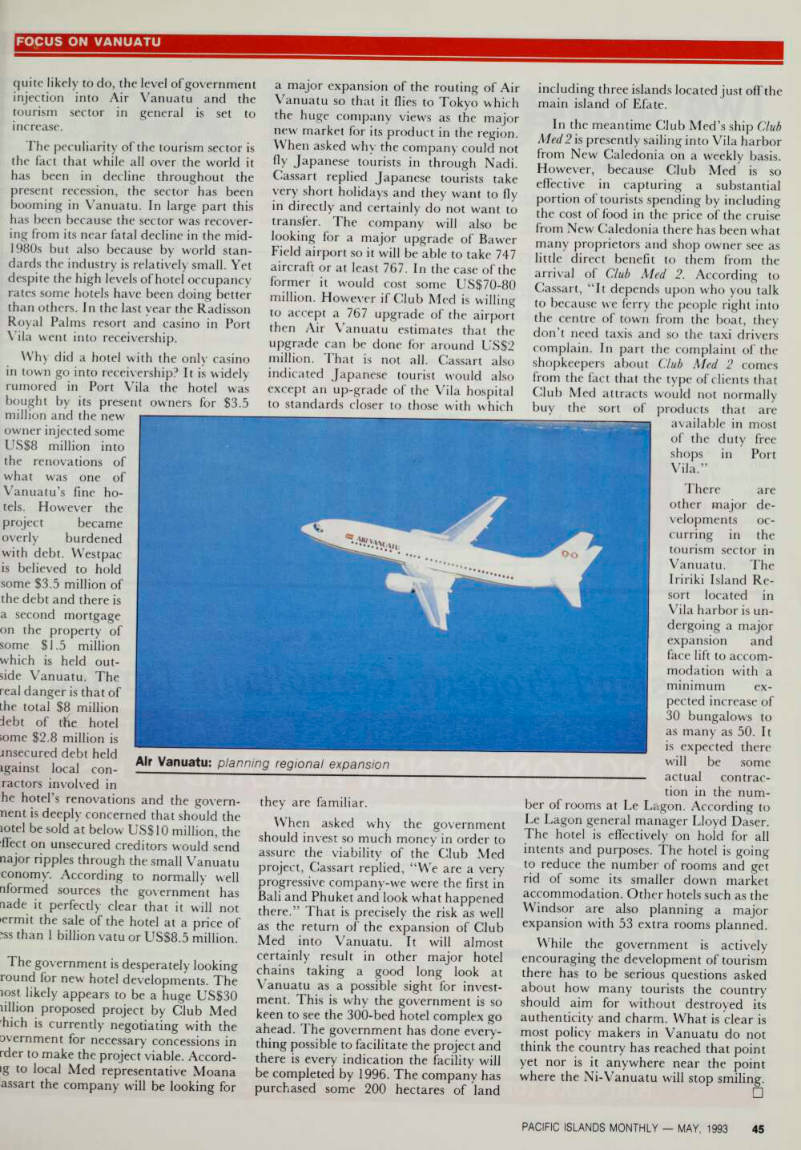
principle constraint to the expansion of its operation is the fact that there are simply not enough hotel beds in Vila. At present the airline is leasing a 737-400 from Australian Airlines for three days a week. 1 his flexible leasing arrangement is one of the things that has differentiated the airline from other carriers such as Solomon Airlines, whose committee to full lease arrangement and low capacity utilisation has created severe financial difficulties for the firm. Air Vanuatu used to own a 727-200 but has switched to a lease arrangement to take advantage of the advanced technology of the 737-400.
The airline is also planning some regional expansion. First it is planning to lease a Bandeirante to fly to New Caledonia on the days that Air Cale donie does not. The small aeroplane has the advantage of flying directly to Magenta airport in Noumea rather than to Tontouta airport which is a 45-minute drive from town. However it is yet to be resolved that the French authorities allow the airline to operate to Magenta.
While the Bandeirante is considerably slower than the jet service the shortened journey to town will make the two services of approximate equal duration.
Air Vanuatu is also planning to purchase
a Dash-8 for the regional east-west service which will offer the airline the frequency that is needed in joining Vanuatu to Fiji as well as to other parts of Melanesia. The service could be of great importance depending upon what will eventually happen to the Solomon Airlines east-west service.
For a new airline and by regional standards Air Vanuatu has been remark ably successful. It has however received a great deal of government assistance.
The Vanuatu government arranged a loan of 765 million vatu to assist it to purchase its 8727. The airline also received a grant from the government of Australia of As 6 million, of which Asl million was used to promote Vanuatu in Australia and New Zealand. In 1990 and 1991 the government injected a further 200 million vatu into the airline. The airline has shown remarkable growth of sales of 300 per cent from 1989 to 1991.
The government of Vanuatu on its side has shown a willingness to back the airline and a realisation that if the tourism sector is to be the backbone of the economy then there will certainly be a need for further capital injections in future. It is fairly evident that if the industry will expand as it presently seems
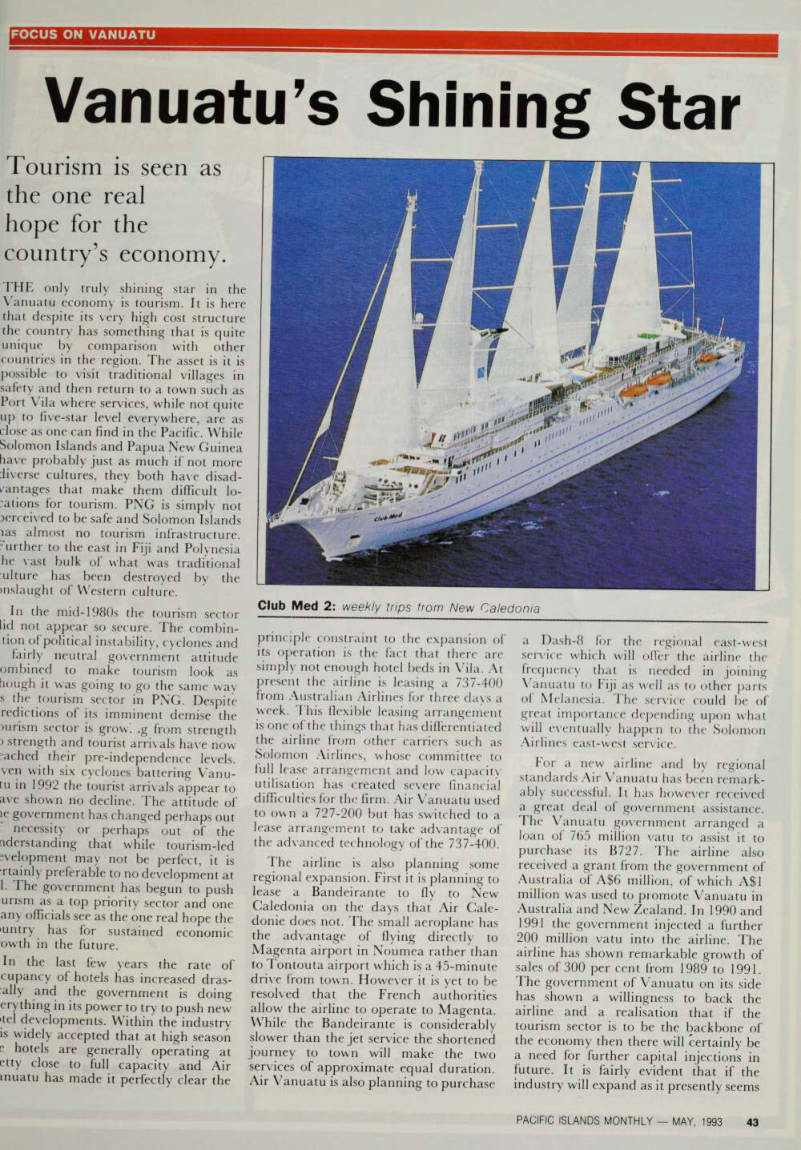
Club Med 2: weekly trips from New Caledonia
quite likely to do, the level of government injection into Air Vanuatu and the tourism sector in general is set to increase.
The peculiarity of the tourism sector is the fact that while all over the world it has been in decline throughout the present recession, the sector has been booming in Vanuatu. In large part this has been because the sector was recover ing from its near fatal decline in the mid 1980s but also because by world stan dards the industry is relatively small. Yet despite the high levels of hotel occupancy rates some hotels have been doing better than others. In the last year the Radisson Royal Palms resort and casino in Port Vila went into receivership.
Why did a hotel with the only casino in town go into receivership? It is widely rumored in Port Vila the hotel was bought by its present owners for $3.5
million and the new owner injected some US$B million into the renovations of what was one of Vanuatu’s fine ho tels. However the project became overly burdened with debt. Westpac is believed to hold some $3.5 million of the debt and there is a second mortgage on the property of some $1.5 million which is held out side Vanuatu. The real danger is that of the total $8 million
debt of tile hotel
;ome $2.8 million is insecured debt held igainst local con ractors involved in
he hotel’s renovations and the govern nent is deeply concerned that should the iotel be sold at below US$lO million, the ffect on unsecured creditors would send
najor ripples through the small Vanuatu
conomy. According to normally well aformed sources the government has aade it perfectly clear that it will not •ermit the sale of the hotel at a price of jss than 1 billion vatu or US$B.5 million.
The government is desperately looking round for new hotel developments. The lost likely appears to be a huge US$3O lillion proposed project by Club Med hich is currently negotiating with the overnment for necessary concessions in rder to make the project viable. Accord ig to local Med representative Moana assart the company will be looking for
a major expansion of the routing of Air Vanuatu so that it flies to Tokyo which the huge company views as the major new market for its product in the region.
When asked why the company could not fly Japanese tourists in through Nadi.
Cassart replied Japanese tourists take very short holidays and they want to fly in directly and certainly do not want to transfer. The company will also be looking for a major upgrade of Bawer Field airport so it will be able to take 747 aircraft or at least 767. In the case of the former it would cost some US$7O-80 million. However if Club Med is willing to accept a 767 upgrade of the airport then Air Vanuatu estimates that the upgrade can be done for around US$2 million. I hat is not all. Cassart also indicated Japanese tourist would also except an up-grade of the Vila hospital to standards closer to those with whirh
they are familiar.
When asked why the government should invest so much money in order to assure the viability of the Club Med project, Cassart replied, “We are a very progressive company-we were the first in Bali and Phuket and look what happened there.” That is precisely the risk as well as the return of the expansion of Club Med into Vanuatu. It will almost certainly result in other major hotel chains taking a good long look at Vanuatu as a possible sight for invest ment. This is why the government is so keen to see the 300-bed hotel complex go ahead. The government has done every thing possible to facilitate the project and there is every indication the facility will be completed by 1996. The company has purchased some 200 hectares of land
including three islands located just off the main island of Efate.
In the meantime Club Med’s ship Club Med 2 is presently sailing into Vila harbor from New Caledonia on a weekly basis.
However, because Club Med is so effective in capturing a substantial portion of tourists spending by including the cost of food in the price of the cruise from New Caledonia there has been what many proprietors and shop owner see as little direct benefit to them from the arrival of Club Med 2. According to Cassart, “It depends upon who you talk to because we ferry the people right into the centre of town from the boat, they don’t need taxis and so the taxi drivers complain. In part the complaint of the shopkeepers about Club Med 2 comes from the fact that the type of clients that Club Med attracts would not normally buy the sort of products that are
available in most of the duty free shops in Port Vila.”
There are other major de velopments oc curring in the tourism sector in Vanuatu. The Iririki Island Re sort located in Vila harbor is un dergoing a major expansion and face lift to accom modation with a minimum ex pected increase of 30 bungalows to as many as 50. It is expected there will be some actual contrac tion in the num
ber of rooms at Le Lagon. According to Le Lagon general manager Lloyd Baser.
The hotel is effectively on hold for all intents and purposes. The hotel is going to reduce the number of rooms and get rid of some its smaller down market accommodation. Other hotels such as the Windsor are also planning a major expansion with 53 extra rooms planned.
While the government is actively encouraging the development of tourism there has to be serious questions asked about how many tourists the country should aim for without destroyed its authenticity and charm. What is clear is most policy makers in Vanuatu do not think the country has reached that point yet nor is it anywhere near the point where the Ni-Vanuatu will stop smiling. □
Air Vanuatu: planning regional expansion