Going Nowhere
pp. 39-41 · Read in the full issue
Focus On Vanuatu
Vanuatu’s economy may be stable but for the moment it is not going anywhere.
WHEN you walk down the main street of Vila it is hard to imagine Vanuatu still maintains what is called ‘least developed country status’. To many in the develop ment business it looks like a bit of joke.
It remains like that until you get out to the outer island and then it is no joke.
The French restaurants, five star hotels and duty free shops mask a rural economy that has not changed much over the last ten years of independence.
Vanuatu like most of the Pacific is going nowhere and maintains a real growth rate that does not even keep up with population growth. Over the period 1983-90 the rate of growth of real GDP was 2.3 but over the same period
population was increasing at
approximately 2.8 per cent every year. a result Vanuatu, like its two
Vlelanesian neighbors has slipped back
wards over the years with declining real jDP per capita. In the last three years lowever there has been a change in brtune with growth rates for 1988-1991 it approximately 4.3 per cent on aver se. What makes Vanuatu quite decep ive is if you stay in Vila you will never et the sense that it is just not growing in the Solomons or Tonga or Western amoa that powerful stench of no growth right there on main street.
The arithmetic of low real growth and igh population growth have not put the [ueeze on Vanuatu as it has increasingly PNG where the resulting impoverish ed of the population has caused serious ime problems. Vanuatu remains a iven for many ex-PNG expatriates who ive moved to ‘Melanesia without the Mence’. How long Vanuatu will be able remain so is a question of conjecture it still for the moment it is a place icre there are no fears of walking down “ street or sitting in bars and there pear as yet none of the hideous panties between rich and hopelessly or as exist in PNG. rince independence Vanuatu has re -1 heavily upon three or four main tors to be engines for growth. Tra lonally the main source of revenue for bulk of the population has been ting copra but the export of copra has lined m relative importance and has n supplanted by other exports. The in ones have been exports of cocoa, and hides which have over the years )wmg independence grown to over . copra. Copra has decreased in incance from the point where it mtuted some 70-80 per cent of 3rts to where it is less than 40 per cent sports. In large part this has been a
result of the decline in copra prices over the years. The problems of Vanuatu copra has been seriously compounded by the fact it has over the years suffered from aflotoxin problems because of poor drying and storage. The result has been
not only decreased demand for Vanuatu copra but all copra from other Melanesian countries which have suf fered from the bad reputation that Vanuatu copra has gained from the aflotoxin problem.
What is particularly different about Vanuatu is the degree to which copra and other tree crops have developed into smallholder crops. Approximately 80 per cent of Vanuatu’s copra production comes from smallholders rather than from plantations. For the average rural Ni-Vanuatu cutting copra remains his
principle source of money income and with declining commodity prices the principle reason for the failure of the rural population to be able to generate improved money incomes.
Copra has an utterly abysmal future in
Vanuatu and the rest of the Pacific. The World Bank projects that copra prices, which peaked in 1988 at some US$39O per tonne will only rise very slowly and even by the year 2005 long term copra prices will still be lower than the real 1992 level and will be less than 80 per cent of the 1988 peak.
The future of copra, or more precisely its lack of a future has been predicted throughout the entire 1980 s. In the early 1980’s the cocoa planters used to say that the only future of coconuts was to act as shade tree for cocoa. In the mid-1980s
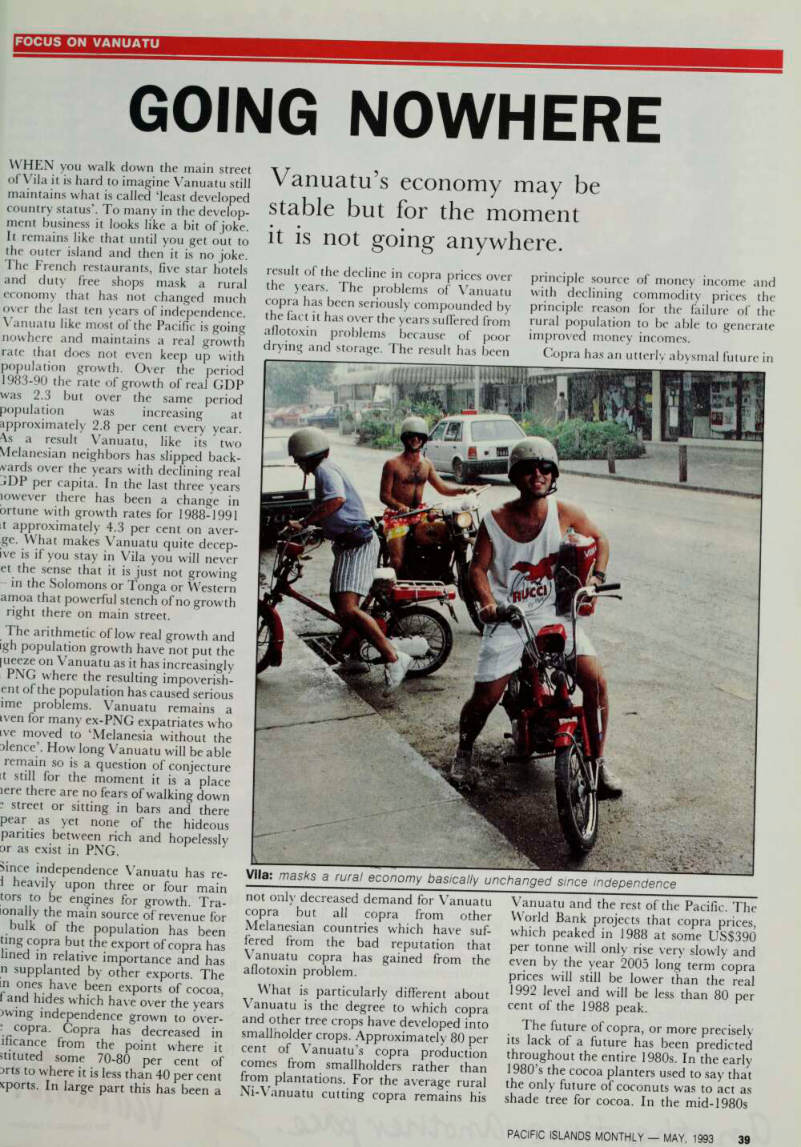
Vila: masks a rural economy basically unchanged since independence
many countries invested heavily in new cocoa plantings, these included countries such as Vanuatu, Solomon Islands and PNG in particular. To their misfortune so too did Indonesia and Malaysia which were responsible for the bulk of the world’s increased production.
The situation that existed in the mid 1980s with cocoa prices in the vicinity of USS3,OOO per tonne have given way to much more depressed prices now with cocoa trading at a third to one quarter of its peak price. Those who planted cocoa in those heady years of the early 1980 s are now looking to turn their plantations into hotels. The cocoa planters were right in one thing the future of coconuts will be as a shade tree
but for tourists, not for cocoa.
Cocoa has grown rapidly in Vanuatu )ver the last few rear but in many )uter islands there is imply no readily •bvious substitute to utting copra and it fill remain of sig ificance for years to ome. Cocoa went ito rapid decline as age rates rose. In irge measure as a ‘suit of the increase i wage rates many the plantations lifted to beef pro- JCtion which was ‘cidedly less la )ur intensive. Beef id hides have ex
mded enormously
" the export mar t which for years d access to the ry lucrative New
Jedonian market. It has however been exported to the much less rative Japanese markets.
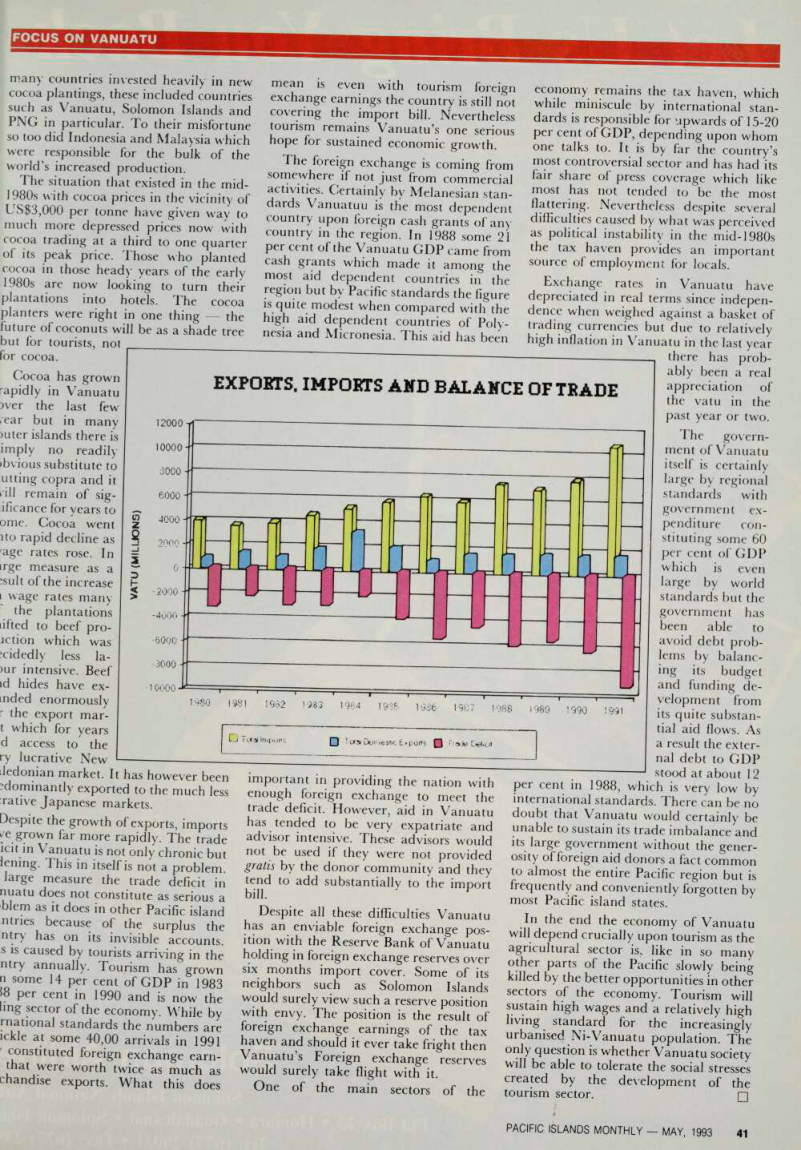
Despite the growth of exports, imports /e grown far more rapidly. The trade icit in Vanuatu is not only chronic but lenmg. This in itself is not a problem, large measure the trade deficit in nuatu does not constitute as serious a blem as it does in other Pacific island ntries because of the surplus the ntry has on its invisible accounts, s is caused by tourists arriving in the ntry annually. Tourism has grown n some 14 per cent of GDP in 1983 [? P er cen * in 1990 and is now the ling sector of the economy. While by rnational standards the numbers are ickle at some 40,00 arrivals in 1991
constituted foreign exchange earn
that were worth twice as much as chandise exports. What this does
mean is even with tourism foreign exchange earnings the country is still not covering the import bill. Nevertheless tourism remains Vanuatu’s one serious hope for sustained economic growth.
The foreign exchange is coming from
somewhere if not just from commercial activities. Certainly by Melanesian stan dards Vanuatuu is the most dependent country upon foreign cash grams of any country in the region. In 1988 some 21 per cent of the Vanuatu GDP came from cash grants which made it among the most aid dependent countries in the region but by Pacific standards the figure is quite modest when compared with the
high aid dependent countries of Poly
nesia and Micronesia. This aid has been
important in providing the nation with enough foreign exchange to meet the trade deficit. However, aid in Vanuatu has tended to be very expatriate and advisor intensive. These advisors would not be used if they were not provided gratis by the donor community and they tend to add substantially to the import bill.
Despite all these difficulties Vanuatu has an enviable foreign exchange pos ition with the Reserve Bank of Vanuatu
holding in foreign exchange reserves over
six months import cover. Some of its neighbors such as Solomon Islands would surely view such a reserve position with envy. The position is the result of
foreign exchange earnings of the tax
haven and should it ever take fright then
Vanuatu’s Foreign exchange reserves
would surely take flight with it.
One of the main sectors of the
economy remains the tax haven, which while miniscule by international stan dards is responsible for upwards of 15-20 per cent of GDP, depending upon whom one talks to. It is by far the country’s most controversial sector and has had its fair share of press coverage which like most has not tended to be the most
flattering. Nevertheless despite several
difficulties caused by what was perceived as political instability in the mid-1980s the tax haven provides an important source of employment for locals.
Exchange rates in Vanuatu have depreciated in real terms since indepen dence when weighed against a basket of trading currencies but due to relatively high inflation in Vanuatu in the last year
there has prob ably been a real appreciation of the vatu in the past year or two.
The govern ment of Vanuatu itself is certainly large by regional standards with government ex penditure con stituting some 60 per cent of GDP which is even
large by world
standards but the government has been able to avoid debt prob lems by balanc ing its budget and funding de
velopment from
its quite substan tial aid flows. As a result the exter nal debt to GDP stood at about 12
per cent in 1988, which is very low by international standards. There can be no doubt that Vanuatu would certainly be unable to sustain its trade imbalance and its large government without the gener osity of foreign aid donors a fact common to almost the entire Pacific region but is
frequently and conveniently forgotten by
most Pacific island states.
In the end the economy of Vanuatu will depend crucially upon tourism as the agricultural sector is, like in so many other parts of the Pacific slowly being killed by the better opportunities in other sectors of the economy. Tourism will sustain high wages and a relatively high living standard for the increasingly urbanised Ni-Vanuatu population. The only question is whether Vanuatu society will be able to tolerate the social stresses created by the development of the tourism sector. n